

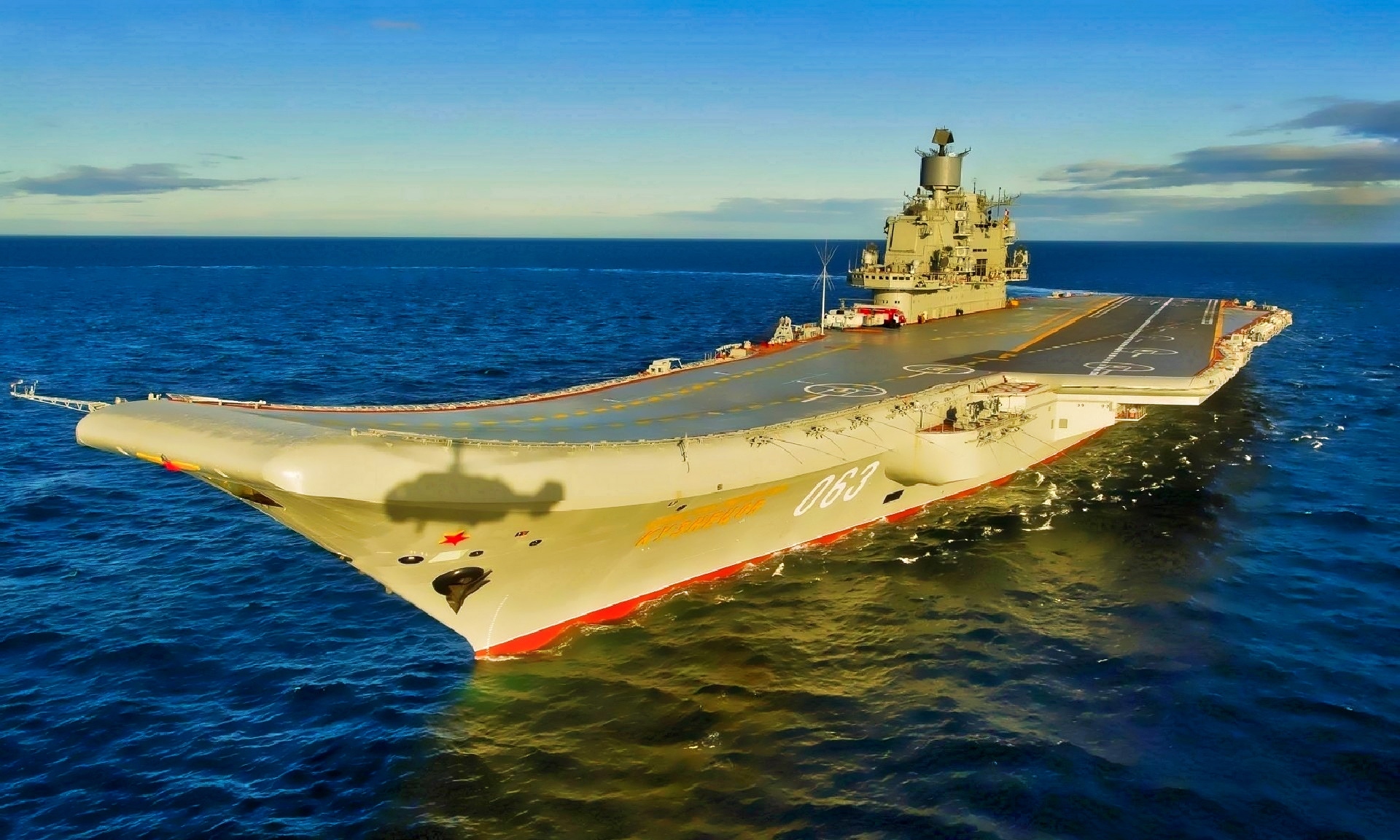
Key Points and Summary – Russia’s sole aircraft carrier, the Admiral Kuznetsov, appears destined for the scrapyard after a disastrous and decade-long repair effort.
-A series of humiliating accidents, including fires and a sinking dry dock, has rendered the costly overhaul a failure.
-Top Russian naval officials have now publicly dismissed the warship as an “expensive and ineffective” relic that is obsolete in the age of modern anti-ship missiles.
-The carrier’s likely demise marks a symbolic end to Russia’s blue-water naval ambitions, highlighting the country’s industrial decline and the severe financial strain of the war in Ukraine.
Aircraft Carrier Admiral Kuznetsov Looks All Done Now
According to recent news reports, the Russians are finally considering pulling the plug on their last remaining aircraft carrier, the Admiral Kuznetsov, after years of repairs and hardships.
Since July of 2018, the carrier has been undergoing extensive repairs and has since seen its fair share of accidents from fires to crane collapses.
The original plan was to have the Kuznetsov return to service by 2022, but the plan was delayed to a later date. Now it looks like that deadline will either get delayed again or canceled entirely.
The Sunk Cost Fallacy Finally Sinks
Russian news sources first reported that work on the Admiral Kuznetsov had been suspended, and that talks were currently underway between the Russian Navy’s High Command and the United Shipbuilding Corporation (USC).
According to sources, debates are underway as to whether the Kuznetsov should be kept or scrapped entirely. Experts argue that scraping the Kuznetsov is the best decision, as the project has been a massive waste of funds and the carrier itself is massively outdated compared to contemporary threats.
Admiral Sergei Avakyants, former commander of the Pacific Fleet, publicly stated that retiring the Kuznetsov is “absolutely the right move,” calling it “a very expensive and ineffective naval weapon.”
He argued that the future of naval warfare lies with robotic systems and unmanned aircraft, not traditional aircraft carriers. His sentiment is reflected by other experts who argue that aircraft carriers are no longer relevant in the age of advanced anti-ship missiles. While Russia has yet to make an official decision regarding the Kuznetsov, it is highly likely that the Carrier is heading to the scrap yard sometime soon.
The Kuznetsov’s Troubled History
The origins of the Admiral Kuznetsov trace back to the Cold War, when the Soviet Union sought to expand its blue-water navy to counterbalance the global reach of the United States Navy. Unlike American supercarriers, which are nuclear-powered and designed for long-range power projection, the Kuznetsov was conceived as a hybrid vessel, a “heavy aircraft-carrying cruiser.” This designation was not merely semantic.
It allowed the ship to legally transit the Turkish Straits under the Montreux Convention, which restricts the passage of aircraft carriers through the Bosporus and Dardanelles. By classifying the ship as a cruiser with aircraft capabilities, the Soviets sidestepped this limitation.
Construction of the vessel began in 1983 at the Black Sea Shipyard in Mykolaiv, Ukraine, then part of the Soviet Union. The ship was launched in 1985 and underwent several name changes (initially Riga, then Leonid Brezhnev, followed by Tbilisi) before finally being named Admiral Kuznetsov in 1990, in honor of Nikolay Kuznetsov, a prominent Soviet naval officer. The ship was commissioned into the Soviet Navy in 1990, just before the dissolution of the USSR, and was inherited by the Russian Navy in the early 1990s.
The Soviet Union’s “Missile-Carrier”
The design of the Admiral Kuznetsov reflects a unique blend of Soviet naval doctrine and practical constraints.
It is conventionally powered, relying on steam turbines fed by oil-fired boilers, rather than nuclear propulsion.
This limits its range and endurance compared to American carriers. The ship displaces between 58,000 and 67,000 tons when fully loaded and measures over 300 meters in length. Its top speed is around 29 knots, and it has a range of approximately 8,500 nautical miles at cruising speed.
One of the most distinctive features of the Kuznetsov is its armament. Unlike Western carriers, which rely on escort ships for protection and focus almost exclusively on air operations, the Kuznetsov is heavily armed with its own offensive and defensive weapons.
These include twelve P-700 Granit anti-ship missiles, surface-to-air missile systems, close-in weapon systems (CIWS), and anti-submarine rocket launchers. This reflects the Soviet emphasis on multi-role warships capable of engaging a variety of threats independently.
The ship’s aviation capabilities are also distinct. It features a ski-jump ramp at the bow for launching aircraft, rather than the catapult systems used on U.S. carriers. This simpler system reduces the complexity and cost of the ship but also limits the maximum takeoff weight of its aircraft, thereby reducing their fuel and weapons load.
The air wing typically includes Su-33 multirole fighters, MiG-29K fighters (introduced later), and Ka-27 and Ka-31 helicopters for anti-submarine warfare and airborne early warning.
Its Time to Let Her Rest
The history of the Admiral Kuznetsov has been marked by long periods of inactivity, mechanical failures, and a few high-profile deployments. In the 1990s and early 2000s, the ship spent much of its time docked due to budget constraints and maintenance issues.
It was not until the 2010s that the ship began to see more regular deployments, albeit still limited in scope and duration.
The most significant deployment of the Kuznetsov occurred in 2016, when it was sent to the eastern Mediterranean to support Russian military operations in Syria. This marked the first time the ship had participated in combat operations.
However, the deployment was plagued by problems. Two aircraft were lost due to arrestor cable failures, and the ship’s engines emitted thick black smoke, drawing international attention and criticism.
The sortie rate of the air wing was also low compared to Western standards. The carrier then returned to dry dock for repairs, where it has remained ever since.
About the Author:
Isaac Seitz, a Defense Columnist, graduated from Patrick Henry College’s Strategic Intelligence and National Security program. He has also studied Russian at Middlebury Language Schools and has worked as an intelligence Analyst in the private sector.
Military Concepts
A 7th Generation Fighter Is Coming


