

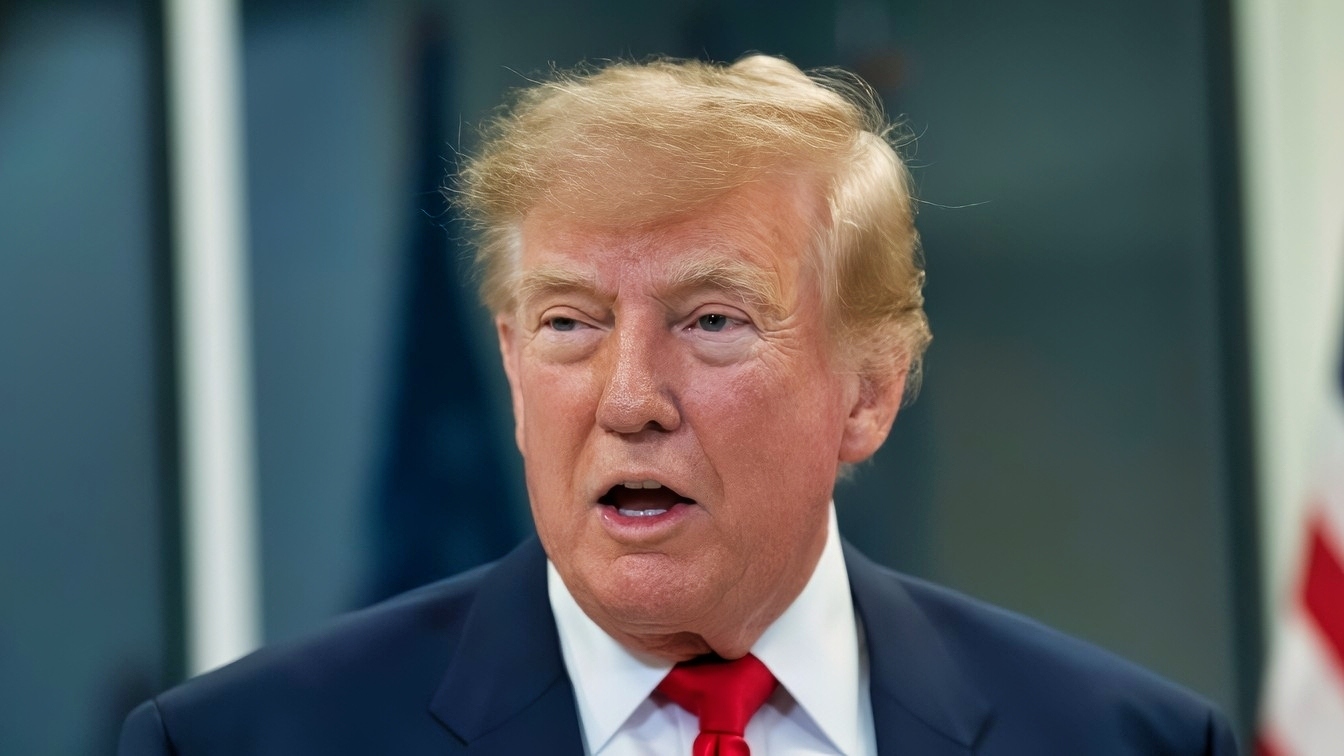
Donald Trump returned to office for a second term with a much broader, very different coalition than the one that brought him to the White House in 2016. However, it was clear from the start that Trump would struggle to keep that coalition together, since it was full of contradictions.
Now, with the midterm elections approaching, that fragile coalition is starting to fray.

Donald Trump Speaking at CPAC. Image Credit: Creative Commons.
According to CNBC, citing its own All-America Economic Survey, Trump’s 2024 coalition is unlikely to replicate itself in next week’s midterm elections.
That’s because Trump has lost major support in key parts of that coalition.
CNBC reported that Trump’s ratings have sunk among Latino voters, with whom he did surprisingly well in 2024.
His net approval rating in that demographic has fallen from -22 to -38, and from -28 to -53 among Latinos aged 18 to 34.
Black respondents, with whom Trump made some gains in 2024, have gone from -55 to -67, while even key parts of Trump’s main base have dropped some support for the president, according to CNBC data.
A Dip in Enthusiasm
CNBC also found that Republican voters still give the president a high approval rating. But enthusiasm among Democratic voters is higher than it is among their Republican counterparts.
In that survey, voters were asked which issues matter most to them.
The most frequent answers were government corruption (36 percent), the cost of food and groceries (34 percent), “protecting democracy” (23 percent), and the price of gas (also 23 percent).
Immigration is less salient, at only 17 percent, followed by Iran and the cost of housing, both at 15 percent.
How the Coalition Died
New York magazine, last week, provided more analysis of how Trump blew up the coalition that brought him back to the White House just two years ago.
As Ed Kilgore noted, the problem is that Trump has begun to lose the “non-MAGA elements of his coalition.”
Kilgore writes that it’s part of “a tale of trends reversing themselves that robbed Trump and his cohort of what many thought might be a political realignment making the GOP the majority party for years.”

President Donald Trump is joined by Secretary of Commerce Howard Lutnick, Vice President JD Vance, British Ambassador Peter Mandelson, U.S. Trade Representative Jamieson Greer, and Secretary of Agriculture Brooke Rollins, while announcing a trade agreement with the U.K., Thursday, May 8, 2025, in the Oval Office. (Official White House Photo by Emily J. Higgins)
Trump may have done better with certain demographics than before, but there’s little reason to think those gains will last.
How He Lost Them
How did it happen? According to the analysis, Trump’s coalition was never all that widespread to begin with.
While his electoral votes were well distributed and he carried all the major swing states, Trump won the popular vote by just 1.5 percent and failed to reach 50 percent.
While Trump swept the battleground states, Kilgore noted that all seven had close margins.
Then there are the specific ways Trump let certain groups down.
Many people voted for Trump in 2024 due to the high cost of living at the time, and it appears many of those voters had soured on Trump for not delivering any relief.
High prices were a major theme of the 2024 election, and they’re once again a major issue in the 2026 midterms.
“There is no way to sugarcoat these numbers on the most important issue of the midterms,” Kilgore writes.
Furthermore, Trump’s gains with Latino voters in 2024 have been largely undone by the mass deportation campaigns, which are unpopular with those voters.
Many, the analysis says, had hoped Trump would focus on deporting criminals, not “the types of hardworking immigrants who strengthen our nation,” to quote an Equus survey from March.
In addition, per New York, Trump “offended Black voters as much as possible,” through various actions he’s taken in his second term.
Meanwhile, Trump has also lost much of the support he gained from young voters, who are particularly opposed to the Iran war.
And finally, the analysis noted that Trump is now focusing on his MAGA base because “it’s all he has left.” The author noted that Trump has focused his campaign rallies on red states, where he’s been rallying for Senate candidates in places like Kansas, who are defending seats in states Trump won comfortably in 2024.
About the Author: Stephen Silver
Stephen Silver is an award-winning journalist, essayist, and film critic, and contributor to the Philadelphia Inquirer, the Jewish Telegraphic Agency, Broad Street Review, and Splice Today. The co-founder of the Philadelphia Film Critics Circle, Stephen lives in suburban Philadelphia with his wife and two sons. For over a decade, Stephen has authored thousands of articles that focus on politics, national security, technology, and the economy. Follow him on X (formerly Twitter) at @StephenSilver, and subscribe to his Substack newsletter.


