

The Trump Administration appears to be pursuing a different strategy in its quest to find an exit from the Iran conflict: Economic pressure, in what the president and Treasury Secretary are calling “Economic D-Day.”
Secretary Scott Bessent announced how the new sanctions would work on Monday afternoon. According to the New York Times, and as previously teased by President Donald Trump and Bessent, the idea is economic sanctions, including on countries that help Iran or do business with it in any way.
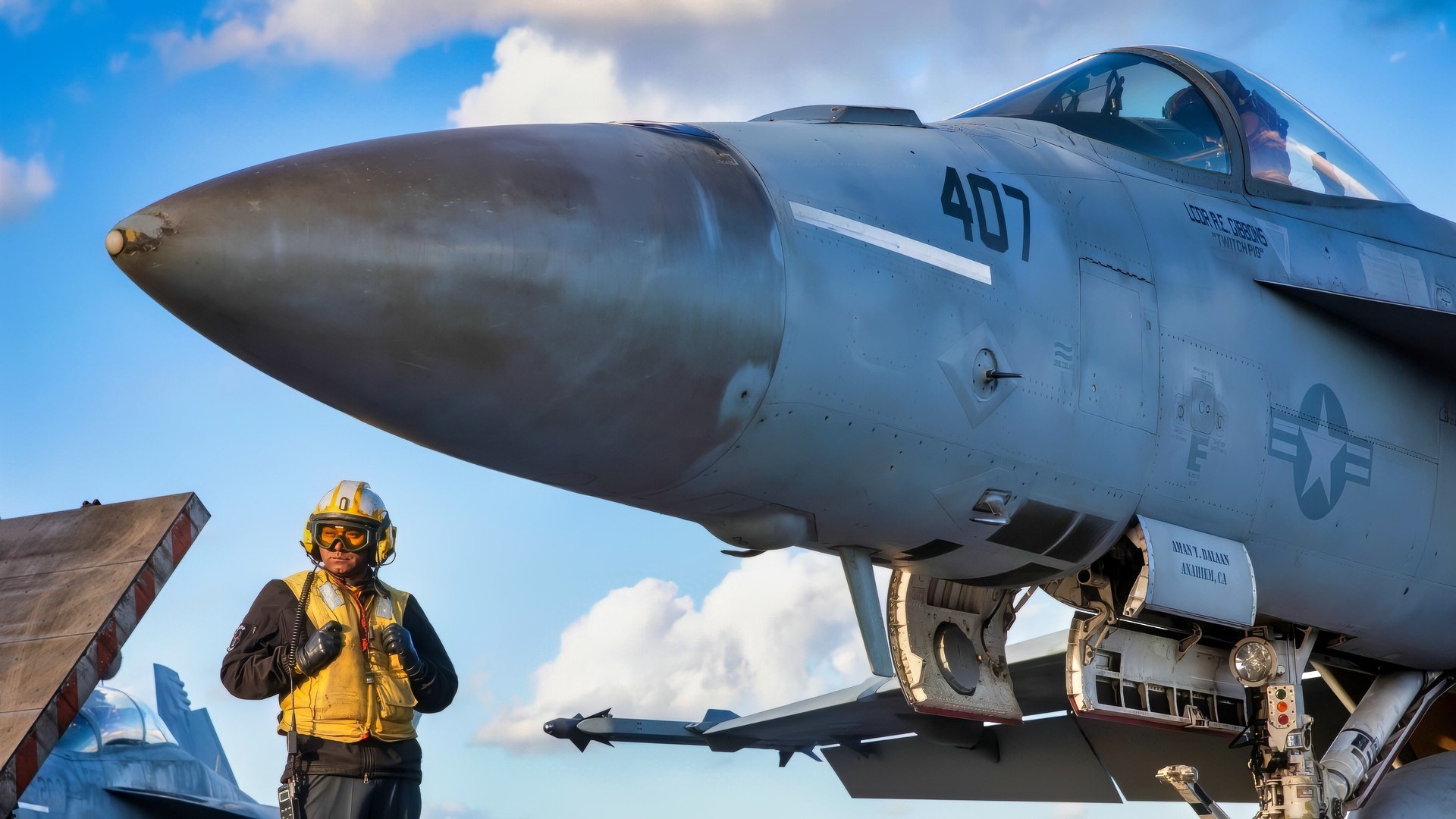
Aviation Boatswain’s Mate (Aircraft Handling) 1st Class Jose Mejiacastro, assigned to Air Department aboard the world’s largest aircraft carrier, USS Gerald R. Ford (CVN 78), prepares to signal to a Carrier Air Wing 8 F/A-18E Super Hornet attached to Strike Fighter Squadron 87 on the flight deck, Sept. 26, 2025. Gerald R. Ford, a first-in-class aircraft carrier and deployed flagship of Carrier Strike Group Twelve, is on a scheduled deployment in the U.S. 6th Fleet area of operations to support the warfighting effectiveness, lethality and readiness of U.S. Naval Forces Europe-Africa, and defend U.S., Allied and partner interests in the region. (U.S. Navy photo by Mass Communication Specialist 2nd Class Mariano Lopez)
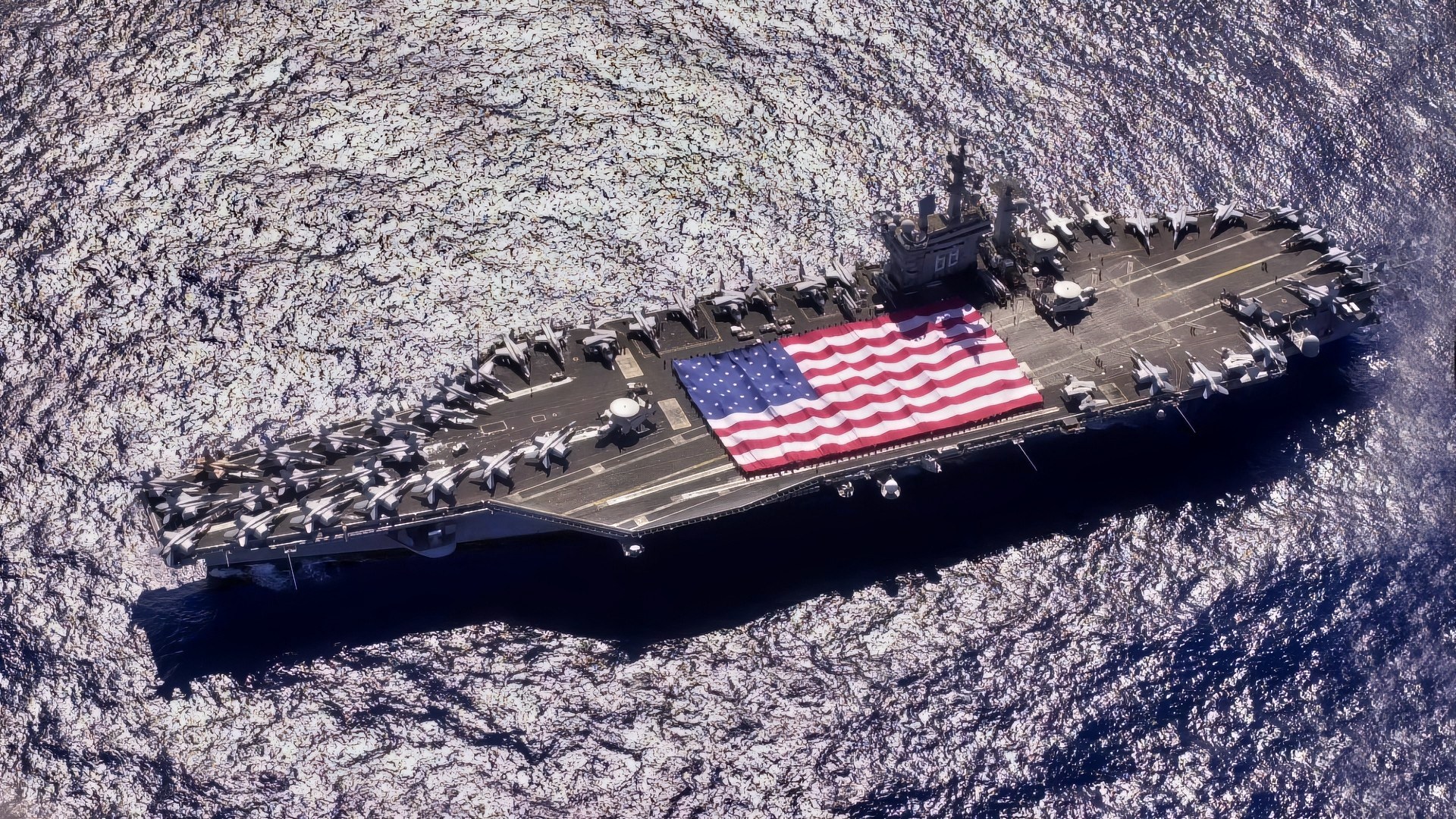
Pacific Ocean (November 3, 2003) — During Tiger Cruise aboard USS Nimitz (CVN 68), Nimitz and Carrier Air Wing Eleven personnel participate in a flag unfurling rehearsal with the help of fellow tigers on the flight deck. The Nimitz Carrier Strike Force and Carrier Air Wing Eleven (CVW-11) are in route to Nimitz homeport of San Diego, California after an eight-month deployment to the Arabian Gulf in support of Operation Iraqi Freedom. U.S. Navy photo.
The White House fact sheet calls it Operation Economic Outcast, and the stated goal is “total isolation of the Iranian regime” and to “sever every remaining economic lifeline sustaining the Islamic Republic of Iran.”
The White House positions the new sanctions program as the final capstone of what it calls a successful military effort.
“We are enforcing a ‘zero-leakage approach’; there will be no minimal breathing space for the regime to rebuild its capacity to inflict terror against America and the world,” Bessent said in his Monday announcement. The sanctions will target five areas specifically: “Digital assets, technology, gold, aviation, and shipping.”
The fact sheet did not mention any specific countries that will be targeted for their assistance to Iran, nor did an op-ed Bessent had published in the Financial Times the day before.
The push appears to have seen some early results, with the United Arab Emirates, earlier this week, announcing that it was halting trade with Iran.
Will It Work?
Per the Times, the new strategy represents the Trump Administration “reaching for yet another strategy to grope their way out of a military adventure gone wrong.” The newspaper also noted that this represents a different order of doing things than is typical: The threat of sanctions usually comes before military action, not after.
Plus, the United States and its allies have already sanctioned Iran for many years, going back to the George W. Bush administration.
And there’s another big concern: What about China?
The Chinese Exception
As noted by the Times, China was not mentioned by name in Bessent’s remarks. China purchased more than 80 percent of Iran’s oil exports last year and has other ongoing economic relations with the Islamic Republic.
The Wall Street Journal also noted that China is “the country that has enabled Iran to withstand years of American pressure.”
To truly test the “Economic Outcast” sanctions regime, Trump and Bessent would need to confront China seriously. But they have several incentives not to.
“This will be tricky,” Peter Harrell, an expert on the effects of economic sanctions at Georgetown Law School, told the Times of how Trump can thread the China needle.
Trump, when threatening Iran earlier this year, “had a choice to really come down hard on the Chinese, which he didn’t want to do because of his own economic agenda with Xi, or put the naval blockade on the Iranian tankers,” Harrell told the newspaper. So he chose to blockade the tankers rather than threaten to impose sanctions on China.
As for China’s response, Foreign Ministry spokesman Lin Jian said Monday that the Chinese government opposes “illegal unilateral sanctions,” and that “Cooperation between China and Iran has always been conducted within the framework of international law and should not be interfered with or disrupted.”
Back to Regime Change?
When the war in Iran first launched in February, officials with the Trump Administration, as well as Benjamin Netanyahu’s government in Israel, spoke about the fall of the Iranian regime both as a key objective of the war and as something that could be imminent, especially after Supreme Leader Ali Khamenei was killed on the first day of the war.
The regime, though, has remained in place, with the former ayatollah’s son replacing him as Supreme Leader, and less talk in recent months from Trump and his allies about removing the regime.
However, Bessent raised that possibility in Monday’s speech.
“To the ordinary soldiers supporting this regime,” Bessent said, per the Times, “as more and more of your paychecks stop or are supposedly just delayed, ask whether your commanders are leading your country to triumph or to ruin, and recall that the Berlin Wall fell when ordinary soldiers decided not to shoot at their own people.”
Whether that idea, like the sanctions themselves, is a winning strategy or mere wishful thinking remains to be seen.
About the Author: Stephen Silver
Stephen Silver is an award-winning journalist, essayist, and film critic, and contributor to the Philadelphia Inquirer, the Jewish Telegraphic Agency, Broad Street Review, and Splice Today. The co-founder of the Philadelphia Film Critics Circle, Stephen lives in suburban Philadelphia with his wife and two sons. For over a decade, Stephen has authored thousands of articles that focus on politics, national security, technology, and the economy. Follow him on X (formerly Twitter) at @StephenSilver, and subscribe to his Substack newsletter.


