

In what has become a far too common occurrence, two more commercial oil tankers were attacked near the Strait of Hormuz (SoH) over the weekend.
This was part of an ongoing, escalating series of strikes by Iran on commercial shipping since the United States and Israel initiated their attacks on Iran in February of this year.
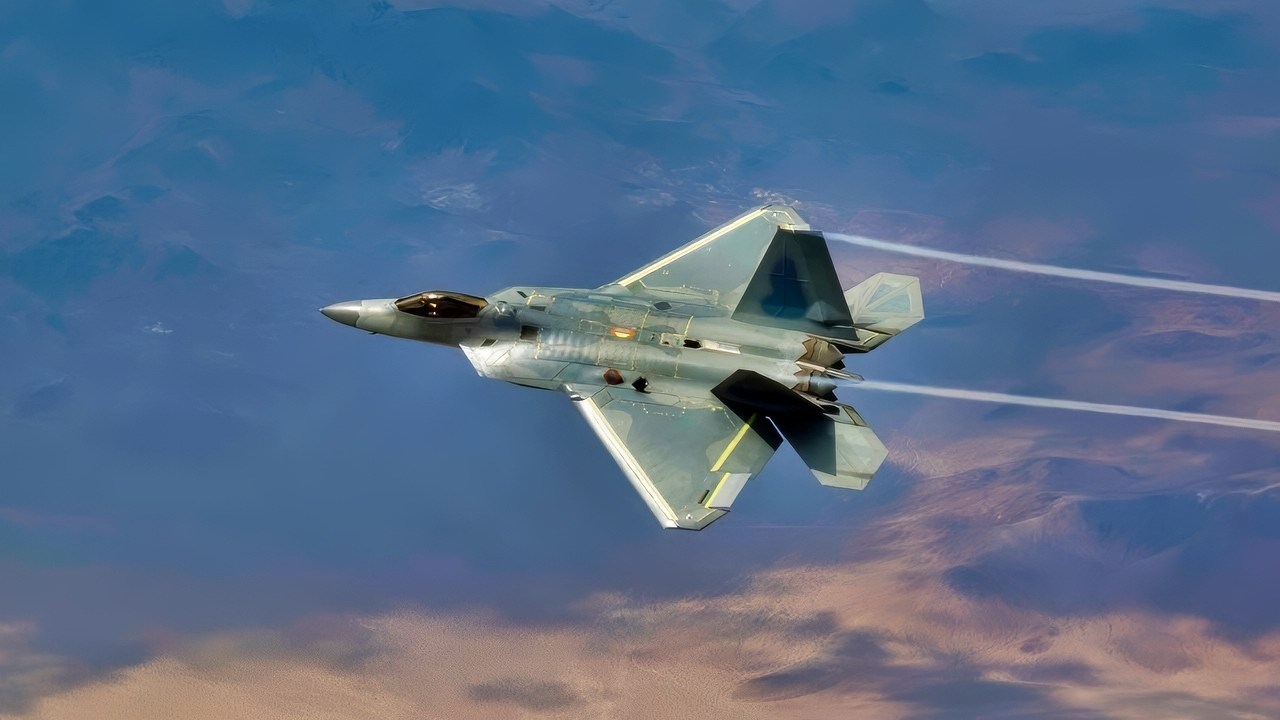
F-22 Raptor Flying High in the Sky Air Force Photo.

DAYTON, Oh.–An F-22A Raptor from the 1st Fighter Wing conducts flying operations during a solar eclipse, April 8, 2024. The aircraft is from the 27th Fighter Squadron stationed at Joint Base Langley-Eustis, Va. The squadron was conducting dissimilar formation training in unfamiliar airspace.(U.S. Air Force Tech. Sgt. Matthew Coleman-Foster)
A Terrible Attack
The most recent strikes happened on October 11.
One tanker was struck while transiting the SoH, and another was hit near the Omani port of Sohar.
Two Indian sailors are missing following the attacks. Commercial shipping has been under strain since the start of the war.
Both American naval forces and Iran are imposing a blockade on ships passing through the SoH, with Iran using missiles and drones rather than ships.
A Marshall Islands-flagged Suezmax-class crude oil tanker carrying Iraqi oil loaded at Basrah was hit.
The 150,000-deadweight-ton vessel left Iraq on October 8 and was hit by a massive projectile while traveling outbound through the SoH.
A fire erupted aboard the ship. All 11 Indian crewmembers were safe.
But the second vessel, the Petro Dolphin, a smaller oil-products tanker that was anchored near Sohar, Oman, was struck by an unmanned aerial vehicle (UAV).
That caused a fire and prompted an emergency response.
It is from this vessel that two crewmembers are reported missing. Nine were rescued. Omani authorities are conducting search-and-rescue operations for the two missing.
Iranian naval forces have targeted ships that do not use the Automatic Identification System (AIS).
Because these devices transmit a ship’s identity, position, course, and speed, they make it easy for groups seeking to target ships using AIS transponders.
Some commercial transports have heeded this reality and switched off their transponders. It doesn’t totally protect them from attack. But it complicates Iran’s ability to target them.
But the IRGC navy has figured out what many civilian transports were doing to try to avoid Iran’s gaze.

Iran’s missile capabilities. Image Credit: Creative Commons.
So the IRGC warned that it would treat any vessels operating without identification signals as hostile.
Iranian authorities claimed that a tanker attempting to use a prohibited route struck a naval mine, resulting in the explosion and fire.
These claims have not yet been verified.
On the other end, the Americans have been attacking vessels they think are violating US restrictions on Iranian maritime activity.
Explosive Price of Oil
Reuters reports at least 12 tanker incidents between September 28 and October 5.
That’s the highest weekly total since the war began in February. Until then, July saw the highest rate of incidents.
Brent crude futures climbed 2% on October 12 to $106.79 per barrel, while West Texas Intermediate rose to $93.54.
Additional attacks in the Middle East, including a deadly Houthi drone strike against Riyadh’s King Fahd International Airport in Saudi Arabia, have only sent the price of energy stratospheric.
India is now demanding de-escalation and has condemned the attacks. Indian leaders have emphasized the need to protect commercial shipping and civilian infrastructure at this crucial time.
India’s response reflects how exposed it is to Persian Gulf energy supplies.
Plus, as evidenced by news about the loss of those two Indian sailors, it is clear that India has many of its citizens working in the region.
Alternative routes, of course, are available and have helped to maintain regional oil shipments.
Yet, regional oil shipments and tankers keep facing drones, missiles, and mines, to name a few issues.
While many alternatives are being tried to keep Middle East energy moving out of the region, the SoH remains the best way to move large quantities of oil and natural gas to global markets.
India Demands the War End
The war has significantly complicated moving these goods. Yes, much has still gotten out — but at great cost.
Iran has clearly allowed much of that energy to keep flowing.
Now, Tehran is flexing and signaling to the West that it can choke off flows at will.
Distant nations, like India, are panicking now because it’s their people and economy that are being disproportionately harmed by the US-Israeli war in the Middle East against Iran.
And Iran understands that the surest way to stunt the blows from America (and Israel) is to disrupt the SoH.
Until those disruptions cease, the world will experience hardships — and the oil and natural gas reserves around the world are at their breaking point, meaning Iran likely has to hold out long enough to force the Americans to abandon their self-destructive blockade and war against the Islamic Republic.
MORE – The Ukraine Ceasefire Is Toast
About the Author: Brandon J. Weichert
Brandon J. Weichert is the Senior National Security Editor. He also manages The Weichert Brief on Substack. Weichert also hosts “National Security Talk” on Rumble. He is the author of four bestselling national security books, most recently A Disaster of Our Own Making: How the West Lost Ukraine (Encounter Books). Follow him via Twitter/X @WeTheBrandon.


