

Summary and Key Points: When fire broke out aboard the aircraft carrier USS Gerald R. Ford last March, the Navy described it as a minor, quickly contained incident — two minor injuries, no real operational impact. The newly leaked video suggests that it was far from the truth.
-The footage reportedly shows gutted berthing compartments, charred bulkheads, and melted wiring — the aftermath of a blaze the crew fought for some 30 hours.

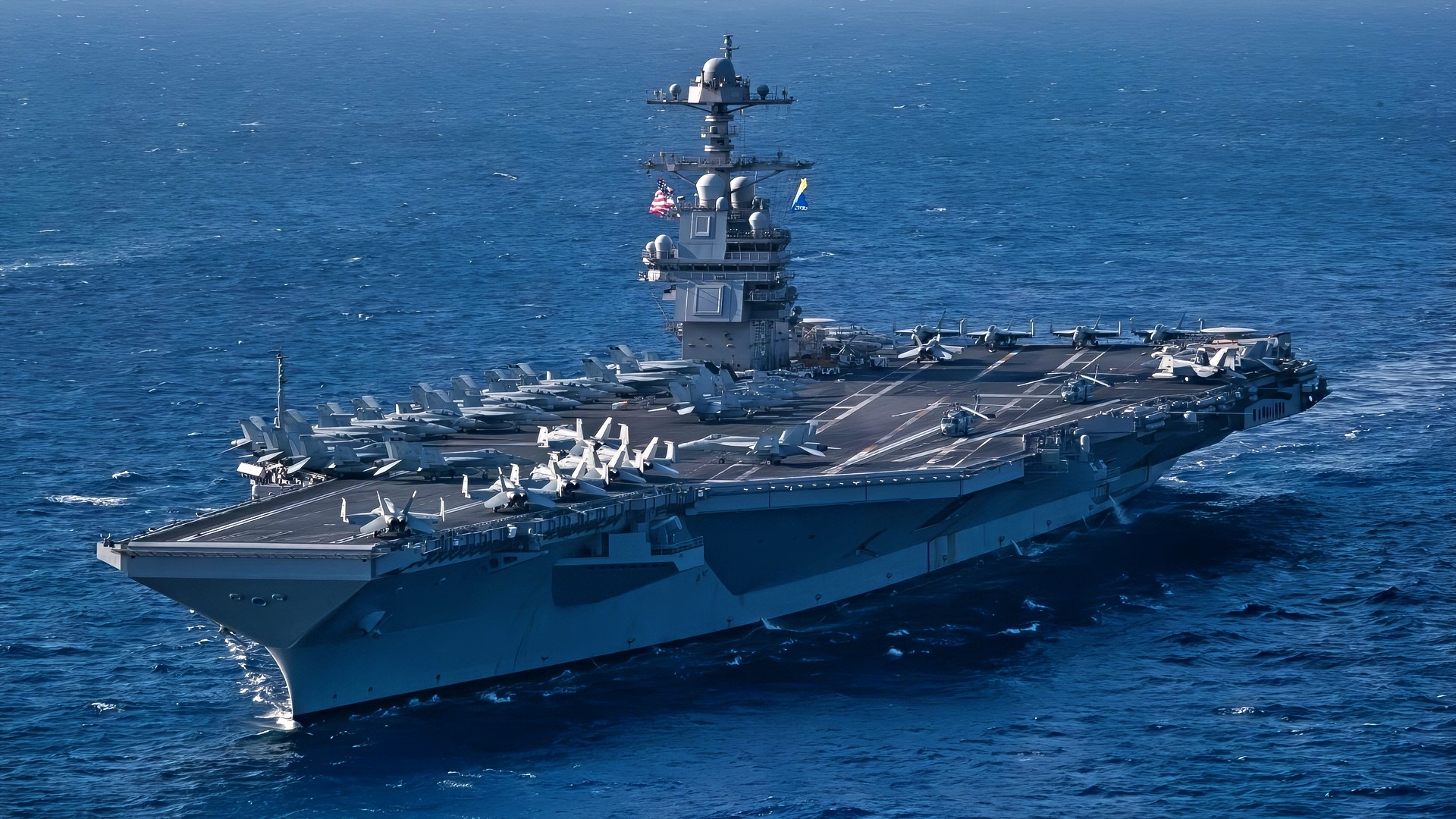
A U.S. Sailor, assigned to Airborne Command and Control Squadron 124, signals the launch of a Carrier Air Wing 8 E-2D Hawkeye aircraft on the flight deck of the world’s largest aircraft carrier, Ford-class aircraft carrier USS Gerald R. Ford (CVN 78), while underway in the Caribbean Sea, Nov. 29, 2025. U.S. military forces are deployed to the U.S. Southern Command area of responsibility in support of Operation SOUTHERN SPEAR, Department of War-directed operations, and the president’s priorities to disrupt illicit drug trafficking and protect the homeland. (U.S. Navy photo)
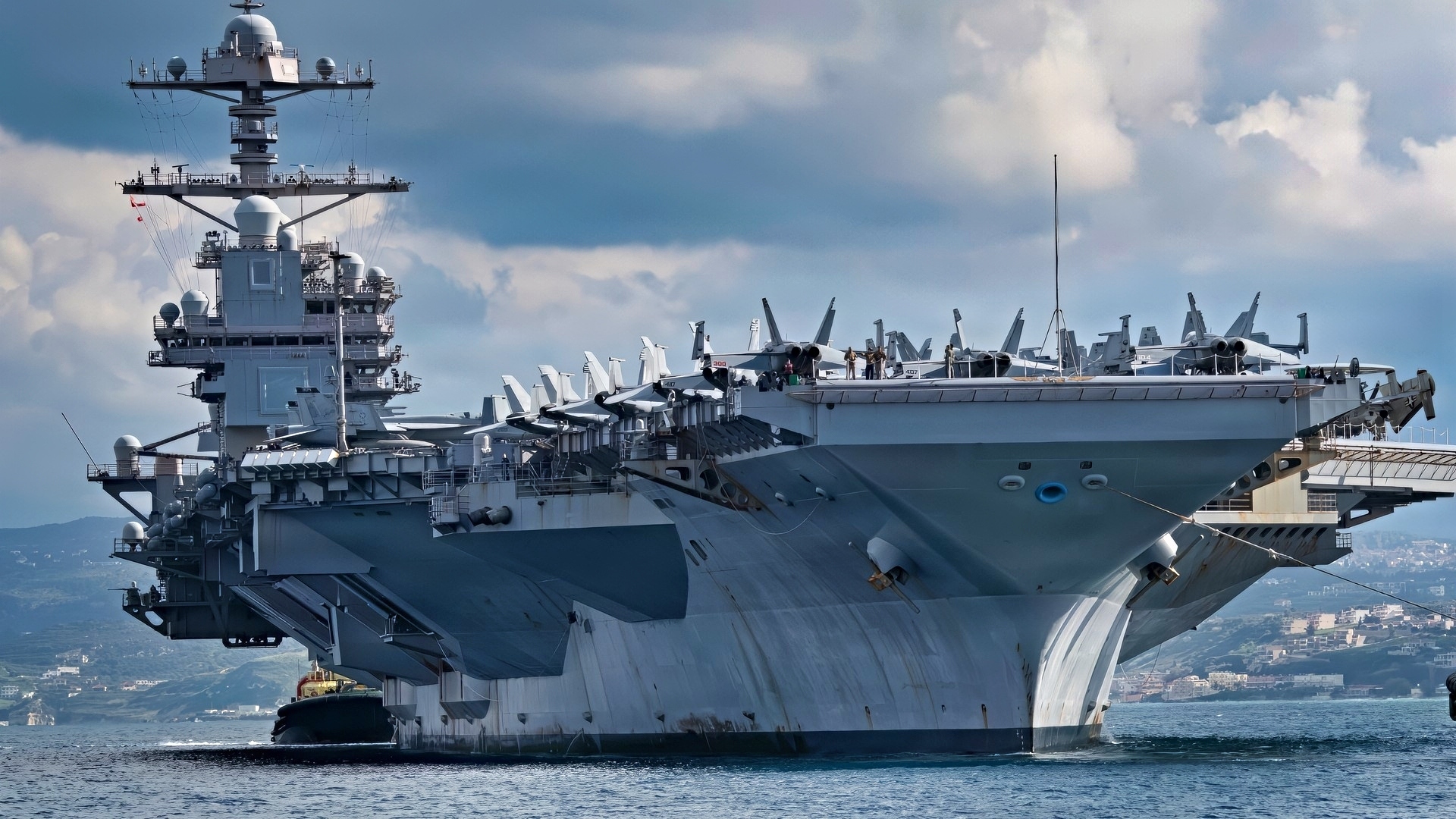
NAVAL SUPPORT ACTIVITY SOUDA BAY, Greece (Feb. 23, 2026) The world’s largest aircraft carrier, Ford-class aircraft carrier USS Gerald R. Ford (CVN 78) arrives at the NATO Marathi Pier Complex in Souda Bay, Crete, Greece, during a scheduled port visit on Feb. 23, 2026. NSA Souda Bay is an operational ashore installation that enables and supports U.S., Allied, Coalition, and partner nation forces to preserve security and stability in the European, African, and Central Command areas of responsibility. (U.S. Navy photo by Mass Communication Specialist 3rd Class Hannah Donahue)
-Now America’s newest and most expensive carrier could be sidelined for up to two years, at a moment the Navy can least afford to lose one. The question the leaked footage raises is bigger than a single fire.
Aircraft Carrier USS Gerald R. Ford: A Fight to Save the Supercarrier?
Newly leaked video appears to show that the March 2026 fire aboard the aircraft carrier USS Gerald R. Ford (CVN-78) was far more severe than the Navy initially disclosed. Statements released immediately after the fire described a minor, easily contained incident with two minor injuries and no major operational impact.
But the leaked footage tells a different story: gutted berthing compartments, charred bulkheads, melted wiring, and destroyed living spaces.
And apparently, the ship’s automated fire suppression system failed to work—so the story expands, raising questions about the ability of the Navy’s $13 billion, highly automated supercarrier to sustain combat operations safely.
What Happened Aboard USS Gerald R. Ford
On March 12, 2026, a fire broke out in the aft laundry facility while the Ford was in the Red Sea, supporting Operation Epic Fury.
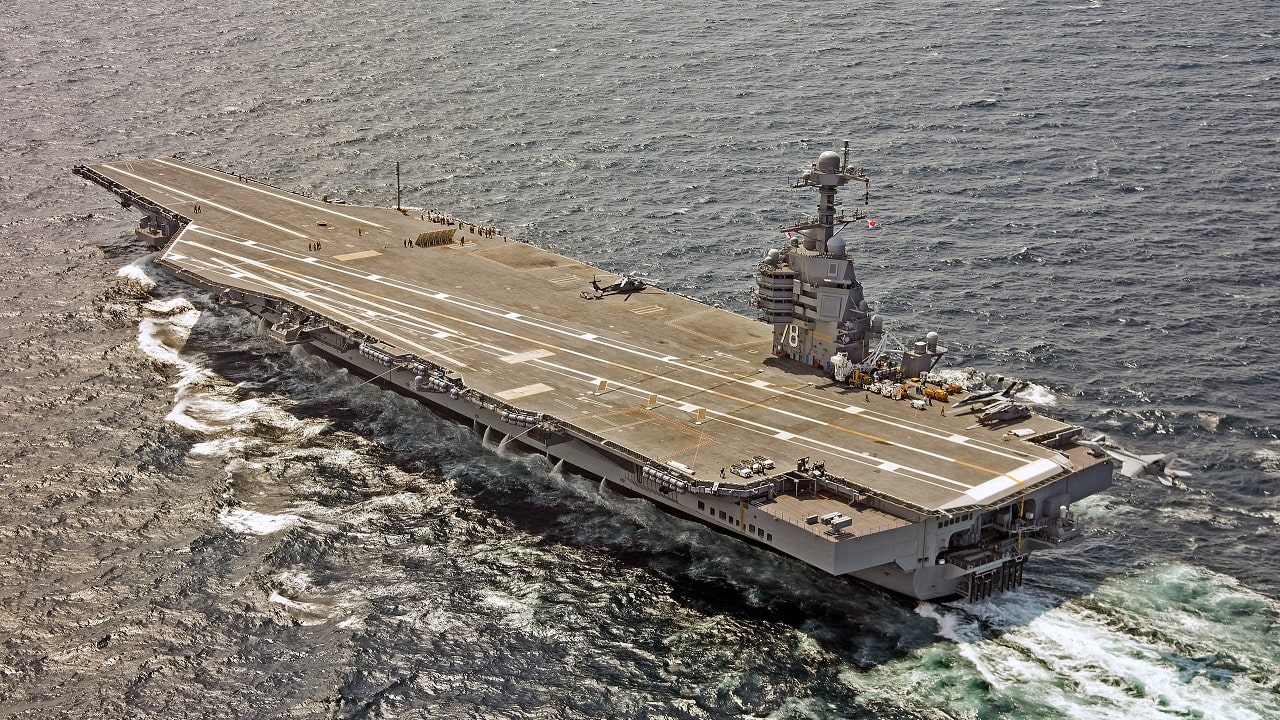
Ford-Class Aircraft Carrier in Test Run. Image Credit: Creative Commons.

ATLANTIC OCEAN (Sept. 21, 2024) The world’s largest aircraft carrier, USS Gerald R. Ford (CVN 78), sails in formation with the Japan Maritime Self Defense Force (JMSDF) Kashima-class training ship, JS Kashima (TV-3508), middle, and Hatakaze-class guided missile destroyer JS Shimakaze (TV-3521) while conducting routine operations in the Atlantic Ocean, September 23, 2024. The U.S. Navy and JMSDF continue to train together to improve interoperability and strengthen joint capabilities. For more than 60 years, the U.S.-Japan Alliance has been the corner stone of stability and security and is crucial to the mutual capability of responding to contingencies at a moment’s notice. (U.S. Navy photo by Mass Communication Specialist 2nd Class Jacob Mattingly)
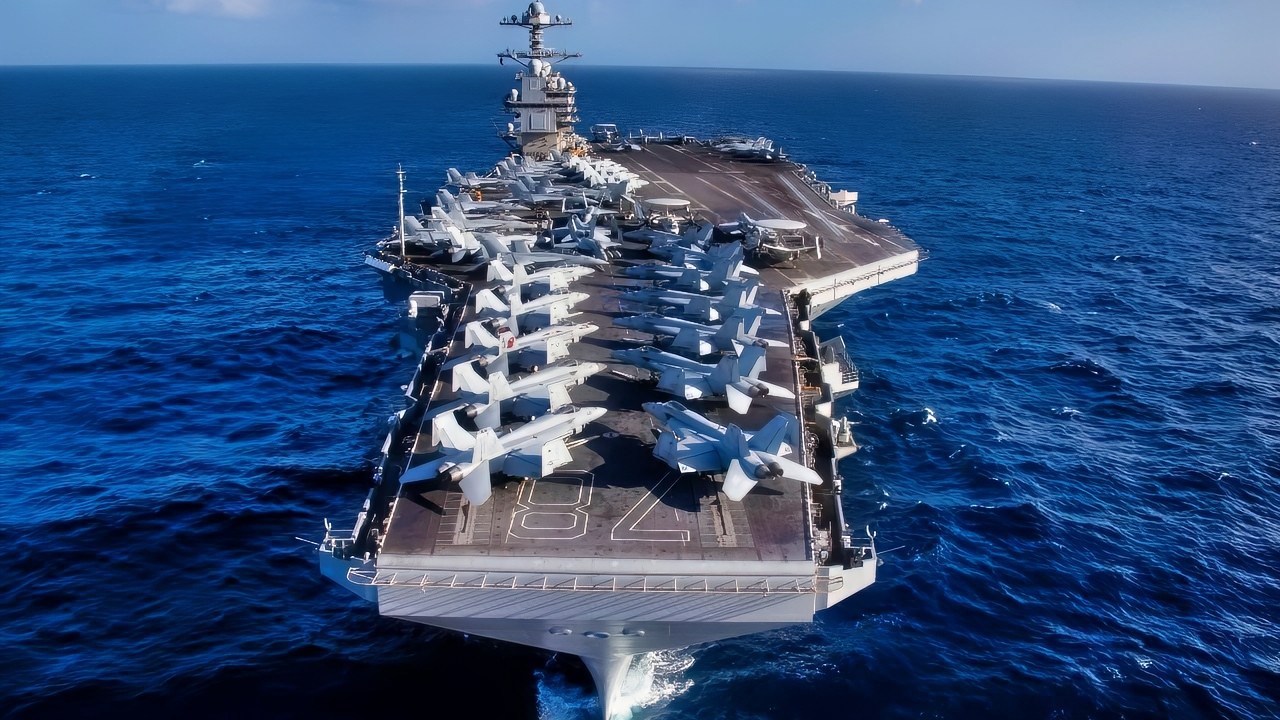
USS Gerald R. Ford Aircraft Carrier At Sea. Image Credit: U.S. Navy.
The initial assumption, as later statements would suggest, was that the fire was localized. But the fire was not localized; the crew reportedly fought the blaze for 30 hours.” I seriously thought we were going to lose the ship,” one sailor told CNN, adding that when fighting the fire, it was “either fight or die.”
This is deeply concerning, as the Ford class was designed around extensive compartmentalization and damage-control systems, meaning a laundry-room fire should not become a 30-day battle for the ship’s survival.
Damage Control
The damage was extensive, with berthing spaces hit hardest. Reportedly, up to 600 sailors lost their quarters due to fire, smoke, and heat damage.
More than 200 sailors were treated for smoke inhalation. Living conditions aboard the ship subsequently deteriorated, with displaced sailors sleeping on cots, floors, and mess-deck tables for the remainder of the record-setting deployment.
The Navy was even forced to fly out 1,000 mattresses from the still unfinished USS John F. Kennedy (CVN-79), plus thousands of sweatsuits for sailors whose clothing had been destroyed. Clearly, this was not a cosmetic problem like the Navy initially suggested; the fire significantly affected daily life aboard the ship.
Bigger Questions
A controversy could be emerging: reports indicate that portions of Ford’s automated fire-response architecture may not have functioned as designed.
The system, at least on paper, was supposed to detect the fire immediately, isolate ventilation, seal compartments, and activate suppression systems, thereby minimizing the effect of an onboard fire. But what reportedly happened is that the fire spread beyond the point of origin, the aft laundry room, and smoke entered adjacent berthing spaces. To contain the fire, the crew had to engage in a prolonged, manual effort.
The grand irony is that the Ford was designed around the concept of automation, on the theory that it would reduce manpower, which, over the vehicle’s lifecycle, would save billions of dollars. But in this case, what should have been a minor, containable laundry room fire, automation appears to have failed, raising an important question: if automation fails, does USS Gerald R. Ford have enough manpower to compensate?
And if billions and billions were invested into novel automated systems, why is Ford still relying on manpower at all?
Down Time
The USS Gerald R. Ford will need significant repair work before returning to sea. The current estimate is that repairs and system overhauls will take 12 to 24 months. Damaged compartments will need to be replaced; this is deeper, structural work that can be time-intensive.
The ship will also need wiring replacement, a repair of the faulty fire suppression system, and additional maintenance for the vacuum sewage system—all stacked on top of deferred deployment maintenance needed after a historic 326-day deployment.
The timing is unfortunate. With the Ford sidelined for one to two years, the USS Nimitz approaching retirement, and the USS JFK still not operational, the Navy has reduced carrier availability (which is why the Ford was just put through a grueling 326-day deployment in the first place).

The aircraft carrier USS Nimitz (CVN 68) arrives at Joint Base Pearl Harbor-Hickam, Hawaii, for a scheduled port visit Dec. 3, 2013. The Nimitz was in the process of returning to its home port, Everett, Wash., following an eight-month deployment to the U.S. 5th Fleet, U.S. 6th Fleet and U.S. 7th Fleet areas of responsibility. (U.S. Navy photo by Mass Communication Specialist Seaman Apprentice Rose Forest/Released)
With the US grand strategy being so forward-leaning, aircraft carriers remain central to Middle East operations, Atlantic and Mediterranean presence, and Indo-Pacific deterrence.
The remainder of the fleet will likely face longer deployments, greater maintenance strain, higher crew burnout, and lower retention rates.
About the Author: Harrison Kass
Harrison Kass is a writer and attorney focused on national security, technology, and political culture. His work has appeared in City Journal, The Hill, Quillette, The Spectator, and The Cipher Brief. He holds a JD from the University of Oregon and a master’s in Global & Joint Program Studies from NYU. More at harrisonkass.com.


