

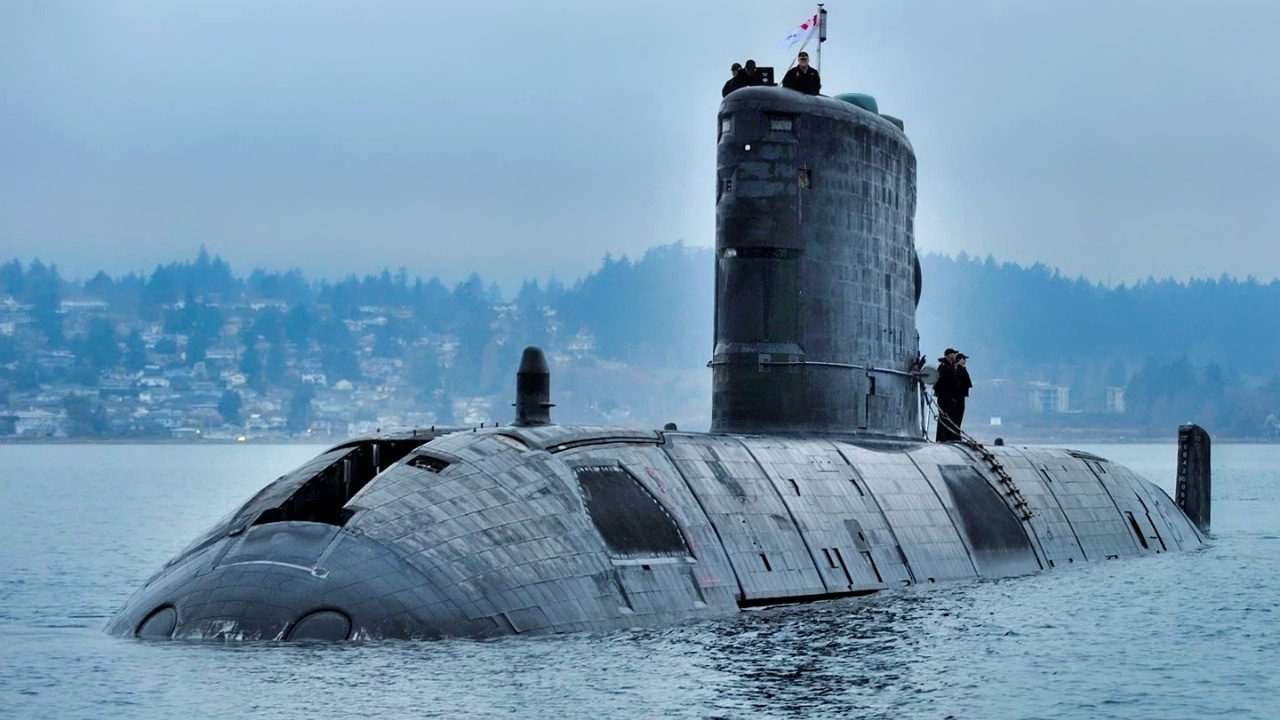
Key Points – The Royal Canadian Navy operates four aging Victoria-class diesel-electric submarines, acquired from the UK in the late 1990s, which are expected to retire between 2034 and 2040.
-While a modernization program is underway to maintain their relevance, Canada has launched the Canadian Patrol Submarine Project to procure up to 12 new boats with a focus on Arctic operational capabilities.
-However, a significant capability gap looms, as internal defense documents suggest a minimum 15 to 25-year timeline from project start to first delivery, a challenge compounded by Canada’s low defense spending and the risk of cost overruns.
Canada’s Submarine Crisis: A Looming Gap in Undersea Power?
The Royal Canadian Navy currently operates four Victoria-class submarines, which were acquired from the United Kingdom in the late 1990s, but have since grown long in the tooth.
These diesel-electric attack submarines, originally acquired second-hand from the United Kingdom, are expected to remain in service until between 2034 and 2040.
Still, for now, no replacement submarine has yet been chosen.
Canadian Patrol Submarine
The federal government has launched the Canadian Patrol Submarine Project to find a new fleet of conventionally powered submarines.
The government has previously said that up to 12 new submarines could be purchased, with a focus on ensuring the new vessels can operate under ice to maintain Canada’s security interests in the Arctic, given the country’s enormous coastline, much of which is frozen for a great part or all of the year.
However, specific decisions about what exactly will replace the Victoria-class are still open questions, though there have been some indications about capability requirements.
Victoria-class Modernization
The government of Canada opted to modernize the Victoria-class in the meantime to keep the submarines operational until the mid-2030s or so when the proposed new submarines are operational.
The Canadian government explained that “the Victoria-class Modernization (VCM) will provide modernized and increased capability which will maintain the Victoria-class submarines’ (VCS) operational relevance through the mid-2030s. VCM is considered a series of 17 individual projects implemented on a common platform to generate the necessary capability for Canada’s submarinesas detailed in Strong, Secure, Engaged: Canada’s Defence Policy.”
The Canadian government also said, “Overall, the modernization outcomes will make Canada and its allies stronger and safer by:
Improving the habitability and deployment conditions onboard the VCS for Royal Canadian Navy (RCN) submariners;
Positioning the VCS to contribute meaningfully to Canadian Armed Forces (CAF) Joint Operations ashore; and
Ensuring the survivability of the VCS against current and evolving threats in an increasingly complex and changing battle space.”
Problems Are Lerking Below the Surface
However, despite the efforts of the Victoria-class Modernization program, there are still concerns about the potential for a capability gap between the retirement of the Victoria-class and the deployment of their replacements.
Submarine acquisition programs are complex and can take years, if not decades, to complete.
Canada spends less than 1.5 percent of its GDP on defense projects, giving the country very little wiggle room in the event of cost overruns caused by schedule delays or unforeseen costs. Trouble may already be brewing.
The Ottawa Citizen, a Canadian daily newspaper, reported the following.
“The procurement timeline from project establishment to contract award is highly specific to the project, but staff analysis has shown that the procurement of a new submarine class will take a minimum of 15 years total from project establishment to first delivery and could exceed 25 years depending on the adopted procurement strategy,” DND and military officials told then-Defence Minister Harjit Sajjan in a briefing note on Jan. 6, 2021.
Canada’s plans for replacing the Victoria-class are still on the drawing board, and the coming years will be crucial in determining if Canada can transition to a new submarine fleet or whether unforeseen delays or costs will lead to a serious reduction in the country’s submarine fleet and therefore its underwater capabilities.
About the Author: Caleb Larson
Caleb Larson is an American multiformat journalist based in Berlin, Germany. His work covers the intersection of conflict and society, focusing on American foreign policy and European security. He has reported from Germany, Russia, and the United States. Most recently, he covered the war in Ukraine, reporting extensively on the war’s shifting battle lines from Donbas and writing on the war’s civilian and humanitarian toll. Previously, he worked as a Defense Reporter for POLITICO Europe. You can follow his latest work on X.


Swamplaw Yankee
June 16, 2025 at 5:08 am
These PR hacks must be assigned to a keyboard Gulag. Blather to the inner beltway aquarium about news from a tiny location that they all can read on their govt networks, if they so wanted.
Tiny Canada is not the titanic Canada of 1939-40-41-42! Nope: all gone. Only a tiny fragment remains in the shape of their 102 year old General Rohmer. This genuine war hero can out talk Trump and look every Yankee into their souls and talk about Yelllooou Beelllliie America of 1939-40-41-42. Coward America screaming to Canucks and Newfoundlanders to sacrifice their life and limbs so Yankees can go mariachi with their amigo cuddlers to the south. A triple standard Yankee scam.
Now, the PR hacks seem to avoid their analysis of the Mexican Submarine fleet. The huge Mexican submarine fleet that sunk the world’s biggest submarine of WW2, Surcoue, right in the Gulf of (MEXICO Not) America. The huge Mexican submarine fleet that scares the Ruskie subs from even coming closer than 2000 miles to Mexico.
Yep, fellas, these PR hacks seem like Mexican Kim Philby’s wanting to retire in the Mexico City “No Go’ zone. These Kim Philby’s blather about Canada while they refuse to warn the inner beltway that the Mexicans are blatantly stealing free, no-cost, air protection from deficit ridden America.
These PR hacks need to start revealing how much Mexico owes the USA for military protection since 1939. Yeah, 1939. Back then, the Yankee cuddled with the amigo as they both did the “No HITLER Here” mariachi dancing.
The many filthy rich Mexican drug cartels have bigger 2025 submarine fleets than tiny Canada! The drug cartels send their super stealth submarines all over but particularly north of San Diego as the Mexican generals know that the US Navy aggressively snores in that town. How does the US not use the Mexican submarine yards to fast order a cuple hundred FREE submarines for delivery to over taxed senior citizen Canadians.
These PR hacks never give the dollar figures that a huge population base such as Mexico and Central America “MUST” be spending in 2025 on the purchase of US military hardware. Why? Well, they must be in the pay of the Han CCP Xi spy cells. According to De Vore, the Han CCP Xi shovels money at the drug cartels to incentivize the building of Triad super stealth submarine fleets, etc. Or, is Putin in Mexico with his ” little green groomers” ready to kidnap the “Lolita” children for his orc muscovite elite child lovers.
This irrational focus of PR Hacks to pick on tiny Canada seems so some old ancient mnemonic recollection. 1939 is long gone. No More F-35, Bonnie air craft carriers, and/or nuclear submarine fleet illusions for free affordable housing Canada. 3T knows that for the next 5 years.
PR hacks, attention, please. Tell the inner beltway intellectuals of how the Mexican elite have long very much loved Americans. The Mexicans so long lived in Peace with the Yankee and now want to spend some of their totally huge historic drug profits in the purchase of that long valued Yankee military hardware! Stop: what do you mean: NOT! -30-
Pingback: Canada 'Conducted a Simulated Sinking' of a Navy Aircraft Carrier - National Security Journal