

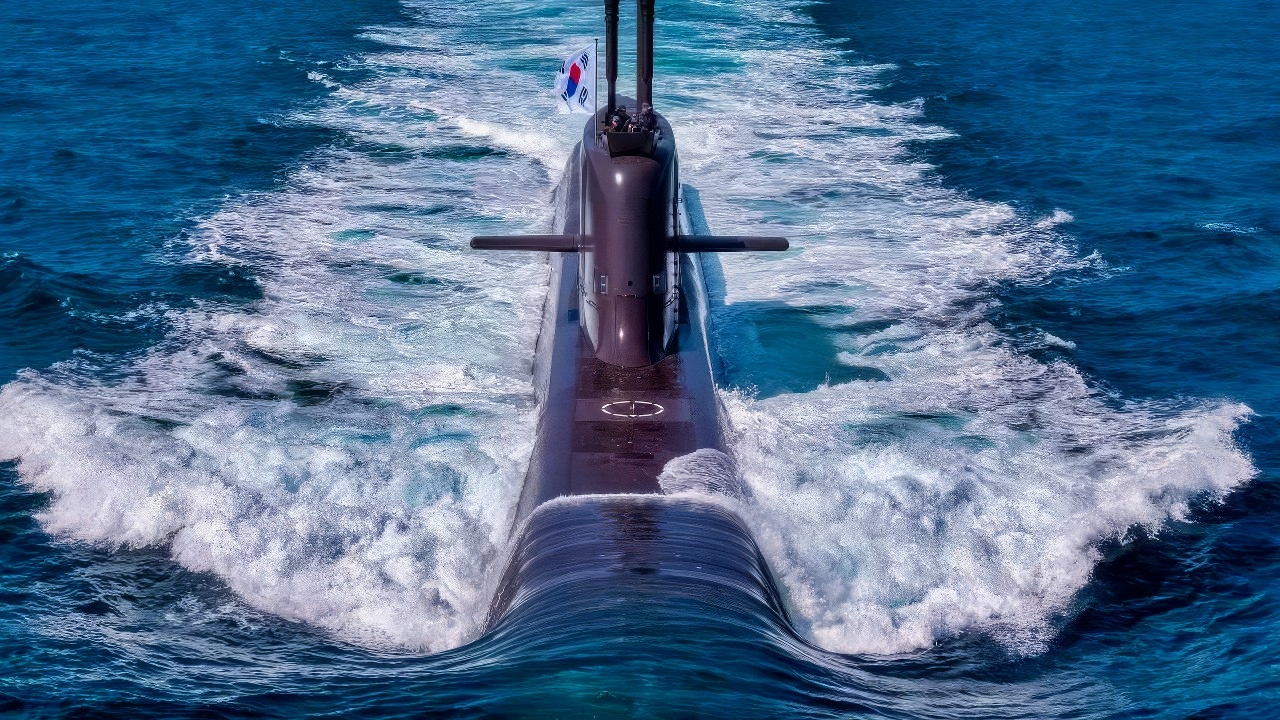
Key Points – South Korean shipbuilders Hyundai Heavy Industries and Hanwha Ocean are actively marketing the advanced KSS-III (Dosan Ahn Changho-class) diesel-electric attack submarine for export, targeting NATO allies like Canada and Poland.
-These submarines feature Air Independent Propulsion (AIP) for extended underwater endurance and are uniquely capable of launching conventionally armed Submarine-Launched Ballistic Missiles (SLBMs), like South Korea’s Hyunmoo 4-4.
-Amid US-Canada trade frictions and F-35 concerns, a joint South Korean proposal offers Canada four KSS-IIIs by 2035 with domestic maintenance facilities. Hanwha Ocean is also bidding for Poland’s Orka submarine program with a similar package.
The KSS-III Submarine Has Arrived
South Korean submarine builders are entering the fray for foreign defense contracts, hoping to secure an agreement as substantial as some of their land-based counterparts in the South Korean defense sector.
The KSS-III, the latest iteration of the KSS submarines, is already in production and service with the Republic of Korea Navy. However, the advanced submarines could also be in service with several other countries, having made bids for at least two different submarine programs. The Korean submarines may eventually find them in service within the auspices of the NATO alliance.
KSS-III Explained
The submarines are larger than the previous KSS-II submarines, which were initially based on a German design. However, like the older submarines, the KSS-IIIs are also diesel-electric submarines equipped with cell fuel technology, which allows for Air Independent Propulsion, or AIP. The endurance of submarines while underwater is estimated to be around 20 days, with a top speed thought to be approximately 20 knots.
In a first for the Korean shipbuilding industry, the KSS-III will be capable of launching submarine-launched ballistic missiles from vertical launch silos just above the submarine’s sail. On the export market, foreign operators of the KSS-III may choose to use their own SLBMs, but in the Republic of Korea Navy, they’re equipped with Hyunmoo 4-4 ballistic missiles. These non-nuclear weapons have a range of just under 300 kilometers. It’s a prodigious capability and one that has even garnered notice from the United States Navy.
“South Korea’s ambitious, indigenously designed KSS-III submarine program introduces conventionally armed submarine-launched ballistic-missile (SLBM) capabilities and cements the nation’s reputation as a preeminent builder and operator of non-nuclear air-independent propulsion (AIP) submarines,” the United States Naval Institute said of the South Korean submarine program.
Export to Canada?
Amidst the ongoing trade friction between the United States and Canada — a trade war that was recently deemed an overreach by America’s executive — two South Korean firms would like to join forces and seduce Ottawa with an attractive offering for Canada’s aged submarines.
Hyundai Heavy Industries and Hanwha Ocean teamed up, offering the Royal Canadian Navy proposals — reportedly unsolicited — to take advantage of the cool relations between Canada and its closest ally. The joint proposal, valued at 20 billion to 24 billion Canadian dollars, would cover the delivery of the first four submarines and deliver them to the Royal Canadian Navy by 2035. And to sweeten the deal, the joint pitch also includes the creation of domestic submarine facilities in Canada for maintenance and servicing.
The Polish Connection
Hanwha Ocean would also like to sell submarines to Poland too. The company “has revealed its updated offer for the supply of future submarines to the Polish Navy under the Orka program. The South Korean shipbuilder is willing to deliver KSS-III Batch 2 vessels along with an extended MRO (maintenance, repair, and overhaul) package as well as to invest in Polish shipyard infrastructure under the contract,” Janes, a defense publication, wrote.
“During a briefing held in early April,” Janes added, “Hanwha Ocean presented a new updated timeframe for the delivery of three submarines for Poland. According to the Hanwha representatives, the first vessel could be delivered within six years after signing the contract, and all vessels could be delivered within eight and a half years.”
South Korean Expertise
This pitch to Ottawa builds on the recent success the South Korean brand has enjoyed in the international arms export market. Hyundai Rotem, another South Korean defense firm, has previously inked deals with the Polish government for hundreds of K2 Black Panthers, a NATO-compatible main battle tank, and K-9 self-propelled howitzers.
“We do not think of this as a single, one-time deal between two countries. “It’s not a transaction for us, “ South Korean Deputy Defense Minister Hyunki Cho said to CBC News. “If we do succeed in making the sale, then we are going to try and give our effort toward strengthening the capabilities of Canada’s defense industry, as well as furthering defense cooperation.”
Whether the soured relations between Canada and the United States can be remitted in the long term remains to be seen. But in the short term, there will be much to do to repair relations between two of the world’s oldest and closest allies.
Canadian citizens and lawmakers alike have called for Ottawa to reevaluate its role within the American-led -35 stealth fighter program. Although still a member of the initiative, which aims to replace Canada’s Cold War-era CF-18 Hornet fighter jets, concerns about F-35 sustainment and operational control have caused some consternation. A move toward the South Korean kit and away from that of the United States would be one of the strongest rebukes to date.
KSS-III: What Happens Next?
Regarding the South Korean firms’ bid to replace Canada’s aging Victoria-class submarines, the proposal’s rapid delivery of four brand-new submarines is certainly an attractive offer. In the case of Poland, Warsaw already has experience with South Korean defense material, having purchased hundreds of pieces of armor from Hyundai Rotem. And Hanwha Ocean officials said, “The deliveries would be on time and budget with no surprises.”
About the Author: Caleb Larson
Caleb Larson is an American multiformat journalist based in Berlin, Germany. His work covers the intersection of conflict and society, focusing on American foreign policy and European security. He has reported from Germany, Russia, and the United States. Most recently, he covered the war in Ukraine, reporting extensively on the war’s shifting battle lines from Donbas and writing on the war’s civilian and humanitarian toll. Previously, he worked as a Defense Reporter for POLITICO Europe. You can follow his latest work on X.
Military Matters
France ‘Sunk’ A US Navy Aircraft Carrier in a Wargame
US Navy Submarines Can Crash Into Underwater Mountains and Survive


