


Summary and Key Points: America’s network of major bases across Asia — its biggest bet for deterring China — now sits within range of Beijing’s vast missile, drone, and hypersonic arsenal, which dwarfs anything Iran fielded in the recent war.
-Key sites like Guam remain lightly hardened, and analysts, including Hudson’s “Concrete Sky” report, warn that shelters are too few.
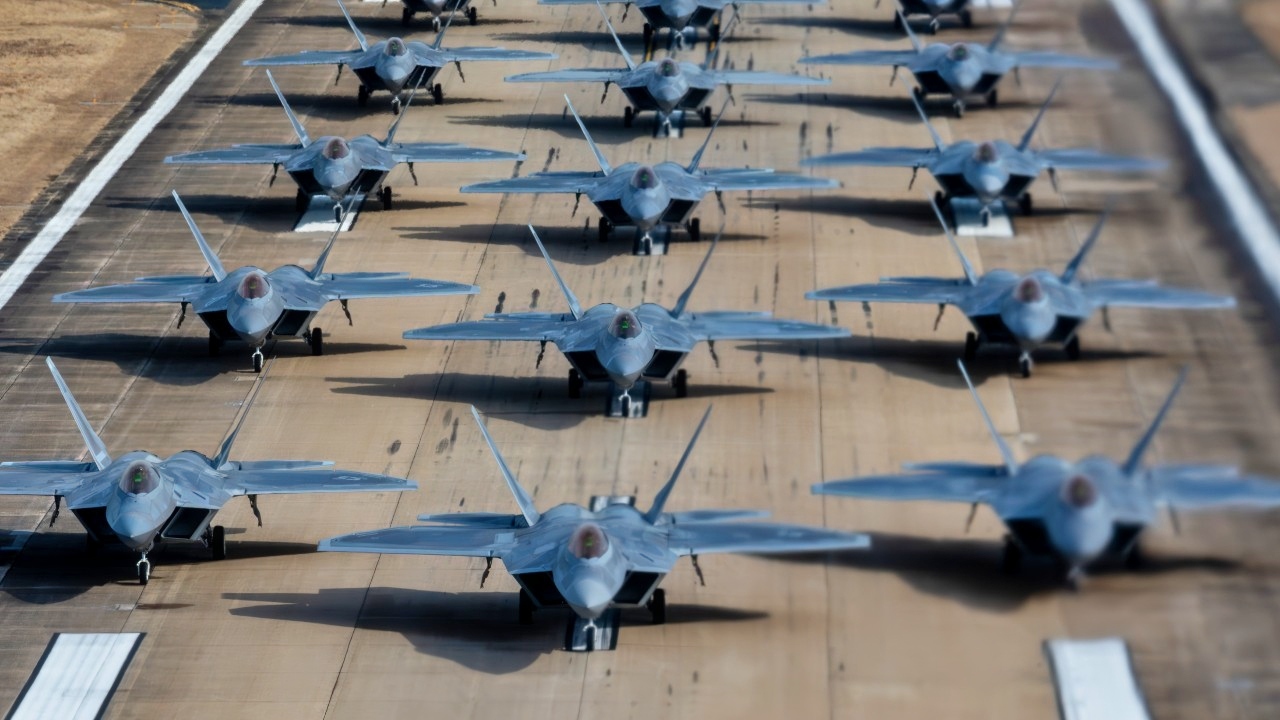
Aircraft from the 1st Fighter Wing conducted an Elephant Walk at Langley Air Force Base, Jan. 31, 2025, showcasing the wing’s readiness and operational agility. This demonstration highlighted the wing’s capability to mobilize forces rapidly in high-stress scenarios. The wing’s fleet includes F-22 Raptors and T-38 Talons. As Air Combat Command’s lead wing, the 1 FW maintains unparalleled combat readiness to ensure national defense at a moment’s notice. (U.S. Air Force photo by SrA Ian Sullens)
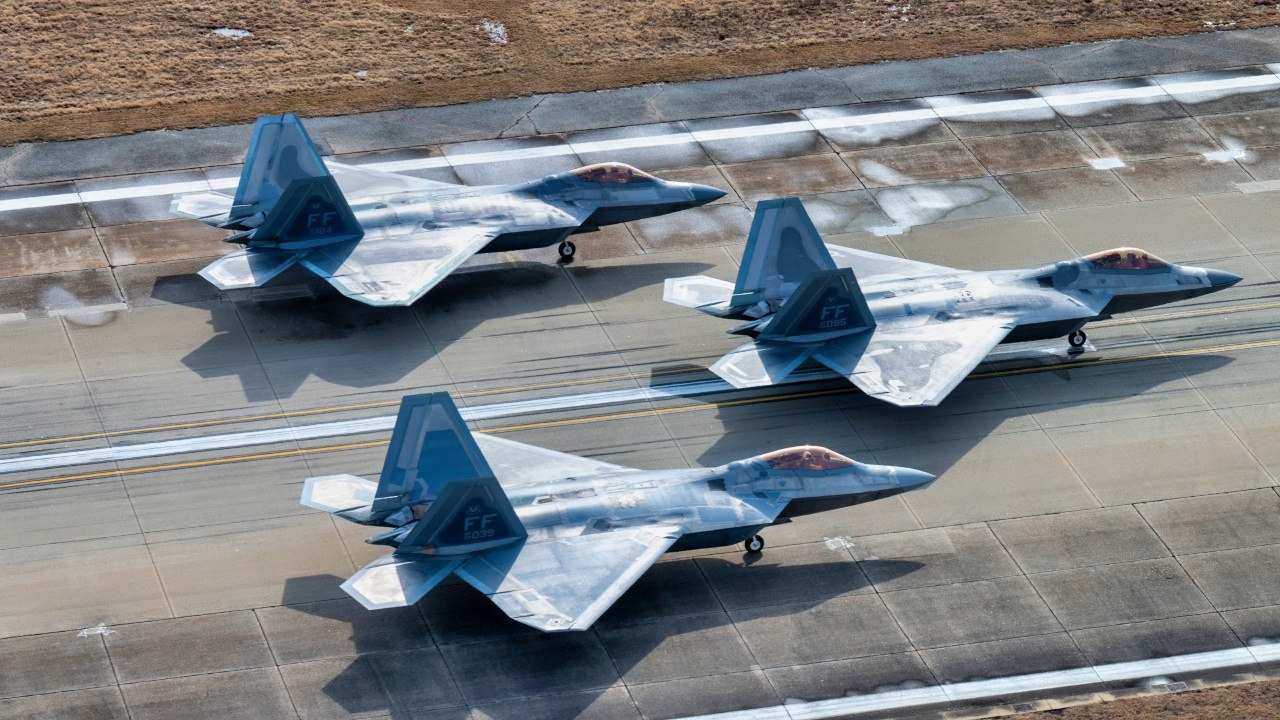
LANGLEY AIR FORCE BASE, Va. – F-22 Raptors from the 1st Fighter Wing sit in position on the runway fduring the Elephant Walk at Langley Air Force Base, Virginia, Jan. 31, 2025. The surge was designed to showcase the wing’s operational readiness and its ability to rapidly mobilize airpower. The 1st FW operates F-22 Raptors and T-38 Talons, maintaining combat capabilities that enable the U.S. Air Force to execute missions across the globe. With a focus on air superiority, the 1st FW plays a critical role in defending the nation’s interests. (U.S. Air Force photo by Tech Sgt. Matthew Coleman-Foster)
-With a massive defense budget request on the table, the urgent question is whether Washington can harden its Pacific bases before China is ready to act.
China’s Missiles are Far More Powerful Than Iran’s
One of America’s biggest defense investments, and one of the capabilities that the Pentagon believes is its greatest asset in any way with China, might actually be the US military’s greatest vulnerability. That’s a reference to the 30- 40 major named US military bases across Asia. Numerous smaller sites, logistics hubs, and shared facilities support these larger facilities. What’s more, these bases and support facilities house tens of thousands of active-duty military and War Department civilian personnel.
America has spent decades since the end of the Second World War building these key bases throughout the Indo-Pacific. Now, every one of them has gone from being force multipliers for the US military to major strategic liabilities.
That’s entirely because of China’s commitment to its anti-access/area-denial (A2/AD) strategy. This strategy insists upon denying the US military forward bases from where the Americans can launch attacks against Chinese forces that could either be attacking Taiwan or another US ally, like Japan or the Philippines.
The Iran War as a Warning for a China War
Washington got a taste of how easily US military bases in a contested region can go from strategic assets to vulnerabilities in the recent Iran War. The US had established more than a dozen key US military facilities around the Islamic Republic of Iran. The moment hostilities started, though, the Iranians used their potent ballistic missile and drone capabilities to flatten those facilities.

B-2 Bomber Elephant Walk. Image Credit: Creative Commons.

B-2 Spirit stealth bombers assigned to Whiteman Air Force Base taxi and take-off during exercise Spirit Vigilance on Whiteman Air Force Base on November 7th, 2022. Routine exercises like Spirit Vigilance assure our allies and partners that Whiteman Air Force Base is ready to execute nuclear operations and global strike anytime, anywhere. (U.S. Air Force photo by Airman 1st Class Bryson Britt)

F-22 Raptor Elephant Walk. Image Credit: Creative Commons.
Now, there is real concern in Washington that they will not be allowed to reconstitute the bases in any meaningful way. Due to political issues arising over the Iran War, there is even more worry about the local governments not welcoming the Americans back to their countries.
After all, the US bases in the Arab states made those Arab nations target priorities for Iranian missiles and drones.
Those attacks caused massive damage to the region’s economies.
Asian states that host US bases are likely looking at the Arab experience and getting worried about what might befall their countries. What’s more, the US bases in question had to be massively evacuated in the run-up to hostilities because defending those bases from the level of Iranian swarm attacks was not possible, given limitations on US defensive stockpiles. Any war with China would increase those risks to American bases in Asia tenfold.
China has infinitely more missiles and drone swarms, to say nothing of advanced hypersonic weapons, than did the Iranians in the recent war.
America’s Bases Are Not Ready for a China Missile War
What’s more, the US bases in the Mideast were poorly prepared to come under attack. Few planners in Washington apparently understood that the Iranians could easily lay siege to those American bases with their missile and drone swarms. That lack of understanding within the Pentagon meant that shelters on the bases were few and poorly defended.
Similar conditions exist in American facilities throughout the Indo-Pacific. And Chinese weapons have a greater range than even those Iranian missiles and drones had over the Americans.
The First Island Chain Problem: Iran
Forward-positioned US bases within what’s known as the First Island Chain (the region extending from the Kamchatka Peninsula through Japan and Taiwan down to the Philippines) are especially at risk of Chinese attack. There are around 15 bases in Japan alone that are now under threat. But the Chinese range on their missiles exceeds that of the First Island Chain today. They can threaten some US bases in the Second Island Chain.
Per the Hudson Institute’s Concrete Sky Report, forward-deployed American bases have seen finite investment in hardening their infrastructure. Guam, the most important US military base in the region, has not even been hardened. The Americans have built a few hardened shelters not only for their personnel on the bases but also for the expensive platforms stationed there.
B-2 Spirit long-range stealth bombers are left undefended on the tarmac, for instance.

B-2 Stealth Bomber at USAF Museum July 19 2025. Image Credit: Harry J. Kazianis/National Security Journal.
A Budget Fix May Come Too Late
While the newest request for the US defense budget is for an astonishing $1.5 trillion, a large portion of which is going toward general increases in US base defenses, it will take some time for those modifications to occur–and there is no guarantee that even a friendly Republican-controlled Congress will ultimately agree to that level of defense spending.
With fears abounding that the Chinese are readying to initiate hostilities in the First Island Chain soon, as reports proliferate proving this author’s original reporting that the US military’s stockpiles of key weapons systems–notably air defenses–are being drained at crisis levels (with a more than five-year lag time for replacing those systems), the chances are high that America’s critical bases in Asia will soon fall under attack.
And that the attacks on those bases will succeed in knocking them out, thereby negating whatever power projection the US military intends to deploy once China initiates hostilities against its US-backed neighbors.
Rethinking America’s Strategy in Asia
A wiser course of action by Washington would be to reduce its footprint, at least in the First Island Chain, before hostilities began, and to reorganize its entire grand strategy for deterring China there.
Frankly, the US has lost the First Island Chain to China’s missile overmatch there. It is unlikely that Washington can easily flip the math on that overmatch anytime soon, given America’s severe defense-industrial deficits.
Keeping US forces forward-deployed there is irresponsible because their presence drives China toward hostility, and the current force imbalance, which now favors China, ensures that critical American units will be lost before they can even engage in a fight.
About the Author: Brandon J. Weichert
Brandon J. Weichert is Senior National Security Editor. Recently, Weichert became the editor of the “NatSec Guy” section at Emerald. TV. He was previously the senior national security editor at The National Interest. Weichert hosts The National Security Hour on iHeartRadio, where he discusses national security policy every Wednesday at 8 p.m. Eastern. He hosts a companion show on Rumble entitled “National Security Talk.” Weichert consults regularly with various government institutions and private organizations on geopolitical issues. His writings have appeared in numerous publications, among them Popular Mechanics, National Review, MSN, and The American Spectator. His books include Winning Space: How America Remains a Superpower, Biohacked: China’s Race to Control Life, and The Shadow War: Iran’s Quest for Supremacy. Weichert’s newest book, A Disaster of Our Own Making: How the West Lost Ukraine, is available for purchase at any bookstore. Follow him via Twitter/X @WeTheBrandon.


xi-xi-xi
May 30, 2026 at 9:54 am
US is truly, undisputably, the true genghis of our time – ruthless, murderous, horribly genocidal and lusting greatly for blood and gore.
Because of that, or precisely as a result of that, to survive any fight with the US, you must have an unfailable backup plan.
Attacking and wipin’ out all US bases in asia would amount to nothing more than a mosquito bite, or a coupla mosquito bites.
To survive and win against the very dreaded modern genghis of our time, you must be able to hold his cities, like chicago, miami, detroit, washington DC, nyc, san diego, LA at risk.
At risk of utter distruction.
Thus, to take on US, china needs to deploy killer nukes in space, circling the planet.
Also, needs to develop a truly advanced FOBS capability, and a fleet of ultra modern battleships carrying IRBMs packin’ thermo warheads that fly on depressed trajectories.
All in all, you need warheads that can reach their target areas within 12 minutes or less upon outbreak of hostilities.
The HELL with genghis !
Crotte
May 30, 2026 at 3:24 pm
Now tell me how many A-Bombs would be headed to China from various locations when their action started????????
Jim Wolf
May 30, 2026 at 5:58 pm
Yes and China could also nuke us and then our submarines would annihilate them. This is not a well thought out analysis–if China attacked our bases we again using vastly superior submarine power would obliterate their military bases. If we’re talking about a non-nuclear war, China would lose, because apart from submarines we have US-based bombers that they couldn’t counter that could destroy whatever we wanted to in China.
PseudoExpertent
May 31, 2026 at 1:53 am
The black commander of all current US forces in korea, general brunson, in an interview, proudly said “The US bases in korea represent a dagger in the heart of asia as seen from china’s eastern coast”.
Clearly, general xavier brunson doesn’t fear any missiles at all, not even a direct attack with missiles.
As the bases in the western pacific are truly like a dagger.
Dagger = a point sharp double-edged weapon used for close-quarter stabbing and killing.
Jason
May 31, 2026 at 2:30 am
I don’t mean to be condescending, but have you looked beyond the paper military assets China has. Yes, they have stealth fighters, no those are nowhere near the capability they claim. Yes they have many missiles, did you research the reason for the recent cleansing of the Chinese military in charge of the nuclear weapons. They have a huge standing army, that can’t go anywhere because of the need to control their own citizens. As we have seen most recently in Iran and somewhat in Ukraine, the weapons systems they have either don’t work, or are terrible at what they do. Then we get into the actual kill chain, Chinas is far to long, fragmented and fragile, to effectively prosecute a regional conflict.
Swamplaw Yankee
May 31, 2026 at 3:42 am
The phrase ” apparently few planners in Washington understood” is the key semantic. say no more!
Were all these planners fired: or, what was the follow-up to the over-paid staff? Most planners need to be BOOTS on the Ground. How many US 4 star brass have spent a full week evading human hunting Kremlin Muscovy drone operators, saliva dripping to kill another senior citizen Ukrainian?
That a elderly senior US brass could die would be useful + telling? Where did the only US general die on the front line in WW2?
Until that happens to top brass in the USA armed forces, the BOOTS ON the ground Han intelligence in Ukraine have the spectrum of top secret UAV/drone tech.
The PRC CCP just have not revealed to the cognitively impaired US intelligence ( including moles) what money can not buy!