

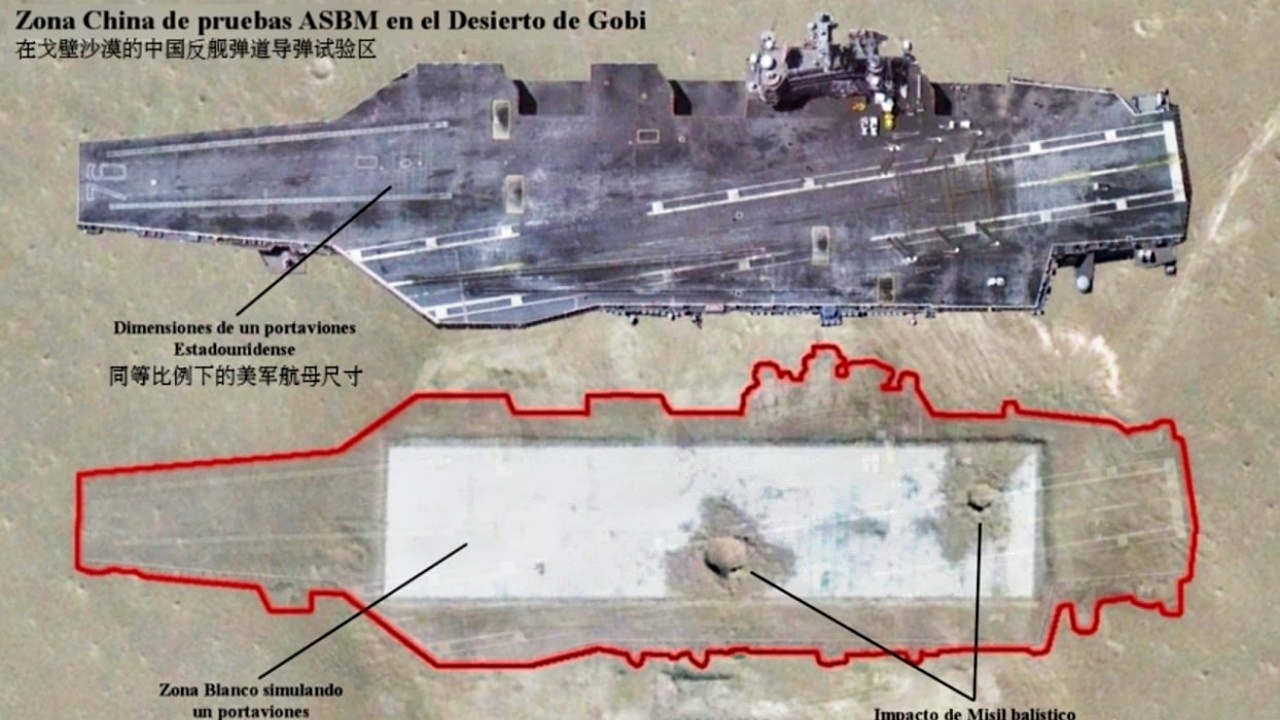
Key Points and Summary – In a remote corner of its Xinjiang desert, China has constructed full-scale, movable mock-ups of US Navy warships, including a Gerald R. Ford-class aircraft carrier and Arleigh Burke-class destroyers.
-These “desert warships” serve as high-fidelity targets for testing China’s “carrier-killer” anti-ship ballistic missiles, such as the DF-21D and DF-26.
-This extensive and sophisticated target range is a key part of China’s anti-access/area denial (A2/AD) strategy and sends a clear and menacing signal to the United States: Beijing is actively practicing how to destroy America’s most powerful naval assets.
China Goes Shooting at Fake Aircraft Carriers in the Desert
Around 2021, satellite imagery from China’s deserts, particularly the Taklamakan and Gobi, revealed some interesting footage.
The Chinese had been building huge mockups of American naval vessels such as aircraft carriers and destroyers.
More curiously, these mockup structures are hooked to rigs that allow them to move, simulating the movements of an actual naval vessel for the most part. But what is the purpose of these “desert warships,” and what does it mean for the U.S.?
Why is China Building American Ships in the Desert?
These desert warships, as some call them, are life-sized mock-ups of U.S. naval vessels, including aircraft carriers such as the USS Gerald R. Ford and Arleigh Burke-class destroyers.
Constructed in remote desert regions like Xinjiang province, these replicas are visible in satellite imagery captured by commercial imaging companies.
Some of the mock-ups are stationary, others are rough cut-outs of warships, like the image above, while others are mounted on rail systems that allow them to move across the desert floor.
The inclusion of mobile targets is particularly notable, as it simulates the motion of real ships at sea, providing more realistic training and testing conditions for missile systems.
The primary function of these desert warships is to serve as targets for China’s growing arsenal of anti-ship ballistic missiles (ASBMs) and cruise missiles. These include the DF-21D and DF-26, often dubbed “carrier killers” due to their purported ability to strike moving naval targets at long range.
By using detailed mock-ups of U.S. warships, the PLA can test missile accuracy, refine targeting systems, and simulate real-world scenarios. The desert environment allows for controlled conditions to simulate attacks on naval vessels without the risks associated with live-fire exercises at sea.
Sending a Message to The U.S. Navy
This initiative is a key component of China’s broader military strategy, which emphasizes anti-access/area denial (A2/AD) capabilities. The A2/AD doctrine is designed to deter or delay the intervention of foreign military forces, particularly the U.S. Navy, in regions like the South China Sea or Taiwan Strait.
By demonstrating the ability to accurately target and potentially destroy U.S. carriers and their escorts, China sends a clear message: it is prepared to challenge American naval dominance in the Indo-Pacific.
The construction and use of these mock-ups are not merely technical exercises; they are also strategic signals. Satellite images of these installations are often picked up by international media and analysts, serving as a form of psychological and geopolitical messaging. The level of detail in these mock-ups is striking.
For instance, the replica of the USS Gerald R. Ford includes four catapult tracks on the flight deck, an accurately positioned island superstructure, and dimensions that closely match the real carrier, which is over 1,000 feet long.
This attention to detail suggests that the PLA is not merely interested in hitting a large target, but in simulating precise strikes on critical ship systems.
China Testing Out Its Missiles
The addition of rail-mounted moving targets is an interesting addition. These systems allow for dynamic testing, where missiles must adjust to a moving target, mimicking the real-world challenge of hitting a maneuvering warship at sea.
Beyond missile testing, these desert warships are also used for training exercises. PLA Rocket Force units, missile operators, and targeting specialists can practice coordinated strikes, real-time targeting adjustments, electronic warfare scenarios, and damage assessment simulations.
This kind of training is invaluable for preparing Chinese forces for potential high-stakes naval engagements.
China’s use of mock targets in the desert is not a recent development. Some reports suggest that as early as 2013, satellite imagery revealed a mock-up of a U.S. aircraft carrier in the Gobi Desert, which was later shown to have been struck by missiles during exercises.
Over the years, the complexity and realism of these targets have increased, reflecting the PLA’s growing emphasis on maritime power projection and counter-intervention strategies. In recent years, the installations have expanded to include multiple carrier and destroyer replicas, simulated airfields and radar installations, and mock-ups of U.S. military bases in Japan and the Pacific.
This expansion indicates a broader training and testing agenda that goes beyond naval warfare to include multi-domain operations.
More Strategic Postering From the CCP
The existence and continued development of these desert warships have several implications.
First, they underscore the intensifying American-Chinese rivalry. These installations are a direct response to the U.S. Navy’s presence in the Indo-Pacific and reflect China’s intent to deter U.S. intervention in regional conflicts, particularly over Taiwan.
Second, the sophistication of China’s missile testing programs may spur further investment by the U.S. and its allies in missile defense systems, stealth technologies, and countermeasures.
Third, while some analysts argue that these mock-ups are primarily for domestic propaganda, their visibility in satellite imagery ensures they are also a message to foreign powers.
Finally, the PLA’s ability to simulate complex naval engagements in a controlled environment enhances its readiness for real-world conflict scenarios.
What Happens Next?
Despite their utility, these mock-ups have limitations. Static targets, even those mounted on rails, cannot fully replicate the complexity of naval warfare at sea, including variables such as weather, sea state, and electronic countermeasures.
Repeated use of the same mock-ups may lead to training that is overly scripted or unrealistic.
Additionally, some experts argue that the installations serve more as a show of strength for domestic audiences than as practical training tools.
About the Author: Isaac Seitz, Defense Analyst
Isaac Seitz, a Defense Columnist, graduated from Patrick Henry College’s Strategic Intelligence and National Security program. He has also studied Russian at Middlebury Language Schools and has worked as an intelligence Analyst in the private sector.
Military Concepts
A 7th Generation Fighter Is Coming


Jim
July 16, 2025 at 12:16 pm
Xi, the President of China isn’t engaged in empty talk.
In Xi’s formal speeches to the Chinese People, he constantly states China’s military buildup, the greatest military buildup in the last 500 years, since the Rise of the West, is about reunifying China & Taiwan.
(Obviously, China has other geopolitical purposes for their military beyond reunification of Taiwan.)
And, possibly, given the advanced technology and the large number units of these advanced military technologies, it’s the greatest military buildup in China’s 5,000 year history.
So, what do you expect, given China’s objective of reunifying China & Taiwan, they are taking all the military steps in preparation for a military solution.
Now, Xi has also stated China would much prefer a peaceful reunification, which is also the U . S. requirement for the reunification process, but again, if reunification can’t be achieved peacefully, then China will employ military means.
The United States has had the One China policy (U. S. commitment to return Formosa to China’s sovereignty after the defeat of Japan) since the Cairo Conference in 1943 when Chiang Kai-shek represented China and all parties agreed on the return of Taiwan to China after the war.
The United States has never repudiated or disavowed the One China policy since 1943, over 80 years ago.
The United States militarily defending Taiwan is the equivalent to the U. S. S. Titanic sailing straight for the Taiwanese Iceberg.
Any sober & objective military affairs analyst knows China has all the military advantages regarding Taiwan, and the U. S. has none.
Get the best deal possible: a date-certain peaceful “hand-off” of Taiwan to Chinese sovereignty in exchange for China relinquishing all claims of sovereignty in the South China Sea beyond the 200 mile Exclusive Economic Zone and any claims in the East China Sea, as well.
I’m sorry, China is way more important than the postage stamp-sized “island province” of Formosa (Taiwan), which means ‘beautiful,’ let’s keep it that way, not turn it into a smoking rock.
But that’s what militarists want to do… they are wrong.
Pingback: What Is China Hiding In Its Desert? The China Ships In Desert