


In 2024, a research team led by Professor Zhang Dong at China’s Northwestern Polytechnical University — one of China’s premier military-aerospace research institutions — published a computer simulation pitting the Chengdu J-20 stealth fighter against the U.S. F-22 Raptor in scenarios set north of Taiwan. The catch: the J-20 was modeled with two to three loyal-wingman drones acting as forward scouts, decoys, and multi-axis attackers, while the F-22 was modeled as a solitary platform with no drone support of its own. In those drone-supported engagements, the J-20 reportedly prevailed in nearly every encounter — but when the same simulation was run without the J-20’s drones, the probability of J-20 victory dropped to under 10%, with the F-22 winning decisively.
F-22 vs. J-20 Fighter: Who Wins? Enter The Drones
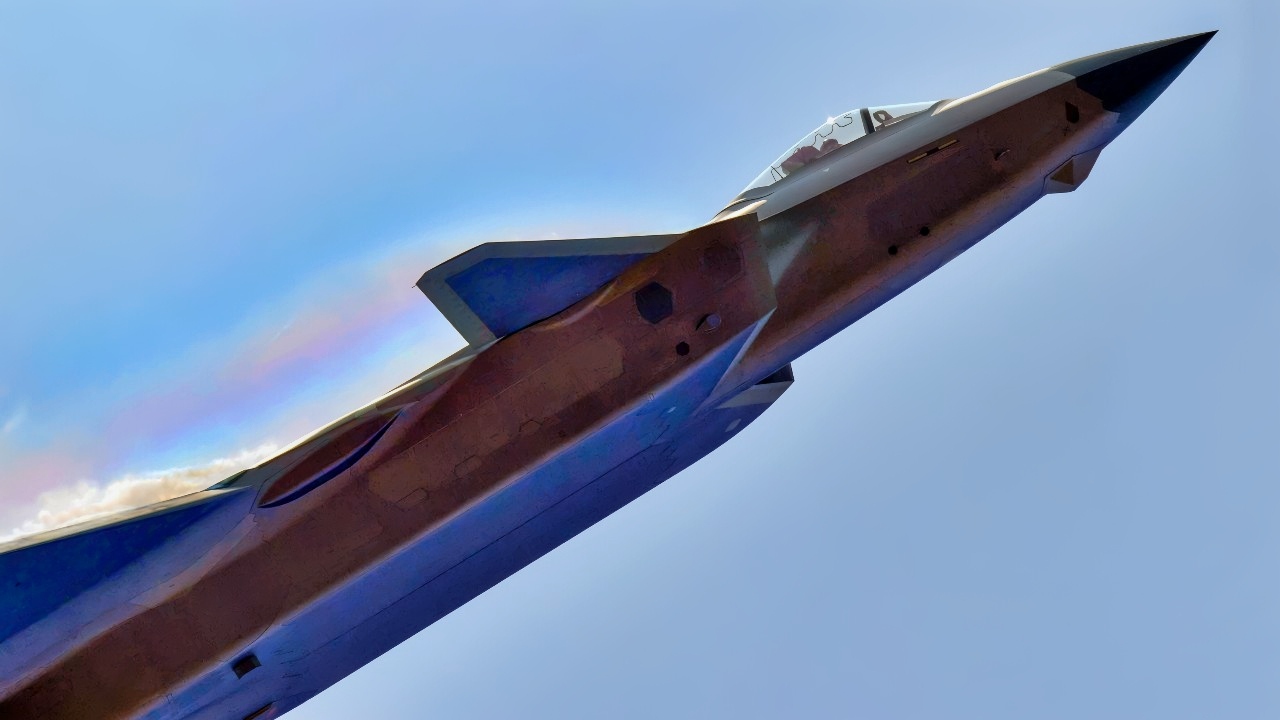
China J-20 Long Shot from 2021. Image Credit: Chinese Military.
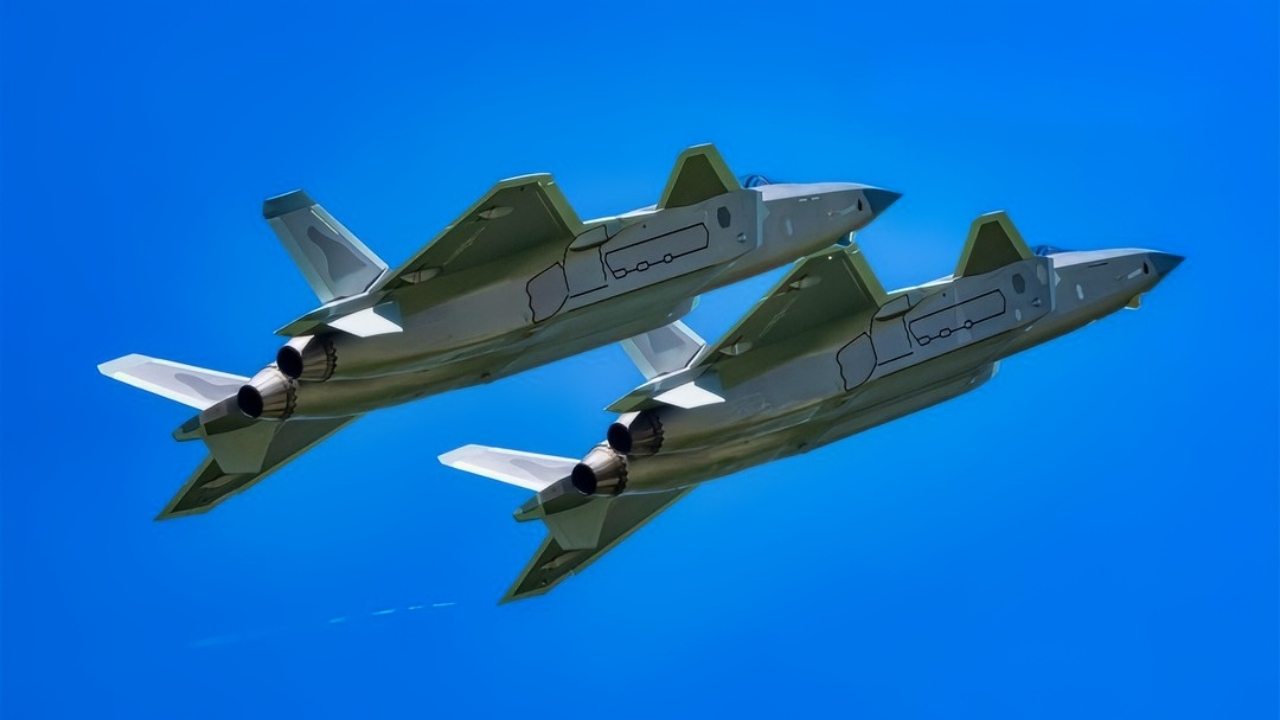
J-20 Fighter In Formation PLAAF Photo
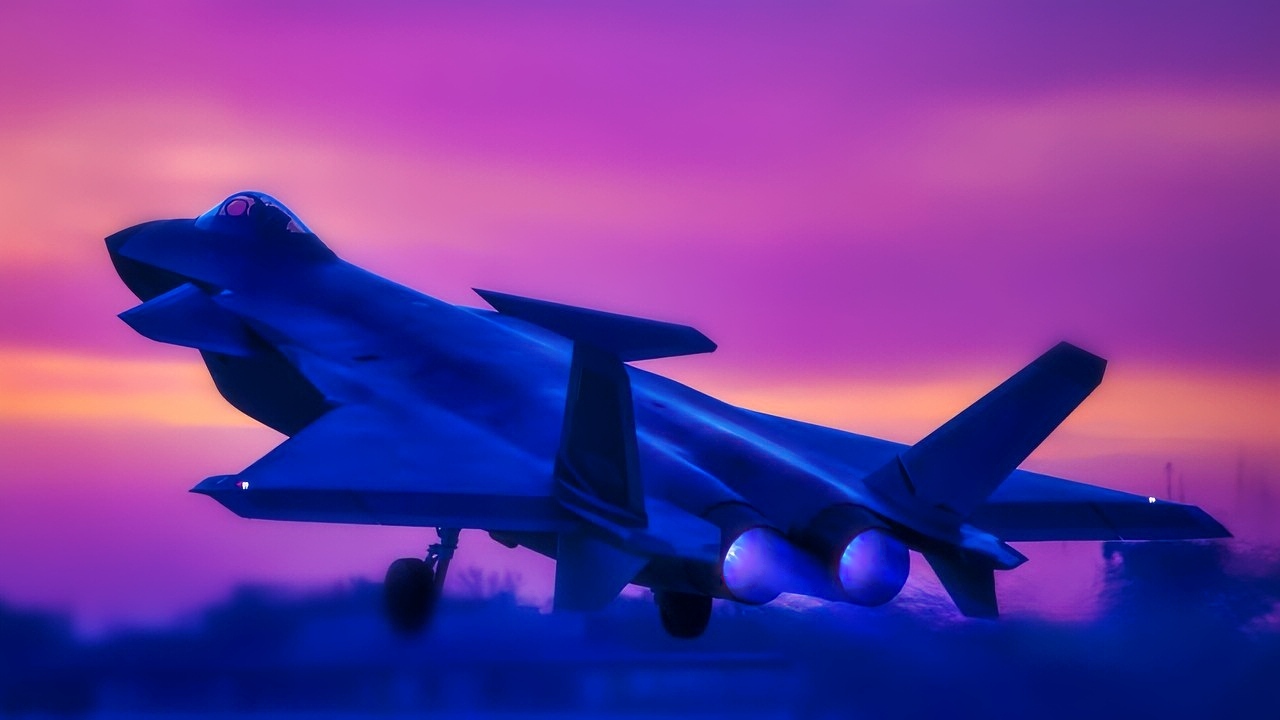
J-20 Fighter from China. Image Credit: PLAAF.
Among aviation circles, experts and enthusiasts have constantly debated whether the Chengdu J-20 is better than the F-22 Raptor. In 2024, the Chinese themselves put the question to the test, but with a few nuances.
One of China’s premier research universities created a computer simulation of a battle between the two aircraft.
Rather than a one-on-one fight, however, the researchers gave the J-20 a small group of loyal wingman drones to see if their presence had any influence on the battle’s outcome.
The results showed that not only did the drones help, but they also boosted the J-20’s chance of success by orders of magnitude.
Background of the Experiment
The simulation was carried out by a research team led by Professor Zhang Dong at Northwestern Polytechnical University (NPU).
NPU is not a neutral civilian institution in the Western sense; it is one of China’s key universities involved in aerospace engineering, weapons development, and military-relevant research.
Work produced there frequently informs the People’s Liberation Army’s (PLA) concept development efforts, even when formally presented as academic research.
The findings were described in a paper and then summarized in Chinese and English-language media.

A U.S. Air Force F-22 Raptor assigned to the Air Force F-22 Demonstration Team, Air Combat Command, performs aerial maneuvers during the 2025 Marine Corps Base Hawaii Kaneohe Bay Air Show, Aug. 9, 2025. The Kaneohe Bay Air Show provides an opportunity to showcase the aircraft, equipment and capabilities of the armed forces in the Indo-Pacific region to the local community. The air show, which contained aerial performances, static displays, demonstrations and vendors, was designed to celebrate MCBH’s longstanding relationship with the local community. (U.S. Marine Corps photo by Lance Cpl. Blake Gonter)
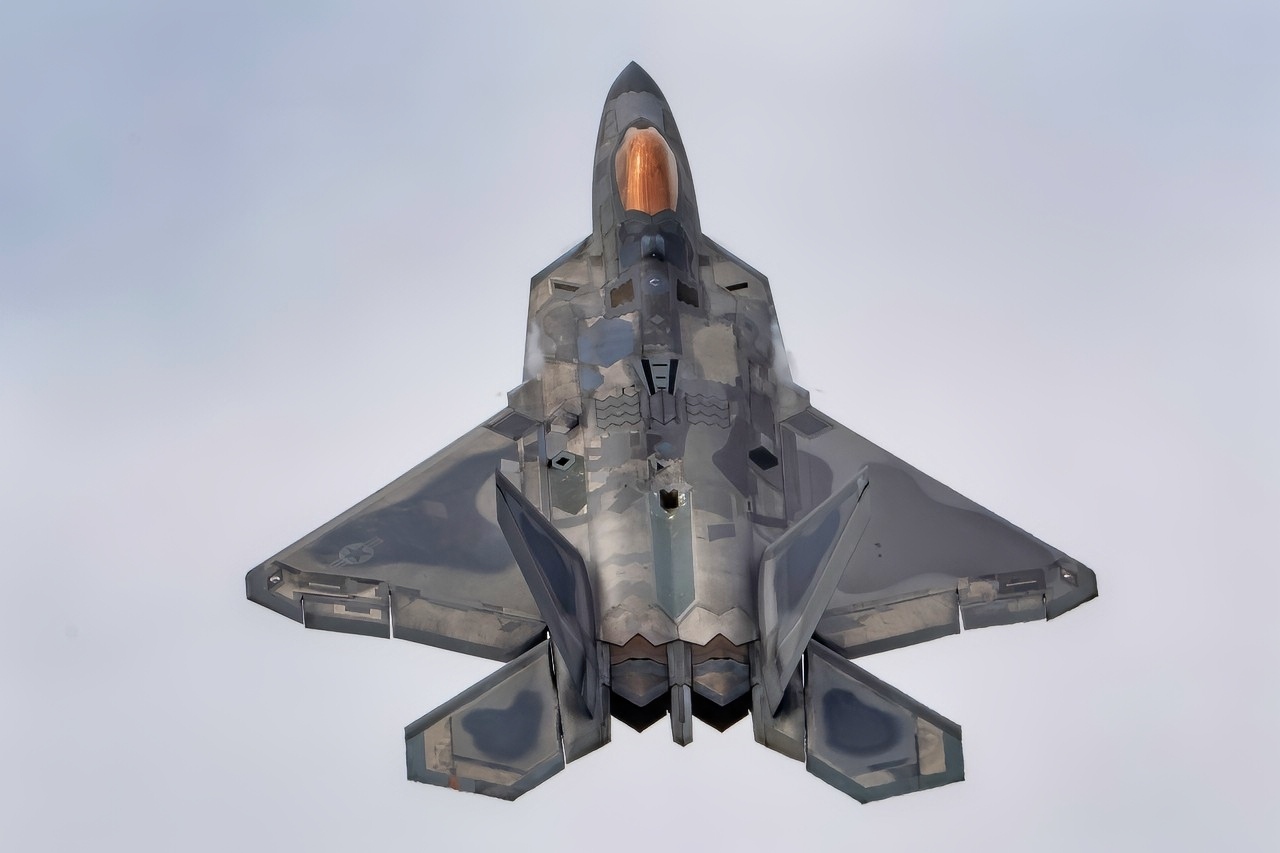
U.S. Air Force Maj. Josh Gunderson, F-22 Demo Team commander, performs the Raptor slide during the Geneseo Airshow July 10, 2021, Geneseo, N.Y. During the maneuver the aircraft actually slides down and backwards under control before Gunderson adjusts the aircrafts position and powers out of the maneuver. (U.S. Air Force photo by Staff Sgt. Don Hudson)
While the study did not represent an official PLAAF exercise, it was clearly intended for military applications.
As some analysts have pointed out, the fact that the results were publicized so close to the Zhuhai Airshow, where China unveiled the two-seat J-20S variant, may not have been accidental.
Some have suggested that the simulation was part of a broader effort to showcase the technological maturity of China’s airpower doctrine, though this may be reaching a bit too deeply.
Structure of the Simulated Engagement
The simulated engagement was set geographically to the north of Taiwan.
This detail is important because it situates the scenario squarely within the most plausible region of a future high-intensity China–U.S. confrontation.
Because the true capabilities of the F-22 remain highly classified, the Chinese researchers relied on open-source and inferred data to model the American aircraft.
They also stated that, to avoid accusations of bias, they deliberately set the J-20’s radar performance, stealth characteristics, and other technical parameters lower than those attributed to the F-22 in the simulation. Despite this conservative modeling, the J-20 reportedly prevailed in nearly every simulated engagement.
What is most interesting is that the paper was not a test to simulate a one-on-one fighter or to compare the two fighters’ performances.
In most of the modeled encounters, the J-20 did not fight alone. Instead, it operated alongside two to three unmanned aerial vehicles functioning as loyal wingmen.
The F-22, by contrast, was modeled as a solitary platform without organic unmanned teammates. The goal of the test was to determine whether loyal-wingman drones made a difference in simulated combat conditions. Lo and behold, they did.
The Role of Loyal Wingman Drones
The integration of loyal wingman drones significantly altered the encounter in favor of the J-20, according to the report. In the modeled engagements, the drones extended the J-20’s sensor range by acting as forward scouts, shared targeting data back to the crewed fighter, and in some cases deliberately exposed themselves as decoys to draw enemy fire.
Other drones reportedly participated in multi-axis attacks that overwhelmed the situational awareness of a single opposing aircraft, leaving the J-20 free to deliver the final missile shot.
When the exact tests were run again without the drones, the results varied dramatically.
According to the researchers, when the drones were removed, and the engagement became a more conventional one-on-one fight, the probability of a J-20 victory reportedly dropped to less than 10 percent, with the advantage shifting decisively to the F-22.
In other words, the simulation implicitly acknowledged that the J-20 does not outperform the F-22 as a standalone aircraft (at least not according to the simulation’s parameters). Its success depended overwhelmingly on networked manned-unmanned cooperation.
Test Limitations
Of course, any computer combat simulation has to be taken with a healthy grain of salt.
Digital simulations like this one cannot account for the wide range of conditions that complicate any battlefield. For example, input data for the F-22 is incomplete. The aircraft’s electronic warfare capabilities, low-observability characteristics, and real-world tactics are closely guarded secrets.
As the paper itself acknowledges, the aircraft’s true specifications are unknown to the general public, so a lot of the data is guesswork when you boil it down.
No external simulation can fully capture them, and conservative or inaccurate assumptions could significantly alter outcomes.
Second, the modeled scenario stripped away many elements that would shape a real conflict.
There were no AWACS aircraft, which would absolutely be used by both sides. There were no surface-based air defenses, no EW interference, no account for human piloting, and so on.
The engagement was simplified to test the interactions between fighters and drones rather than to reproduce the complexity of an actual Taiwan conflict. This is not to diminish the study’s results, but rather to offer cautionary advice against jumping to any premature conclusions.
Big Takeaways: The Age of the Loyal Wingman
The obvious implications of this test, even understanding its limitations, are that loyal wingmen are bound to play a huge role in future air combat. The U.S., China, and Russia have all invested significant resources in developing and testing their own loyal wingmen.
So far, only the Russian Sukhoi S-70 has been confirmed to have seen combat (though it admittedly did not end well).
The U.S. has been investing in loyal-wingman drones, though they are still in early development. The future of air dominance will likely depend on who can field the most of these unmanned aerial systems the fastest.
About the Author: Isaac Seitz
Isaac Seitz, a Defense Columnist, graduated from Patrick Henry College’s Strategic Intelligence and National Security program. He has also studied Russian at Middlebury Language Schools and has worked as an intelligence Analyst in the private sector.


The Custodian
May 10, 2026 at 5:20 pm
…and that’s after the propaganda ministry put a pretty face on things.
Tom
May 10, 2026 at 9:21 pm
why on earth would F-22 win? It is old. Very old design. old radar etc. And how exactly do wingmen help? And why so many? Who would use expensive drone as decoy?!
Travis Works
May 11, 2026 at 12:14 am
I never would have guessed that having three friends helping you fight a single opponent would help you win.
fly3900
May 11, 2026 at 4:55 am
after 2025 all newer batch of J-20 are qequip with more powerful engine designed for its. so good luck with these obsolet F-22
Wick
May 11, 2026 at 6:36 am
There is also a third option.
Option 3)
J20 only wins if it is in the hands of highly skilful PAF Pilots ( Pakistani 🇵🇰 Air force)