

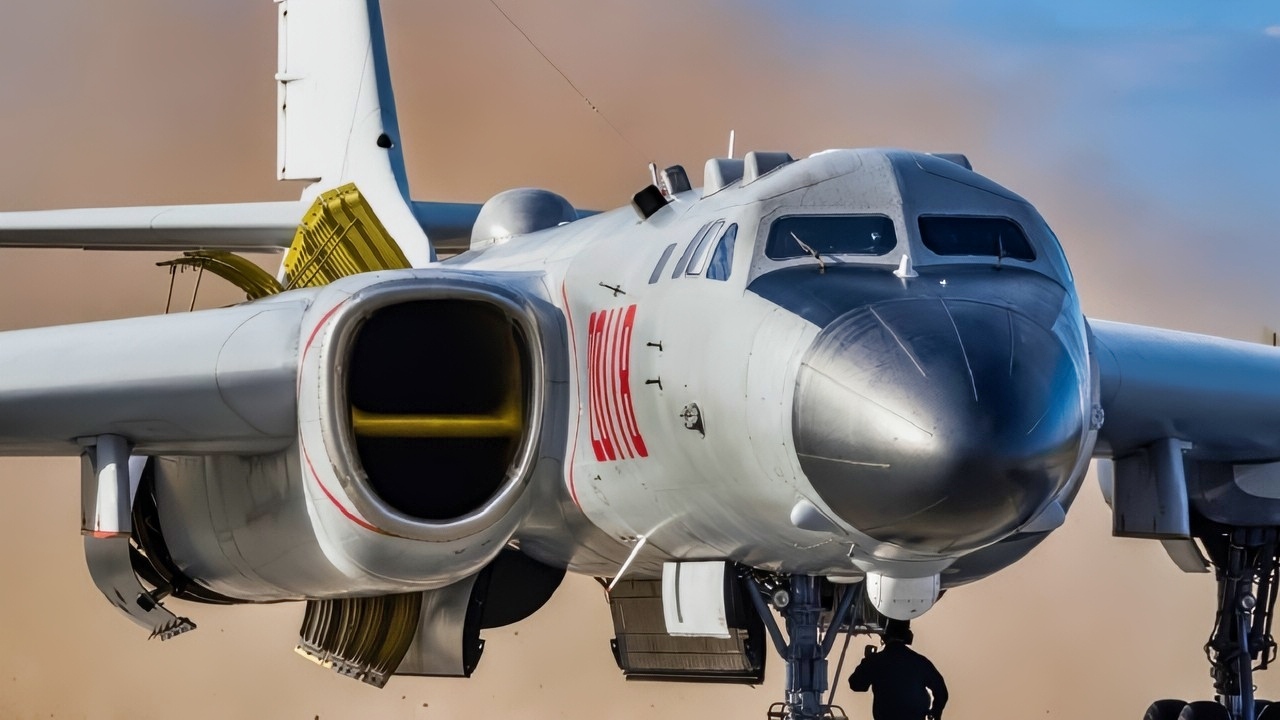
The H-6 Bomber in One Word: New. That is not a typo, and it is not a joke about relative ages.
The H-6 descends from the Tupolev Tu-16, which first flew in April 1952. But China stopped building H-6s in the early 1990s, when the design was plainly obsolete, and then restarted the production line around 2006. The bulk of the modern force, the K and N models that make up China’s front-line bomber strength, was built after that restart. The outline is seventy years old. The airframes under it are not, the engines are not, the cockpits are not, and the weapons hanging beneath the wings did not exist when the last Cold War H-6 rolled out.

PLAAF Xian H-6M makes a turn over central Changzhou.
That is the part most coverage misses. The H-6 is not an old aircraft that China keeps flying. It is a new aircraft that China keeps building in an old shape.
How It Got Here
The Soviet Union delivered Tu-16s to China in 1958 and licensed local production. The first Chinese-assembled example flew in 1959, and the first fully domestic one followed in 1968, by which point the Sino-Soviet relationship had collapsed, and China was on its own. Early H-6s did the job bombers did then: the H-6A dropped live nuclear weapons during nine of China’s nuclear tests.
Then the world moved. By the 1980s, a subsonic aircraft with a bomb bay and tail guns could not survive over a defended target, and China knew it. The H-6 stopped being a credible nuclear bomber long before it stopped flying, and the production line shut down.
What changed was not the aircraft. It was the arithmetic of standoff weapons.
The Pivot
If a missile can fly a thousand kilometers on its own, the aircraft carrying it never has to approach the target at all. It only has to reach a launch point, release, and turn for home. That requirement does not demand stealth, or speed, or agility. It demands range, payload, and wings strong enough to hang things from.
A 1950s heavy bomber turns out to be very good at exactly that.
So the H-6K, the variant that dominates the fleet, is a substantially different aircraft wearing the same silhouette.
The old Chinese turbojets were replaced with Soloviev D-30 turbofans, the intakes enlarged, the glazed bombardier’s nose replaced by a solid radome, and the flight deck rebuilt with far fewer windows. Six pylons were added under the wings for long-range cruise missiles such as the CJ-20.
The tail guns went, replaced by electronic warfare equipment. In some variants, the internal bomb bay went too, because nothing needed to go in it. The Chinese designation for the K, fittingly, translates as an air-striking platform rather than a bomber.
The Family It Became
From there, the type splits into specialists. The H-6J went to naval aviation, hardened against salt air and armed with the YJ-12 family of supersonic anti-ship missiles, weapons fast enough and numerous enough to stress a carrier group’s defenses.
The H-6N is the one that changed China’s strategic position. It carries an in-flight refueling probe and a semi-recessed hardpoint under the fuselage sized for a single very large air-launched ballistic missile, and the Pentagon’s annual reporting has assessed that the weapon may be nuclear capable. Analysts at the China Aerospace Studies Institute noted satellite imagery showing a Henan airfield upgraded to support H-6Ns in a nuclear role.
When the H-6N appeared at the 2019 National Day parade, it gave China something it had never actually possessed: a working air leg, which is to say a completed nuclear triad.
A 1952 design carried China into the same strategic club as Washington and Moscow, seventy years later, because someone bolted a ballistic missile to its belly.
Why It Still Matters
Today, the PLAAF and naval aviation fly on the order of 120 modernized H-6s, roughly 110 of them K models with a dozen or more Ns, organized across multiple bomber regiments, with a combat radius beyond 1,000 miles before refueling and before the missiles add their own reach. Only three countries operate long-range bombers at all, and China’s are the youngest of the three fleets by build date.
That is the context in which the endlessly delayed H-20 stealth bomber should be read. China has spent a decade failing to produce a penetrating bomber, and it has mattered less than it should, because the H-6 does not need to penetrate anything. It is a truck that carries the weapons that do the penetrating, and China can build more of them whenever it wants, from a line that has been running, on and off, since Eisenhower was president.
Which is why the honest one-word description of this bomber is not ancient. Everyone who matters was built in this century.
About the Author: Harry J. Kazianis
Harry J. Kazianis (@Grecianformula) was the former Senior Director of National Security Affairs at the Center for the National Interest (CFTNI), a foreign policy think tank founded by Richard Nixon based in Washington, DC. Harry has over a decade of experience in think tanks and national security publishing. His ideas have been published in the NY Times, The Washington Post, The Wall Street Journal, CNN, and many other outlets worldwide. He has held positions at CSIS, the Heritage Foundation, the University of Nottingham, and several other institutions related to national security research and studies. He is the former Executive Editor of the National Interest and the Diplomat. He holds a Master’s degree focusing on international affairs from Harvard University.


