


PUBLISHED on August 11, 2025, 11:27 AM EDT – Key Points and Summary – In a hypothetical head-to-head matchup, China’s fifth-generation J-20 “Mighty Dragon” stealth fighter holds a decisive advantage over the U.S. Navy’s 4.5-generation F/A-18 Super Hornet.
-While the Super Hornet is combat-proven, more numerous, and has a 20mm cannon that the J-20 lacks, these strengths are negated by the J-20’s superior stealth, speed, and range.
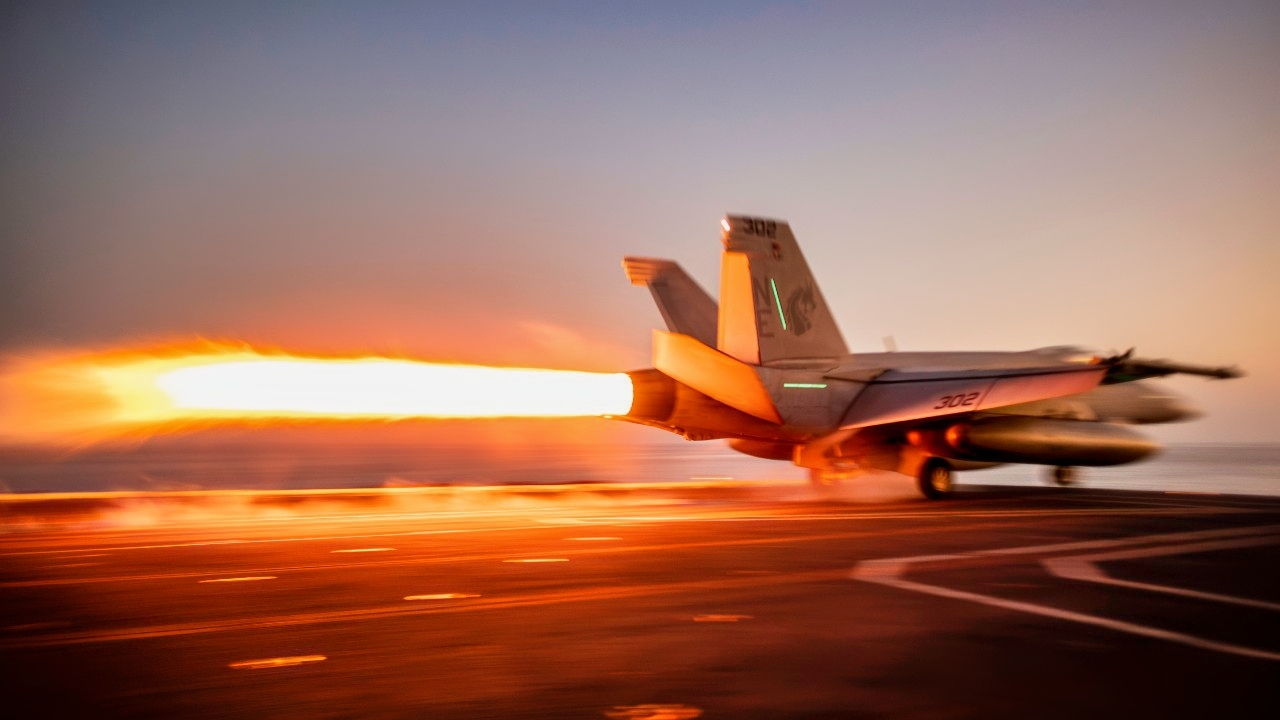
250429-N-FS097-1154 U.S. CENTRAL COMMAND AREA OF RESPONSIBILITY (April 28, 2025) An F/A-18E Super Hornet, attached to Strike Fighter Squadron (VFA) 192, launches from the flight deck of the Nimitz-class aircraft carrier USS Carl Vinson (CVN 70) in the U.S. Central Command area of responsibility. (Official U.S. Navy photo)
This “see-first, shoot-first” capability, a hallmark of fifth-generation design, would likely allow the Chinese jet to detect and engage the Super Hornet from beyond visual range, making it the clear winner in any realistic engagement.
Stealth Chinese J-20 vs. Super Hornet Fighter Dogfight: Who Wins?
With the People’s Republic of China’s endless acts of belligerence towards the United States of America’s allies in the Indo-Pacific region—particularly Taiwan, the Philippines, Japan, and Australia—there is a very real and very disturbing possibility that the region will serve as the flashpoint for World War III.
In case of such a worst-case scenario, many prognosticators examine the aerial component of such a conflict in terms of a stealth fighter vs. stealth fighter air war, i.e., the American F-22 and F-35 vs. the Chinese J-20 and J-35.
However, neither side has switched exclusively to 5th-generation stealth fighters, so if the war were hypothetically to break out tomorrow, there would inevitably be battles between 5th-generation fighter jets on the one side and 4th and 4.5-generation fighter jets on the other side.
Accordingly, National Security Journal now presents a theoretical head-to-head intergenerational warbird clash between the US-made Boeing F/A-18E/F Super Hornet and the PRC’s Chengdu J-20 Weilong (“Mighty Dragon;” NATO reporting name “Fagin”).
So then, who would win in a hypothetical clash between these two mighty warbirds?
J-20 Advantages
The most glaringly obvious advantage of the Chinese fighter is full-fledged stealth technology. As noted by Army Recognition, “The Chengdu J-20, also known as Mighty Dragon is a single-seat, twinjet, all-weather, stealth fifth-generation fighter aircraft developed by China’s Chengdu Aerospace Corporation for the People’s Liberation Army Air Force (PLAAF).”
In fairness, however, the latest & greatest iteration of the Super Hornet, the Block III, has been made somewhat stealthier and more survivable with additional treatments that reduce its radar cross section (RCS).
Indeed, Jen Tebo, Boeing’s vice president of F/A-18 and EA-18G projects, refers to the Super Hornet as “the risk-reducer and the bridge to get to Next Gen Air Dominance. [NGAD]” Nonetheless, the American warbird still has a comparatively larger RCS—thanks mainly to its external weapons stores—that’s easily detected from beyond visual range (BVR). In other words, the J-20’s pilots would be able to see first and strike first before the F/A-18’s crew dogs even know it’s there.
As the fighter pilot’s motto goes, “Speed is life.” The “Fagin” is the faster fighter, with a max airspeed of Mach 1.70 (1,305 mph, 2,100 km/h, 1.134 knots) vs. the 1.54 Mach (1,187 mph, 1,910 km/h, 1.031 knots) top speed of the Super Hornet. That speed advantage of the Weilong is made possible by its two Xian WS-15 afterburning turbofan engines that generate 27,500 lb. of thrust each with afterburner; the American plane’s two General Electric F414-GE-400 engines, though very capable in their own right, spool up a mere 22,000 lb. of thrust apiece in afterburner mode.
Moreover, the WS-15 engines give the Chinese stealth plane greater range—2,113 miles (3,400 km) vs. a paltry 680 miles (1.095 km)—and rate of climb—66,000 feet per minute vs. 44,890 feet per minute.
The Mighty Dragon is also the higher flyer, with a service ceiling of 59,055 feet (18,000 meters), which gives it a hypothetical ability to pounce from above upon the lower-flying J-35, whose service ceiling tops off at 52,000 feet (16,000 meters).
F/A-18E/F Super Hornet Advantages
Armament-wise, the American plane has a distinct advantage: a gun. The F/A-18 wields a 20 mm (0.787 in) General Dynamics M61A1 Vulcan 6-barreled Gatling cannon along with 412 rounds of ammunition, whilst the J-20 (just like the Shenyang J-35) omits a cannon altogether; so much for the philosophy of “Better to have and not need than vice versa”. In other words, the so-called “Mighty Dragon” doesn’t breathe literal gunfire.
In addition to the technical aspects, there’s an intangible factor to consider: experience counts, as in real-world combat experience. The Super Hornet and its crews have been battle-tested in the deadly skies over Iraq, Syria, and Yemen alike, including an air-to-air kill against a Syrian Sukhoi Su-22 “Fitter” fighter-bomber back in June 2017 Meanwhile, the J-20 and its pilots are untested in combat (as is also true of the J-35), which is unsurprising when you remember that China hasn’t been in a major shooting war since the 1979 Sino-Vietnamese War.
The F/A-18 also benefits from being the less expensive warbird, at an estimated $70 million cost per unit, contrasted with the J-20’s whopping equivalent of $120 million (862.07 million Chinese Yuan/Renminbi). That in turn explains why at least 632 Super Hornet airframes have been built to date, contrasted with an estimated 200 J-20 specimens. As the one saying goes, “Quantity has a quality all [of] its own.”
In 4 Words: The J-20 Fighter Wins
Unfortunately, despite the F/A-18 Super Hornet’s many great attributes, I would still have to go with the J-20 in a one-on-one matchup due to its see-first, shoot-first capability, as well as speed, power, altitude, range, and rate of climb advantages.
The US Navy would need its own F-35C Lightning II stealth fighters to augment and back up the Super Hornets to be on truly equal footing with the J-20. (And it also underscored the sense of urgency to revive the 6th Generation F/A-XX program from its current borderline moribund status.)
About the Author: Christian D. Orr, Defense Expert
Christian D. Orr is a Senior Defense Editor. He is a former Air Force Security Forces officer, Federal law enforcement officer, and private military contractor (with assignments worked in Iraq, the United Arab Emirates, Kosovo, Japan, Germany, and the Pentagon). Chris holds a B.A. in International Relations from the University of Southern California (USC) and an M.A. in Intelligence Studies (concentration in Terrorism Studies) from American Military University (AMU).
Defense Watch
F/A-XX Is the YF-23 on a Carrier?


