

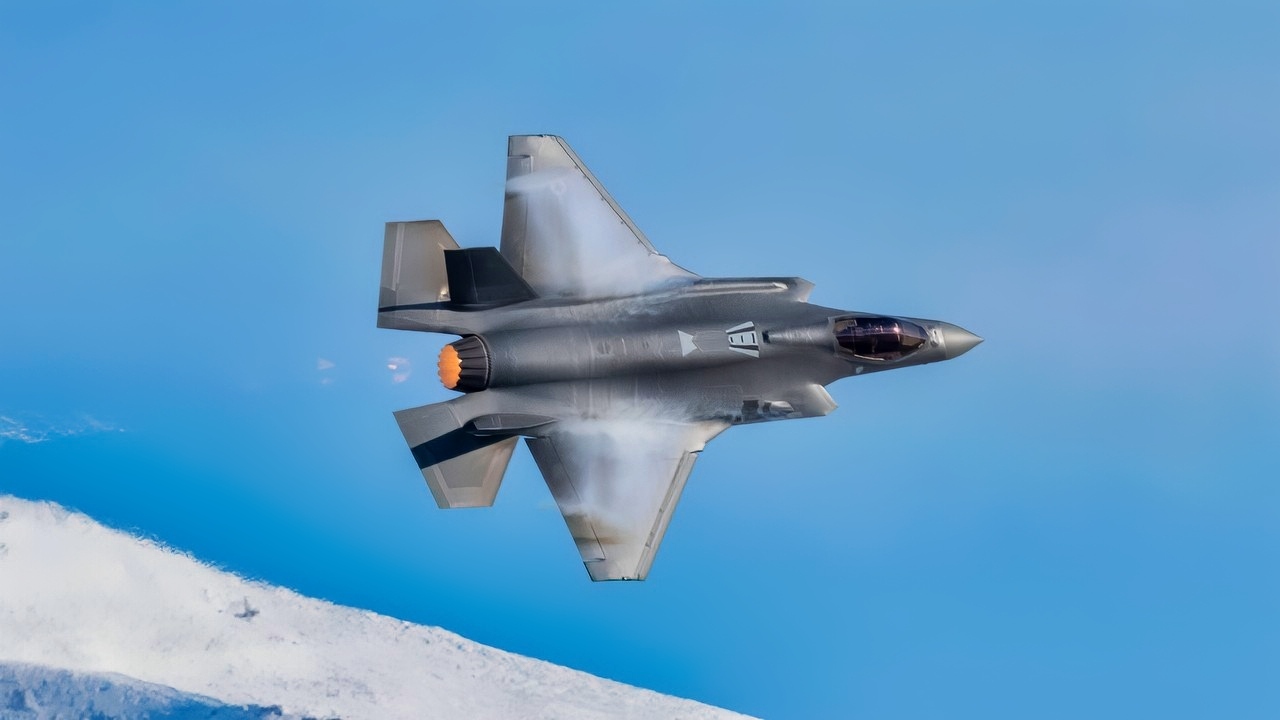
Key Points and Summary – In a head-to-head comparison, China’s J-20 “Mighty Dragon” boasts several on-paper advantages over the American F-35, including greater speed, range, and payload.
-However, the F-35 holds the edge in the areas that truly matter: superior stealth and far more sophisticated and integrated avionics and sensor systems.
-The most decisive factor is the “intangibles”: the F-35 stealth fighter is a combat-proven platform flown by battle-hardened pilots from a long legacy of air combat dominance, whereas the J-20 has never seen a single day of combat in its short career.
J-20 vs. F-35: Which is the Better Stealth Fighter?
The Cold War was more than a battle of political ideologies and economic systems. It was also a battle for technological superiority and bragging rights. Competition ranged from the space race to the effort to field the best submarines and main battle tanks.
In the skies, deadly clashes pitted the F86 Sabre against the MiG-15 “Fagot” during the Korean War; the F-4 Phantom II against the MiG-21 “Fishbed” during the Vietnam War; and the F-15 Eagle versus the MiG-29 “Fulcrum” during the 1991 Persian Gulf War.
The New Cold War that we find ourselves in has brought a third major player to the jet fighter game: the People’s Republic of China. During the original Cold War, Beijing imported Soviet-made fighters or produced license-built versions of the same. But now China builds plenty of homegrown warbirds. Their efforts are exemplified by the Chengdu J-20 Mighty Dragon, an aircraft that gave China, and not Russia, bragging rights as the second country to field an operational fifth-generation stealth fighter jet.
In any future U.S.-China conflict, the J-20 would go head-to-head with two U.S. stealth fighters, and the National Security Journal is comparing the J-20 to both.
In this second installment of the series (Part I here), we compare the J-20 to the F-35 Lightning II.
J-20 Advantages
According to an August 2023 article for Defence Street, the Chinese warplane has the following advantages over its American-made counterpart:
-It has longer range than the F-35 and can stay in the air for a longer period of time, making it more suitable for long-range missions.
– Its heavier weapons payload capacity equips it better for missions that require a large amount of firepower.
-The J-20 is significantly less expensive than the Lightning II.
-It has a greater maximum speed.
F-35 Lightning II Advantages
The F-35 has a number of qualities of its own, including:
-Superior stealth due to its smaller radar cross-section.
-Better thrust-to-weight ratio, which translates to superior acceleration and maneuverability.
-More integrated and sophisticated avionics and sensor systems.
Beyond the specifications, the F-35 has been in production for over a decade and is already in service with several countries.
This gives it a significant interoperability advantage over the newer J-20, which has not been exported.
The Mighty Dragon’s lack of a cannon makes the J-20 unique among operational stealth fighters. The F-35’s blaster is a single 25-mm General Dynamics GAU-22/A four-barrel Gatling gun with 180 rounds of ammo.
While some pundits opine that supersonic jet fighters do not need guns, aircraft-mounted cannons have proved their usefulness against adversaries’ unmanned aerial weapon systems in modern combat. And a fighter plane could still use its gun in the air-to-ground role, such as strafing enemy troop formations while performing close air support duties.
The F-35 has that sort of versatility, while the J-20 inherently lacks it.
In 4 Words: Experience Makes F-22 Winner
The real-world experience of the intrepid men and women who fly these war machines is important. Unlike the F-22, the F-35, and the Russian Su-57, the Chinese warbird has never seen combat. This is not surprising, since China has not been in a major war since its 1979 invasion of Vietnam.
By contrast, the F-35 received its baptism of fire in the highly capable hands of the Israeli Air Force.
The F-35I Adir made its combat debut hitting Hezbollah-associated targets in Lebanon in May 2018. The U.S. Marine Corps, Air Force, and Navy (in that order) would soon follow suit, adding to the F-35’s combat record with their F-35B, F-35A, and F-35C variants, respectively.
That experience differential undoubtedly carries over to the quality of training. While the People’s Liberation Army Air Force puts its fighter pilots through an intensive training regime – as evidenced by their shows of force in the Taiwan Strait – their senior pilots lack any combat experience to pass on to new trainees.
By contrast, U.S. Air Force pilots and naval aviators have seen combat in every decade going back to the 1940s, creating a huge combat history database that inspires constant improvement and refinements in tools, tactics, and training, as exemplified by the U.S. Air Force Weapons School and the real-life version of “TOPGUN,” the U.S. Navy Strike Fighter Tactics Instructor program.
That translates to a talent pool of instructor pilots who have actually “seen the elephant” and can pass that battle-born wisdom to the next generation of fighter jocks.
What’s more, the Lightning II has history on its side. Its manufacturer, Lockheed Martin’s legendary Skunk Works division, has an 80-year track record of producing innovative warplanes, including the P-38 Lightning, the F-80 Shooting Star, the U-2, the SR-71 Blackbird, and the F-117 Nighthawk (the first so-called stealth fighter, although it wasn’t a fighter at all).
By contrast, Chengdu Aircraft Corporation, while a venerable company that was founded in 1958, does not boast a similar litany of history-making military aircraft.
Those intangibles give the Lightning II a huge advantage over the J-20.
About the Author: Christian D. Orr, Defense Expert
Christian D. Orr is a Senior Defense Editor. He is a former Air Force Security Forces officer, Federal law enforcement officer, and private military contractor (with assignments worked in Iraq, the United Arab Emirates, Kosovo, Japan, Germany, and the Pentagon). Chris holds a B.A. in International Relations from the University of Southern California (USC) and an M.A. in Intelligence Studies (concentration in Terrorism Studies) from American Military University (AMU).
Hypersonic Weapons In-Depth
Russia’s Hypersonic Missiles Summed Up in 4 Words


