


Summary and Key Points: China’s H-20 is expected to be its first true strategic stealth bomber—a flying-wing, low-observable aircraft designed for long-range nuclear and conventional strike.
-If fielded as envisioned, it would give Beijing a survivable air leg for a complete nuclear triad and a penetrating option beyond today’s non-stealth H-6 variants.
-Open-source estimates suggest a large internal payload, subsonic speed, and a reach that could threaten U.S. bases and naval forces across the Indo-Pacific—potentially extending to Hawaii with the right basing and tanker support.
-The strategic effect is less about speed and more about stealth, range, and the new dilemmas it creates for U.S. basing, carrier operations, and deterrence stability.
In 2 Words: Game changer?
Forget the H-6: The H-20 Is China’s First True Stealth Bomber and a Triad Game-Changer
Today, only two countries on Earth operate a strategic bomber—the US and Russia. But China, currently developing the H-20, is likely to be the third.
The H-20 would be China’s first true strategic stealth bomber, a product of the Xi’an Aircraft Industrial Corporation.
Intended to give the PLA Air Force a long-range, penetrating strike capability (comparable to the B-2 Spirit, or forthcoming B-21 Raider), the H-20 symbolizes China’s transition from a regional power to a true global player.
Much remains classified about the H-20 program—with most information coming from satellite imagery, model reveals, controlled leaks, etc.—but what’s clear is that the design will give China a complete nuclear triad.

H-20 Bomber from China. Image Credit: Creative Commons.
H-20 Bomber Questions: What is Known?
What is currently known, or credibly reported, about the H-20 is limited.
The aircraft is believed to be a flying-wing, low-observable design—very similar in appearance and concept to the B-2 and B-21. The expected mission will include long-range nuclear and conventional strike, including deep-penetration missions against US bases and naval assets. The emphasis will be on stealth, range, and large internal payload—not speed.
The technical specifications are confidential, but open-source assessments suggest the following: potentially intercontinental range, in excess of 10,000 kilometers; a combat radius of 5,000 kilometers; subsonic speed; 20-meters length; 45-meter wingspan; possibly four engines, likely indigenous; an internal payload, with estimates ranging from 20 to 45 tons.
The H-20 is expected to carry nuclear gravity bombs, air-launched cruise missiles, hypersonic weapons, and anti-ship strike payloads.
The crux of the design will be low observability, namely a blended flying-wing structure, buried engine intakes, serrated engine nozzles or cooled exhaust channels, radar-absorbent material coatings, and internal weapons bays only.
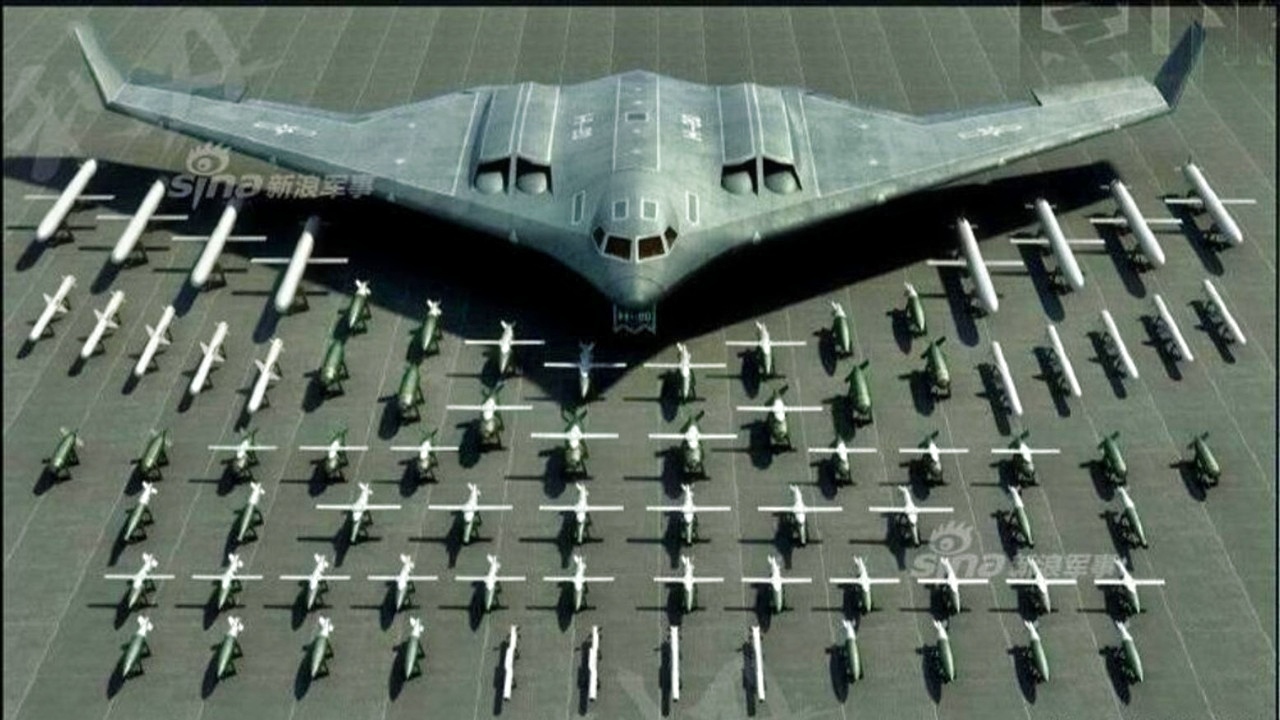
H-20 Bomber. Chinese Internet Social Media Screenshot.
Again, the H-20 will be roughly analogous to the B-21, though less advanced in sensor fusion and LO materials.
Operational Applications
China currently relies on the H-6K/N bomber—an upgraded version of a 1950s design. The non-stealth H-6 variants have long range but no penetration capability against modern air defenses, meaning their application is limited against a near-peer like the US.
The H-20 potentially solves this limitation, however, giving China a survivable first-strike or second-strike nuclear option; deep-strike capability against US regional bases; and the ability to threaten US assets farther than the First and Second Island Chains.
The H-20 will be used for a variety of missions. Penetrating strike, for example, where the aircraft will enter heavily defended airspace (Guam, Okinawa, Korea, Australia) to strike hardened targets. Standoff missile attacks, where the aircraft will be used to launch cruise missiles and hypersonic weapons from outside defended zones.
Maritime strike, in support of anti-carrier operations, delivering long-range anti-ship cruise missiles.
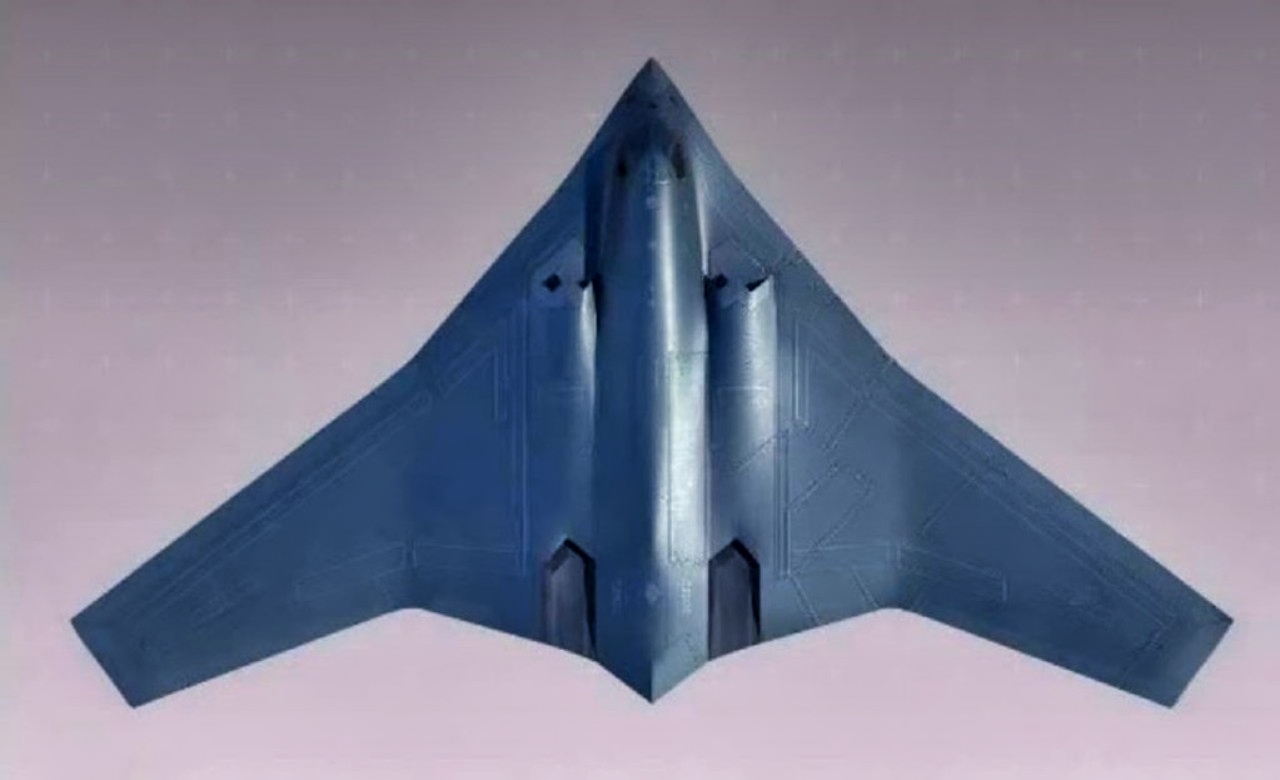
H-20 Bomber from China Artist Rendition. Creative Commons.
Logistics disruption—targeting fuel depots, runways, ports, and command centers.
And of course, nuclear deterrence, the H-20’s survivable airborne component, ensures China’s second-strike credibility.
The Air Force Is Watching
For the US, the strategic implications of the H-20’s arrival could be profound.
The bomber expands China’s strategic reach, allowing it to project power across the Indo-Pacific, perhaps as far as Hawaii, and refuel from the US West Coast. The
US basing strategy will be complicated, as US forces at Guam, Darwin, Japan, and the Philippines will have to account for stealth-bomber threats.
Carrier groups will be challenged as stealth bombers equipped with long-range anti-ship missiles introduce a new vector of vulnerability for carrier strike groups.
Nuclear stability will be affected, too, as an air leg of China’s triad improves survivability and flexibility, offering symmetry with US and Russian doctrines.
China’s A2/AD network will be enhanced, with the H-20 adding a new attack layer.

China’s H-20 Stealth Bomber. Image Credit: Creative Commons.
And with tanker support, the H-20 could give China a truly global presence, enabling missions in the Indian Ocean, the Middle East, or Africa.
From an industrial perspective, the bomber represents something of a coming-out party. The project demonstrates China’s capacity to design large-scale stealth airframes and shows maturation in Chinese aerospace modeling, composite manufacturing, and radar-absorbent materials.
The H-20 serves to boost China’s prestige, signaling parity ambitions with the US.
The H-20 has still not yet been revealed publicly—that will likely come within the next few years.
But full force integration could take years, as stealth bombers are technologically complex.
About the Author: Harrison Kass
Harrison Kass is an attorney and journalist covering national security, technology, and politics. Previously, he was a political staffer, candidate, and a US Air Force pilot select. He holds a JD from the University of Oregon and a master’s in global journalism and international relations from NYU.


Bohica
February 10, 2026 at 5:36 am
I can sum it up in two words as well.
Lawsuit Pending. 🤣😂🤣😂
Jeff.
February 10, 2026 at 7:21 am
Thank the Clinton’s for handing China the blueprints.. Democrats seek and destroy in exchange for notoriety and MONEY.
Mo Rosa
February 10, 2026 at 8:14 am
Its easy to take designs & build & assembly techniques from true innovation from America , and Spend trillions in mimicking it..the fact is , its all copied tech , and they will have major failures during all exercises because everything made in China is cheap & poorly constructed.
Kevin Moran
February 10, 2026 at 8:53 am
Trash
Jay Howell
February 10, 2026 at 10:02 am
So what aew the two words?
Jay Howell
February 10, 2026 at 10:03 am
So what are the two words?
Pete Gobershitzki
February 10, 2026 at 10:54 am
Paper Tiger
Ruppert Baird
February 10, 2026 at 10:55 am
As Jay said: “What are the two words?”
Bu!1 $h17?
Rip off?
Wishful thinking?
Corporate espionage?
Cheap knock-off?
Psychological Operation?
We would really like to know.
Ariel Cantal
February 10, 2026 at 10:58 am
The two words i guess is tofu dreg
Tom Barquist
February 10, 2026 at 11:09 am
3 words. Made in China !
Galen Clark
February 15, 2026 at 2:10 pm
Exactly! Typical Chinese P.O.S. Junk….
MARK
February 10, 2026 at 11:17 am
The article is likely B.S.
None of the pictures match.the overhead one is obviously A.I.
PC
February 10, 2026 at 12:47 pm
No doubt American design and technology. But, wait, that can’t be. Who in their right mind would do that? Oh, that’s right we had a president who wasn’t in his right mind.
Christopher Nishimura
February 10, 2026 at 1:12 pm
Tell china makeup there own designs instead of copying us..
Vick
February 10, 2026 at 2:37 pm
Garbage in garbage out. We have seen the display in Venezuela pakistan Cambodia Thailand Iran.
Neil Richardet
February 10, 2026 at 2:57 pm
If the USA is continuing to develop the F35 for the last 20 years , how close is China to develop theirs ?
Sparkitus Maximus
February 10, 2026 at 3:02 pm
Chinese paper kites.
Phillip james Kalaveras
February 10, 2026 at 3:40 pm
China Russia and the USA should team up and call themselves CHRUSA. Are Combined strength would allow us to disarm the entire planet
Timothy Storer
February 10, 2026 at 4:18 pm
What a joke nothing is going to happen what ever weapons each country has it would of happened by now its only happened to what use to be third world counties for a reason they couldn’t retaliate, in short no real threat it is about control and taking resouces
Mamadou Lamine Diop
February 10, 2026 at 4:20 pm
Still waiting for those two words!
Ethan White
February 10, 2026 at 4:39 pm
All China does is cheat and steal. When I was on college they did it all of the time during tests. The Professors would do nothing because of how much they paid to go there.
Larry Prchival
February 10, 2026 at 4:41 pm
I think its survivability in combat could be the chink in the armor of this Chinese plane.
Loucifus
February 10, 2026 at 4:56 pm
Artificial Inteligence! No sabre rattling via back door after the strategic fail of Russian, Chinese and Cuban defense forces protecting the removal of the Maduro narco regime!!! Xi is not the king of the North!!!
Joe
February 10, 2026 at 5:12 pm
Copy cat. ThankFJB
Dale E Francis
February 10, 2026 at 5:57 pm
Copy Cats are the two words. They have stolen not only from the USA but from The USSR and others. They can’t make anything on their own that is worth anything. That’s why everything you get from China is short lived
Eric E Bibbs
February 10, 2026 at 7:50 pm
Here are the two words for you. Stolen Technology.
Stephen Jones
February 10, 2026 at 7:57 pm
So what are the two words? Obviously a waste of a read!!
Ra
February 10, 2026 at 8:24 pm
two Word pure Junk
It’s like they taking everything duplicate with tin foil and America take decades to perfect.
Bob
February 10, 2026 at 9:57 pm
Summed up in 2 words: Artist rendering
Defly
February 10, 2026 at 11:02 pm
Copy Cat
M
February 10, 2026 at 11:46 pm
I echo the remarks on copied tech. There’s no true innovation. But, how are they always getting our IP? Nasty traitors and too much fluidity with foreign nationals integrated in our schools and tech sector.
Mike
February 11, 2026 at 12:06 am
Are the two words in the room with us right now?
Mike
February 11, 2026 at 12:08 am
Oh, “Game changer”. I found it between the 37th and 38th ads.
Jon Seetal
February 11, 2026 at 1:22 am
Click bait
Alexis Nouvel
February 11, 2026 at 1:48 am
Read it again, he says game changer, which is bull
Alexis Nouvel
February 11, 2026 at 1:50 am
Game changer??? Loooolllllll a copy paste of the B2 (NOT EVEN THE B21) with what they THINK is all the secrets they know. Expectations? Temu
John
February 11, 2026 at 5:04 am
I can sum it in 4 words:
Don’t mess with China
Arnold F Patterson
February 11, 2026 at 10:50 am
It’s one thing to steal the technology but it is another to implement it. I predict there will only be a dozen or so H-20s built and it will take everything the PLA has to keep them flying. And even then it ultimately fail, but China can’t or won’t admit is junk so they’ll be forced to keep it as a weapons platform for the next 20-30 years.
Steven F
February 15, 2026 at 12:52 pm
I’m always late to these articles: I guess it’s what I get for not spending all day on the internet. But, as someone who takes the meteoric rise of the Chinese threat very seriously, I gotta say: I’m not too particularly worried about this bomber. One of the most difficult – and often overlooked by the masses – aspect of designing advanced airframes is building engines that not only produce enough power and energy to support its systems while simultaneously flying the thing, but that does so reliably and, instrumentally important for a large stealth bomber, without producing excessive heat. China has always struggled with their engines. They claim to be making advances, thanks to stealing our trade secrets, but designing a large stealth bomber is a whole another ball game. It needs four engines because they struggle to produce the powerful engines built in the West. There is no reason to believe they will be able to solve the trailing heat dilemma. And stealth alone is rapidly becoming obsolete. Heat management is instrumental to Stealth++. Because the rapid breakthroughs happening in photonic satellites, which can detect even minor heat differences in between sub-meter areas, means if your system is even putting out a little heat, it’ll throw up red flags. These satellites are even powerful enough to visually detect the materials within in a sub meter area. Paired with an Artificial Intelligence, which constantly monitors the air space around sensitive sites for heat discrepancies and visually checks the source when detected, means your stealth system is only going to truly be a stealth system if those four engines aren’t expending heat too noticeably different from the ambient air around them. We’ve been working on our stealth and heat management for 50+ years now. China has been at it, for what, maybe twenty? If that? You can steal all the IP you want, but actually putting it to use is a whole another thing. It’s not just designs that are tricky, that’s only half of it. Machining it and actually putting it together in working order is the other half of the battle. And for the person saying it’s all saber rattling and no major war will ever happen: you are deluding yourself. When two immovable objects are destined for collision, it only ends one way: with one of them breaking. The ONLY reason major war never broke out with Soviet Russia is because we got them to bankrupt themselves. That’s not going to happen with China. Eventual war between the two powers is almost an inevitable fact of life. It is truly only a matter of time. I’d love to be wrong. But I don’t think I am. You can’t have two equal powers pulling at opposite ends eternally. Eventually, one will unseat the other. That typically only happens via war. That’s just human nature. This is why China is trying its best to unseat the US dollar from the global order. They’re trying to bankrupt us to avoid said war. Its also why they’re trying their best to fan the divisional flames in our country, to incite civil war so we destroy ourselves. Sadly, this strategy seems to actually be somewhat working.
Toadhall
February 15, 2026 at 1:42 pm
By TEMU
B
February 15, 2026 at 2:06 pm
Let me try, 2 words, bad copy, piece-o junk, lowered expectations, false hope, poor knockoff, wishful thinking, no imagination, sad commy, etc..
Hellbender
February 16, 2026 at 8:36 am
copy cat
Rick Denson
February 16, 2026 at 10:08 pm
Until it’s battlefield tested in actual combat or dangerous tactical missions surviving enemy defenses it’s just another copycat bird that China stole technology that it doesn’t have and filled in the blanks during its build. Go head to head with the US or NATO and see how long they survive? Wanna place bets anyone?