

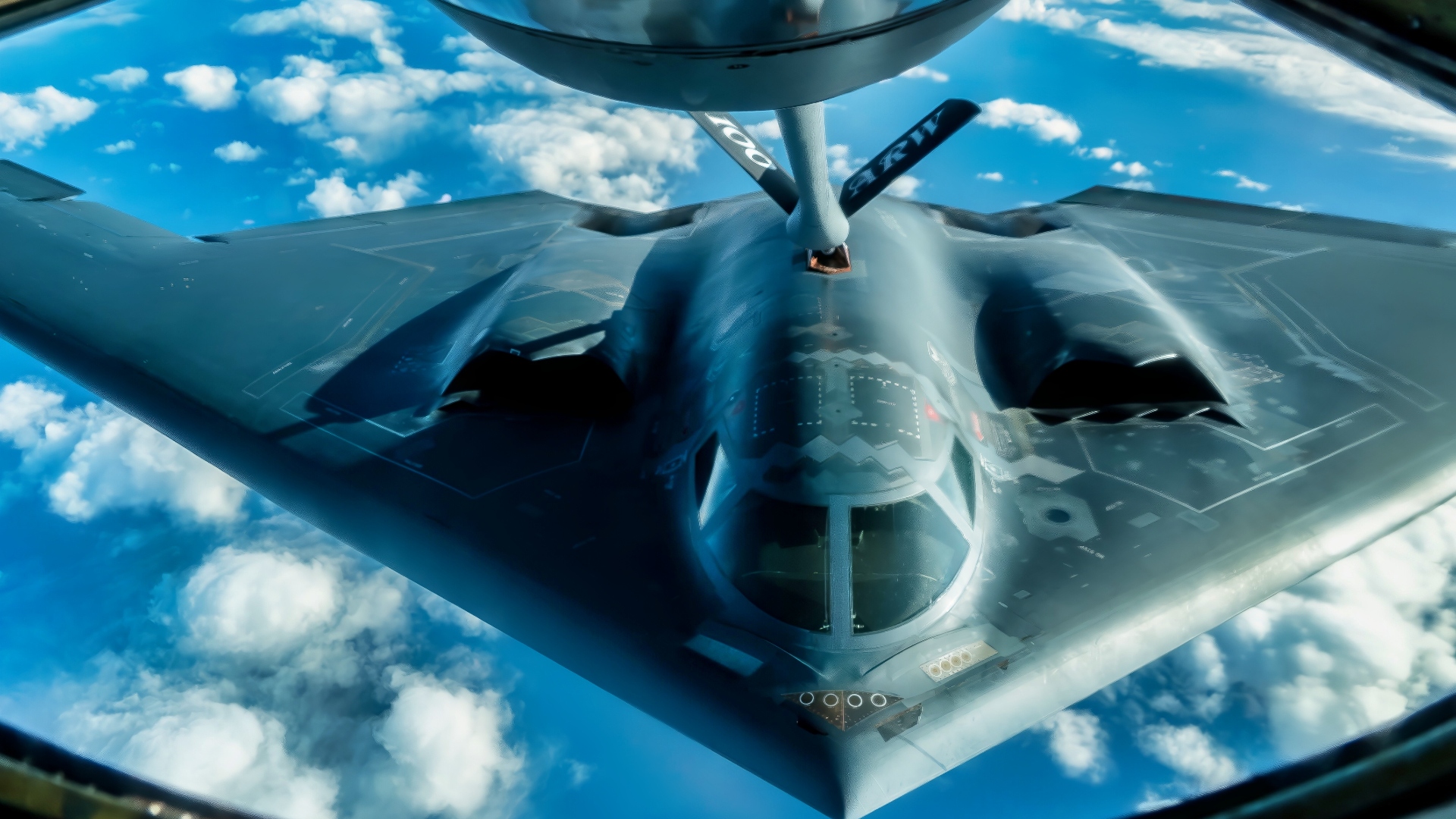
Key Points and Summary – Northrop’s B-2 Spirit is the world’s first operational stealth bomber, combat-proven since 1997 with ~6,000-nm unrefueled reach, internal bays, and ~18-ton payload.
-China’s Xi’an H-20 aims to mirror the flying-wing concept but remains unfielded and largely unseen; open-source estimates claim 8,500–15,000 km range and up to 45-ton payload, possibly carrying long-range cruise or hypersonic weapons. For now, the B-2’s edge is reality—tested stealth, upgrades, and documented missions.

China’s H-20 Stealth Bomber. Image Credit: Creative Commons.
-The H-20’s advantages are theoretical and hinge on final design, engines, materials, and signatures. If China fields it in numbers, H-20 could complicate Indo-Pacific planning; until then, B-2 remains the benchmark.
H-20 vs. B-20: Who Wins?
The Northrop B-2 Spirit was the first stealth bomber designed by the United States. It incorporated advanced stealth technology, which made it incredibly difficult for enemy air defense systems to detect.
The U.S. has so far been the only nation in the world to develop and field stealth bombers and has possessed a stealth monopoly for several decades.
However, other countries are now attempting to create their own stealth bombers in hopes of matching the U.S. China has been working on its own stealth bomber, the Xi’an H-20.
Very little is currently known about this new bomber, but experts expect it to mirror or even surpass the H-20 in some areas.
In that spirit (no pun intended), let us compare what we know to get a sense of who will eventually have the better stealth bomber in the future, avoiding any talk about the B-21 Raider for the moment.
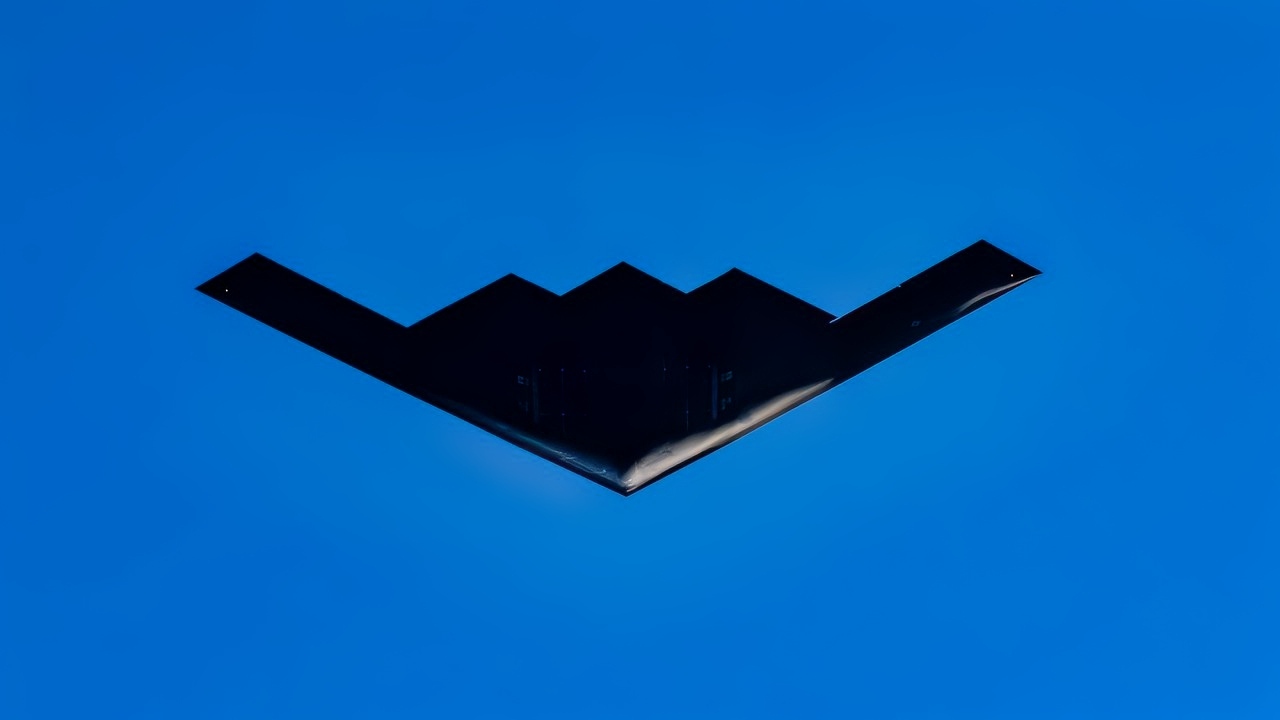
The B-2 Spirit flies over the Rose Parade at Pasadena Ca., Jan. 1, 2024. The Rose Parade is a parade of flower covered floats, marching band, and equestrian units that is produced by the Tournament of Roses. (U.S. Air Force photo by Airman 1st Class Bryce Moore)
Battle of the Stealth Bombers: Meet the B-2
The B-2 Spirit is a strategic stealth bomber developed by the United States and has been operational since 1997.
Built by Northrop Grumman, it was designed during the Cold War to penetrate sophisticated Soviet air defenses and deliver nuclear payloads. Its flying wing design is iconic and highly effective at minimizing radar cross-section.
The aircraft lacks vertical stabilizers, relying instead on advanced flight control systems to maintain stability. It incorporates radar-absorbent materials and internal weapon bays to preserve its stealth profile.
With a crew of two, the B-2 can fly at altitudes up to 50,000 feet and has an unrefueled range of approximately 6,000 nautical miles, which can be extended to over 10,000 nautical miles with aerial refueling.
The bomber has a payload capacity of up to 18 tonnes and has seen combat in multiple theaters including Kosovo, Iraq, Afghanistan, Libya, Yemen, and Iran.
Meet the H-20
In contrast, the Xi’an H-20 is China’s answer to the B-2, though it remains under development and is not yet operational. The H-20 is being developed by Xi’an Aircraft Industrial Corporation and is expected to enter service sometime in the 2030s. Like the B-2, the H-20 is believed to feature a flying wing design, although there is no evidence aside from some unofficial models and artist renditions.
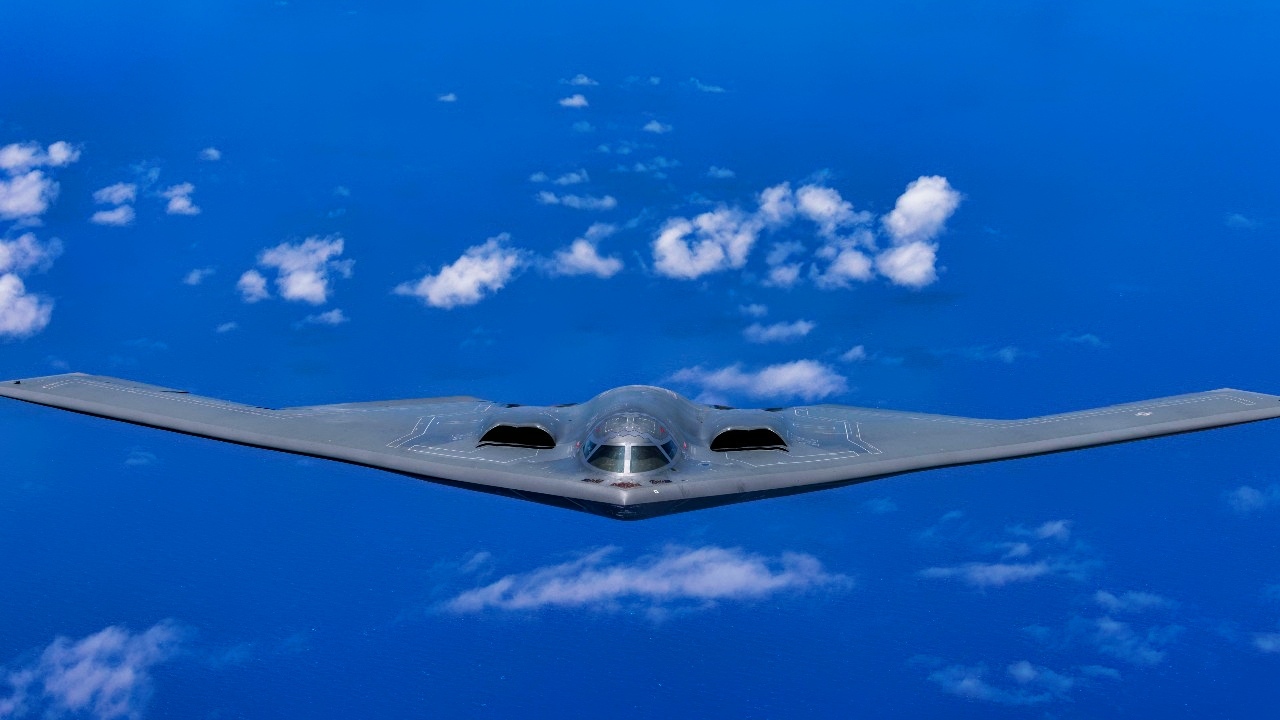
A U.S. Air Force B-2 Spirit bomber flies over the North Pacific Ocean, June 13, 2024. The speed, flexibility, and readiness of the Air Force’s strategic bombers plays a critical role in deterring potential adversaries and signaling unwavering support to allies and partners. Counter-maritime missions provide valuable training opportunities to improve interoperability and demonstrate that Air Force forces are capable of operating anywhere, anytime, to meet any challenge decisively. (U.S. Marine Corps photo by Sgt. Jose Angeles)
The H-20 is intended to be a strategic stealth bomber capable of delivering both conventional and nuclear payloads. Its estimated range is between 8,500 and 15,000 kilometers, which would allow it to strike targets well beyond the Second Island Chain, including U.S. bases in Guam and potentially Hawaii. Payload estimates vary, but some sources suggest it could carry between 10 and 45 tonnes of ordnance, possibly including long-range cruise missiles like the CJ-20 and even hypersonic weapons.
H-20: Analyzing a Bomber That Doesn’t Yet Exist
When comparing these two bombers, the B-2 has one clear advantage over the H-20: the B-2 has actually been tested in real-life combat conditions.
The B-2 has been used in many operations in contested environments. Its stealth capabilities have been proven time and time again. Meanwhile, the H-20’s design has not even been publicly shown as of the writing of this article.
The bomber will likely possess formidable stealth capabilities, but as of yet, its capabilities are entirely theoretical. This is not necessarily a criticism of the bomber; rather, it is an admission that we have very little to work with at this point.
In terms of range, the H-20 could surpass the B-2 if it achieves its maximum projected endurance. The B-2 has a range of 6,900 miles (11,000 km), allowing it to take part in missions around the globe if needed.

(Dec. 9, 2019) This poster is designed to communicate the aircraft specifications of the B2 Spirit Stealth Bomber. The B2 bomber was introduced on Jan. 1, 1997 by the Northrop Corporation.
The H-20’s range, on the other hand, is entirely theoretical and depends on final design choices, fuel efficiency, and payload configuration. If China prioritizes range over payload, the H-20 might be able to reach targets across the Pacific without refueling, which would be a significant strategic capability.
Payload capacity is another area where the H-20 has an edge, on paper. The B-2 can carry up to 18 tonnes of weapons, including nuclear bombs and precision-guided munitions. It is capable of deploying standoff weapons while maintaining its stealth profile. The H-20 is rumored to carry up to 45 tonnes, which would make it one of the most heavily armed bombers in the world. However, these figures are speculative, and it remains to be seen whether the H-20 can maintain stealth while carrying such a large payload.
The H-20: What it Means for the U.S.
The B-2 Spirit is a mature platform that integrates stealth, long-range capability, and precision strike systems. It uses advanced avionics, fly-by-wire controls, and electronic warfare suites. Over the years, it has undergone numerous upgrades to maintain its edge.
The H-20, being a newer design, may incorporate more modern technologies, including broadband stealth and advanced sensors. However, without operational data, it is difficult to assess whether these systems will match or exceed the sophistication of the B-2.
The B-2 has played a central role in U.S. deterrence doctrine ever since its acceptance. It is capable of deep penetration missions against heavily defended targets and has been used in both nuclear and conventional roles.
Its ability to strike anywhere in the world from U.S. soil makes it a powerful symbol of American airpower. The H-20, on the other hand, is China’s chance to project power globally and challenge U.S. dominance in the Indo-Pacific. If deployed in significant numbers, the H-20 could shift the regional balance of power and complicate U.S. strategic planning.
About the Author: Isaac Seitz
Isaac Seitz, a Defense Columnist, graduated from Patrick Henry College’s Strategic Intelligence and National Security program. He has also studied Russian at Middlebury Language Schools and has worked as an intelligence Analyst in the private sector.
More Military
Russia’s ‘New’ Kirov-Class Battlecrusier Is Like a ‘Death Star’
The U.S. Military’s Big X-44 Manta Stealth Fighter ‘Mistake’ Still Stings
China’s New Fujian Aircraft Carrier Looks Close to Fully Operational
The Air Force Could Soon Have 32 Additional F-22 Combat Ready ‘Raptor’ Stealth Fighters
China’s J-20 Mighty Dragon vs. Russia’s Su-35 Flanker Fighter: Who Wins Summed Up in 4 Words


Jubal
September 21, 2025 at 10:29 am
When I was a kid I used clothes pins and a card to make my bike sound like a motorcycle. Maybe China could use clothes pins and cards on their H-20. If it ever gets built.
Bryce
September 21, 2025 at 9:36 pm
Once again China just proves they absolutely can not come up with an original idea themselves and let me guess it’s going to run like s**t like every else they have made over the last 20 years too.
Neo
September 21, 2025 at 11:30 pm
At the very moment when China already has two different models of sixth-generation fighter jets in test flights, the American people, true to form, sticks its head in the sand and calls it “humor.”
Anigo
September 22, 2025 at 9:02 am
What a joke. China’s 6th gen stealth fighter has the radar cross section of the new F18. That’s not good… They also uded footage from TGM to show off its prowess. Why do people write anything that might look serious about their crap? Our designs are also decades old. Imagine the stuff we are working on right now that we’ll finally see as the 8th gen whatever in 25 years.
Ghost_Tomahawk
September 22, 2025 at 5:39 pm
No one has stealth other than the US. Everyone either steals our tech and reverse engineers it OR has it sold to them like China when Clinton sold China stealth tech and ICBM tech in the 90s to get him re-elected.
Stealth is junk. The Bosnian conflict shot down 2 nighthawks and Israel had 3 F35s shot down in a weekend. Active radar clearly sees the planes and passive radar sees them too. It’s the locking that’s hard. Once you see the “basketball” that’s flying mach… it’s time to deploy your planes and get SAMs going. At 130+ million per plane.. losing 3 is almost 400 million in loses. That’s massive.
The US needs to shift AWAY from these wastes of resources and invest in proven upgraded 4th gen airframes drones and state of the art electronic warfare capabilities. Not ineffective modest ability slow “stealth” planes.
Only people stealth tricks are elected govts.