


Key Points and Summary – First seen over Chengdu in December 2024, the rumored J-36 shows a tailless diamond-double-delta planform, no verticals, and—most striking—a tri-jet layout with dual side inlets and a dorsal intake.
-The mission looks simple: Beat the West in a war for the Asia-Pacific region.
J-36 Fighter Artist Rendition from X Screenshot
-A wide, side-by-side cockpit implies a strike/“battle manager” role with EW and drone-teaming tasks.
-Reports cite internal bays for long-range AAMs and anti-ship weapons, revised RAM, and a new EOTS—consistent with all-aspect stealth and range.
-Several 2025 sightings suggest active testing, but much remains unconfirmed.
-Breakthrough or bluff, the J-36 signals China’s intent and a potential capability Western programs and planners can’t ignore.
China’s J-36 Revealed? The Tri-Jet “Sixth-Gen” Mystery Taking Shape
On December 26th, a new aircraft was spotted flying in the city of Chengdu. This aircraft featured a highly unconventional wing layout and a triple-engine powerplant. This first sighting stunned the West and ushered in endless speculation about what this aircraft might be and its specifications.
Unofficially designated the J-36, this aircraft is speculated to be a sixth-generation strike aircraft. Since its first public flight, the aircraft has been spotted multiple times, allowing analysts to view it from various angles.
Unfortunately, very little is currently known about this aircraft, so all the analysis on it is presently a compilation of what we can gather based on publicly available data.
The J-36’s Unusual Design
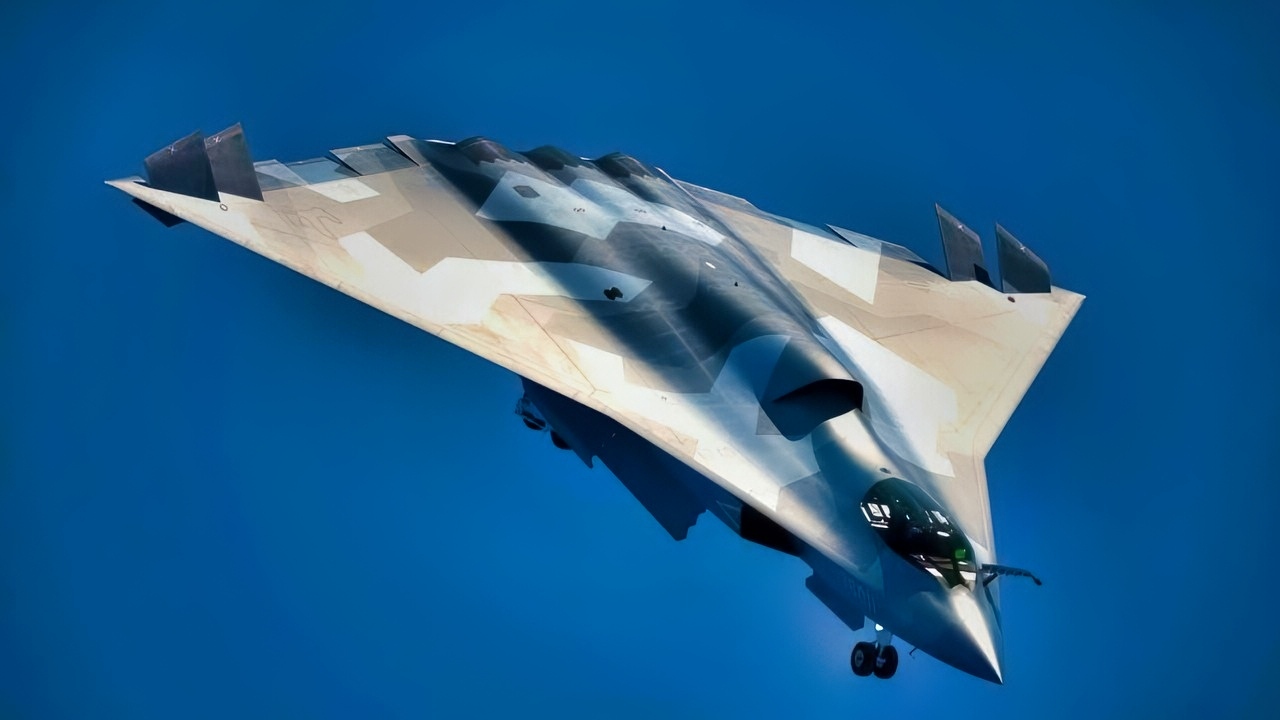
The J-36 features an unusual wing layout with a tailless diamond-doubled-delta wing configuration. This design eliminates vertical stabilizers, significantly reducing the radar cross-section and enhancing stealth.
The aircraft’s fuselage is blended seamlessly with its wings, creating a smooth, low-observable profile optimized for all-aspect stealth.

J-36 Fighter. Image Credit: Screenshot from X.
The absence of traditional tail surfaces is compensated for by sophisticated fly-by-wire systems and split ruddervons on the wings, allowing for precise control and maneuverability.
In terms of size, the J-36 is a large aircraft. It measures approximately 22.5 meters in length with a wingspan of 24 meters and a wing area of 248 square meters.
Its maximum takeoff weight is estimated at 55 tons, and it boasts a combat radius of around 3,000 kilometers. These dimensions suggest a platform capable of long-range missions and heavy payloads, positioning it as a versatile tool for both air superiority and strike operations.
The First Tri-Jet Stealth Fighter
Perhaps the most unique aspect of the J-36 is its trijet propulsion system. Unlike most modern fighters that rely on twin engines, the J-36 incorporates three engines, fed by two side-mounted caret intakes and a third dorsal intake. This configuration is highly unusual and indicates a focus on high thrust-to-weight ratio, supercruise capability, and redundancy.
It also suggests that the aircraft may be designed to generate sufficient power for future technologies such as directed energy weapons. The engines are advanced variants of the WS-10, WS-15, or possibly the newer WS-19, offering improved fuel efficiency and thrust.
On top of its already unusual design, the J-36 features a side-by-side double-seat cockpit, similar to the one found on the Russian Su-34 fighter-bomber.
This design indicates that the J-36 may take on the role of a strike aircraft, or a short-range bomber rather than a traditional fighter jet. Unfortunately, there are no official documents about the aircraft’s role in the broader Chinese military.

J-36 Fighter from China. Image Credit: Creative Commons.
Stealth is a central pillar of the J-36’s design philosophy. The aircraft incorporates radar-absorbing materials, flush-mounted sensors, internal weapons bays, and recessed exhausts to reduce infrared signature.
Its diverterless supersonic intakes (DSI) further contribute to its low observability. The shaping of the airframe is optimized to minimize radar returns from all angles, including side-looking airborne radar arrays and electro-optical targeting systems embedded in the fuselage.
What’s Inside China’s Newest Fighter?
The avionics suite of the J-36 is expected to be state-of-the-art. It likely includes an active electronically scanned array (AESA) radar, electro-optical targeting systems (EOTS), advanced electronic warfare capabilities, and sensor fusion technologies.
These systems will enable the aircraft to operate as a command-and-control node, coordinating unmanned systems and maintaining situational awareness in highly contested environments.
Real-time data links will allow the J-36 to integrate seamlessly into China’s broader networked warfare doctrine, supporting manned-unmanned teaming and multi-domain operations.
Arms
In terms of armament, the J-36 features three internal weapons bays: a central bay capable of housing long-range missiles such as the PL-17, and two side bays for smaller munitions. This internal carriage preserves the aircraft’s stealth profile while allowing it to carry a diverse array of weapons.
Expected armaments include the PL-15 and PL-17 air-to-air missiles, YJ-12 supersonic anti-ship missiles, and potentially hypersonic weapons. There is also speculation that the aircraft may be equipped with directed energy weapons in the future, although this remains unconfirmed.
Legitimate Threat or Strategic Misdirect?
The aircraft’s testing and flight status indicate rapid development. After its first public flight in December 2024, the J-36 underwent additional flights in March and throughout the spring of 2025.
These tests confirmed the presence of a side-by-side cockpit seating arrangement and revealed that a J-20S was used as a chase aircraft during early flights. While the J-36 remains in the prototype phase, the pace of testing suggests that China is accelerating its efforts to bring the plane into service.
The global implications of the J-36’s development, assuming the aircraft is real, are significant. It signals China’s growing technological maturity in stealth, avionics, and propulsion, and presents a direct challenge to Western air dominance.
The aircraft’s emergence could prompt rival programs to accelerate their timelines and influence defense procurement strategies worldwide. It also reflects a broader shift toward networked, multi-domain warfare, where information superiority and platform integration are as important as raw performance.
Some analysts have speculated that the J-36 might be nothing more than smoke and mirrors, a mockup aircraft intended to scare the West and trick them into wasting resources into countering a threat that does not yet exist. Unfortunately, as compelling as this theory is, the J-36 leaves us with a lot of questions and few answers.
It is clear that the J-36 is being intentionally showcased to the West, but there is no definitive proof that it is currently competent. Lest we risk underestimating our enemy, it would be wise to take the Chinese at their word on this one.
About the Author: Isaac Seitz
Isaac Seitz, a Defense Columnist, graduated from Patrick Henry College’s Strategic Intelligence and National Security program. He has also studied Russian at Middlebury Language Schools and has worked as an intelligence Analyst in the private sector.
More Military
China’s J-20S Is Double Trouble For a Reason
The F-35 Is the iPhone of Stealth Fighter Planes


