

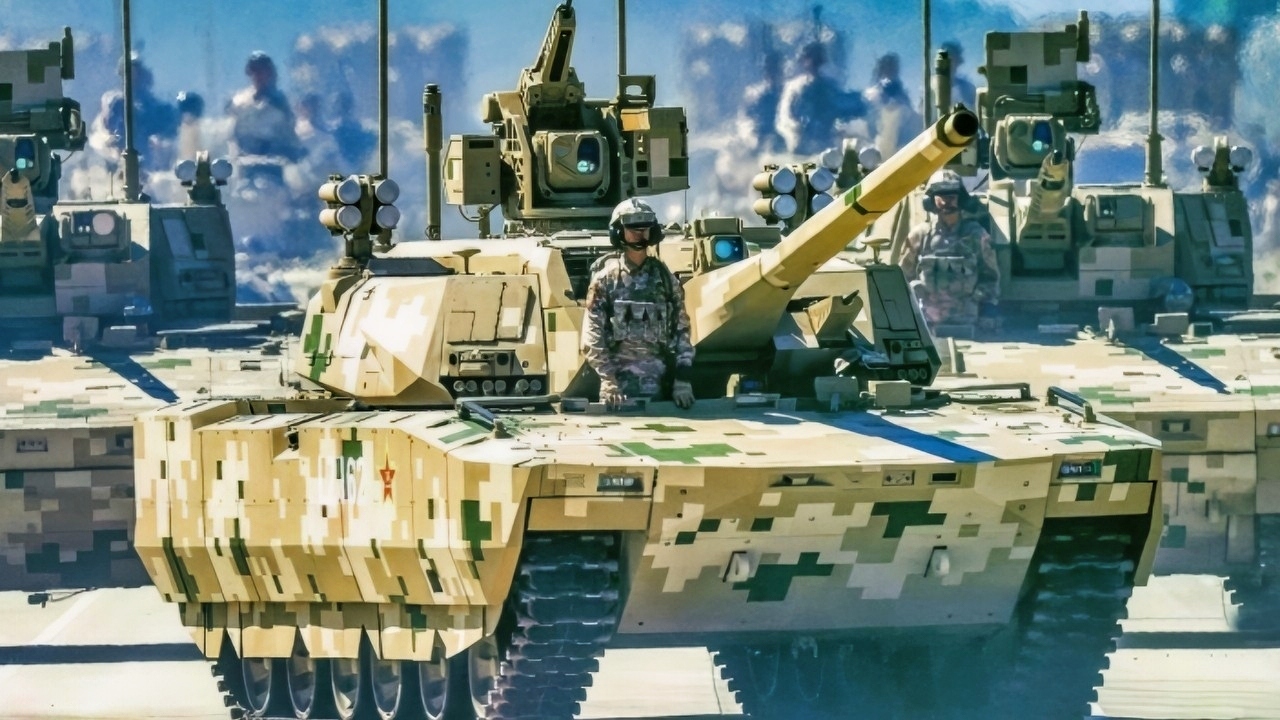
China just unveiled its new Type 100 (ZTZ-100) main battle tank—a complete rejection of traditional armored warfare doctrine that flips the tank formula on its head. Instead of relying on thick armor for survival, the Type 100 uses 360-degree phased-array radar, AR helmets for the crew, dual active protection systems, and a fully unmanned turret to detect and intercept threats before they ever hit.
China’s Type 100 Tank Looks Like a Game-Changer
China has unveiled what many believe is Beijing’s answer to the brutal reality of modern warfare: drones, top-attack munitions, and long-range precision fires shredded the concepts of traditional armored warfare.
Rather than build a better box of armor, as previous tanks sought to do whenever battlefield advances occurred, China has crafted for itself in the Type 100 (ZTZ-100) main battle tank (MBT) a rolling sensor suite that just happens to have a powerful main gun.
The Old Tank is Dead–Detection Replaces Armor
The Type 100 MBT flips the traditional tank formula on its head.
The old model was to ensure the MBT could survive combat thanks to thick armor. China’s new ZTZ-100, however, aims to survive modern tank warfare by early detection, interception, and networking.
In this way, the Type 100 MBT aligns more closely with Russia’s impressive T-14 Armata and America’s experimental AbramsX.

T-14 Armata. Image Credit: Russian State Media.

T-14 Armata Russian Tank. Image Credit: Creative Commons.
Of course, the key difference among China, Russia, and the United States is that China has the world’s best manufacturing base.
Whereas the Russians have so few T-14s at their disposal that Moscow has kept those units away from the grueling combat in the Ukraine War, and the Americans have some wonderful designs but very little ability to implement those designs in a meaningful, affordable, and reliable manner, Beijing can easily take their innovative designs and mass-produce them quickly.
Unmanned Turret, Protected Crew: Designed to Take Hits
One of the most interesting features of the Type 100 MBT is its unmanned turret. In fact, both the turret and the crew compartment in the tank are totally separate. An autoloader performs the reload function that manned personnel would ordinarily perform.
In previous iterations of tank warfare, the crew shared the same space with ammunition storage and the cannon. That design increased the risk to the crew. But, the designers of the Type 100 have better insulated the three-person crew of the Type 100 from an ammunition explosion in combat by making the tank’s turret fully automated.
Plus, the automated turret gives the ZTZ-100 a lower profile, making it harder to detect and hit with enemy fire. Another unique innovation of the Type 100 is the use of specialized blowout panels installed by designers to vent explosions away from the crew.
These interesting additions to Chinese tanks highlight how well Chinese designers have learned the tough lessons of the Ukraine War. They anticipate that enemy fire will hit China’s new MBTs and have implemented designs to keep those crews alive, regardless of that fire.
Sensor Dominance: Turning Tank Crews Into Fighter Pilots
China’s new MBT comes loaded with four phased-array radar panels, providing a total 360-degree coverage; thermal, infrared, optical, and ultraviolet sensors; laser warning systems; and drone detection capability extending to 5 kilometers.
Thanks to their AR helmets, the tank’s three-person crew can see everything. The helmets also provide head tracking, which allows the weapons systems to aim where the crew member is looking. More importantly, thanks to its automation, the engagement cycle is 20-40 percent faster.
Tank crews become more like fighter pilots in terms of their firing capability and reaction times, thanks to these advances.
Active Protection Over Heavy Armor
Of course, other tanks have such capabilities. But the Chinese are demonstrating they have fully caught up with both American and Russian systems. Thanks to their manufacturing supremacy, China is further showing that it can overwhelm American (and US allies) and Russian forces with these Type 100 MBTs.
As for interception capabilities, the Type 100 features dual GL-6 Active Protection Systems (APS) and about 8 ready interceptors, with an engagement range of 10-30 meters. These interceptors stop anti-tank guided munitions (ATGMs), rocket-propelled grenades (RPGs), top-attack weapons, and drones (as well as other loitering munitions). All these advances highlight that the Ukraine War has proven that armor alone is ineffective at protecting tanks during attacks (and their crews).
To successfully defend one’s tank, that MBT must possess the ability to shoot down anti-tank weapons.

A soldier from the Idaho Army National Guard, Charlie Company, 2-116th Combined Arms Battalion, 116th Cavalry Brigade Combat Team makes Idaho National Guard history with the first firing of a Javelin anti-tank missile. In a historic moment of training for the Idaho Army National Guard, soldiers from Charlie Company, 2-116th Combined Arms Battalion, 116th Cavalry Brigade Combat Team, fired the FGM – Javelin portable anti-tank missile on Sunday while conducting a series of field training exercises scheduled for the week on the Orchard Combat Training Center ranges.
Hybrid Power and Battlefield Stealth
Like the proposed American AbramsX, the Chinese Type 100 features a hybrid propulsion system delivering 1,500 horsepower. What’s more, there is an effective silent mode that reduces the Type 100’s acoustic and thermal signatures.
The 1,500-hp hybrid engine allows the Type 100 to reach around 80 kilometers per hour on roads. The electric torque from the hybrid engine also enables the tank to accelerate quickly. China’s new MBT has anywhere between a 400-600 km range, as well.
The Type 100 is designed for ambush, repositioning, and low-signature maneuver warfare rather than simple, brute-force breakthroughs that once defined tank warfare.
The 105mm Debate: Mobility Over Firepower
Interestingly, China’s tank designers are receiving a lot of guff from tank experts around the world, since they opted to mount what many analysts claim is a weaker weapon on this otherwise impressive new tank.
China opted for the 105mm smoothbore cannon rather than the heavier, 120mm/125mm standard smoothbore cannon. Chinese designers argue this was the better choice, since the lighter main cannon allows for greater mobility, which is China’s main goal with its new tanks. Plus, according to Chinese designers, the 105mm has a higher muzzle velocity thanks to its advanced propellants.
Again, this is an example of the new doctrine that China’s tank force is embracing. It’s not brute force. It’s maneuver plus networking.
The Real Weapon: Networked Warfare
And that brings us to what many observers say is the real key to this Type 100 tank: its networking capabilities. This tank doesn’t fight alone. The new tank employs an advanced plug-and-play model.
The Type 100 is but one of many sensor nodes on the modern battlefield that can plug into recon drones, artillery, rocket forces, aircraft, and electronic warfare (EW) systems. On paper, this tank will allow for beyond-line-of-sight targeting, external cueing, and faster kill chains.
China’s new tank indicates that Beijing is committed to sensor-driven armored warfare. They’re adapting to drones faster than most armies, which is interesting given that the Chinese People’s Liberation Army (PLA) is not currently engaged in a war (usually, armies engaged in warfare are quicker to adapt to modern warfare). The Type 100 further shows that China’s military is integrating tanks into its advanced kill-web ecosystems.
The Risks: Tech Fragility and Cognitive Overload
Many uncertainties remain, though.
For instance, any tank in modern combat suffers through brutal EW attacks and disruption. Whatever Chinese designers claim, there is no evidence of how well the Type 100’s electronics will survive. There remains some question about the tank’s APS effectiveness under swarm attack, too. Some have even posited that the three-person crew might suffer from cognitive overload due to data saturation. As many critics of the American version of the hybrid propulsion system can attest, there is no real-world example of its reliability under the strain of modern battle.
Nevertheless, the Type 100 will stunt one rival system: the US MBT fleet. That’s because the Type 100 targets some key American strengths: precision fires, air dominance, and intelligence, surveillance, and reconnaissance (ISR) networks. By compressing detection, decision, and destruction timelines, China aims to out-cycle US forces in high-intensity combat.

Soldiers with the Ohio National Guard’s 1st Combined Arms Battalion – 145th Armor Regiment conduct live fire training with the M1A2 SEPv3 Abrams Main Battle Tank at the Camp Ripley Training Center near Little Falls, Minnesota, on July 28th, 2025 (Minnesota National Guard Photo by Mr. Tony Housey).
The Tank That Ends Tanks
The Type 100 is a prototype of how China will fight the next great war on the ground. It will require less armor and more data–all to allow faster decisions in a fully networked battlefield. The era of the standalone tank is over. Ukraine proved that. The next war won’t be decided by whose tanks have the thickest armor. The next major ground war will be decided by whose tanks see, process, and kill first.
For now, until the Americans field their newest MBT, it looks like China has some real advantages.
About the Author: Brandon J. Weichert
Brandon J. Weichert is a Senior National Security Editor. Recently, Weichert became the editor of the “NatSec Guy” section at Emerald. TV. He was previously the senior national security editor at The National Interest. Weichert hosts The National Security Hour on iHeartRadio, where he discusses national security policy every Wednesday at 8 p.m. Eastern. He hosts a companion show on Rumble entitled “National Security Talk.” Weichert consults regularly with various government institutions and private organizations on geopolitical issues. His writings have appeared in numerous publications, among them Popular Mechanics, National Review, MSN, and The American Spectator. And his books include Winning Space: How America Remains a Superpower, Biohacked: China’s Race to Control Life, and The Shadow War: Iran’s Quest for Supremacy. Weichert’s newest book, A Disaster of Our Own Making: How the West Lost Ukraine, is available for purchase at any bookstore. Follow him via Twitter/X @WeTheBrandon.


