


Soldiers with the 1st Cavalry Division are poised to trail two of the U.S. Army’s most consequential new armored vehicles: the M1E3 Abrams main battle tank, as well as the XM30 Mechanized Infantry Combat Vehicle. The newest Abrams promises to boost mobility while also reducing fuel consumption — and could well incorporate artificial intelligence to boost combat lethality.
Less is known about the XM30, the replacement for the M2 Bradley Infantry Fighting Vehicle, which has been in service since the early 1980s. But both platforms will incorporate lessons learned from the war in Ukraine. Here’s what we know.

Soldiers with the Ohio National Guard’s 1st Combined Arms Battalion – 145th Armor Regiment conduct live fire training with the M1A2 SEPv3 Abrams Main Battle Tank at the Camp Ripley Training Center near Little Falls, Minnesota, on July 28th, 2025 (Minnesota National Guard Photo by Mr. Tony Housey).

A U.S. Army M1A3 Abrams tank fires a round during a live fire training exercise at Smardan Training Area, Romania, April 19, 2017. The combined exercise had U.S. and Romanian armored crewmen taking commands from a Romanian commander to prove the cohesion between units in support of Operation Atlantic Resolve, a NATO mission involving the U.S. and its European Allies and partners in a combined effort to promote regional stability and deter aggression in Europe. (U.S. Army photo by Army Pvt. Nicholas Vidro)
M1E3 Abrams
Multiple iterations of the Abrams tank have been put into production since it was introduced into U.S. Army service during the Cold War, as have increasingly sophisticated iterations of the M2 Bradley Infantry Fighting Vehicle.
But the newest Abrams variant and XM30 differ significantly from their predecessors.
The two new vehicles are “not incremental improvements,” but rather “a major shift forward in terms of technology,” Major General Thomas Feltey, head of the 1st Cavalry Division, explained to reporters.
One of the long-standing criticisms of the M1 Abrams main battle tank has been that platform’s steadily increasing weight. While imposing high logistical costs — notably, some civilian bridges in Europe cannot support the M1 due to its weight — it also hinders mobility and range.
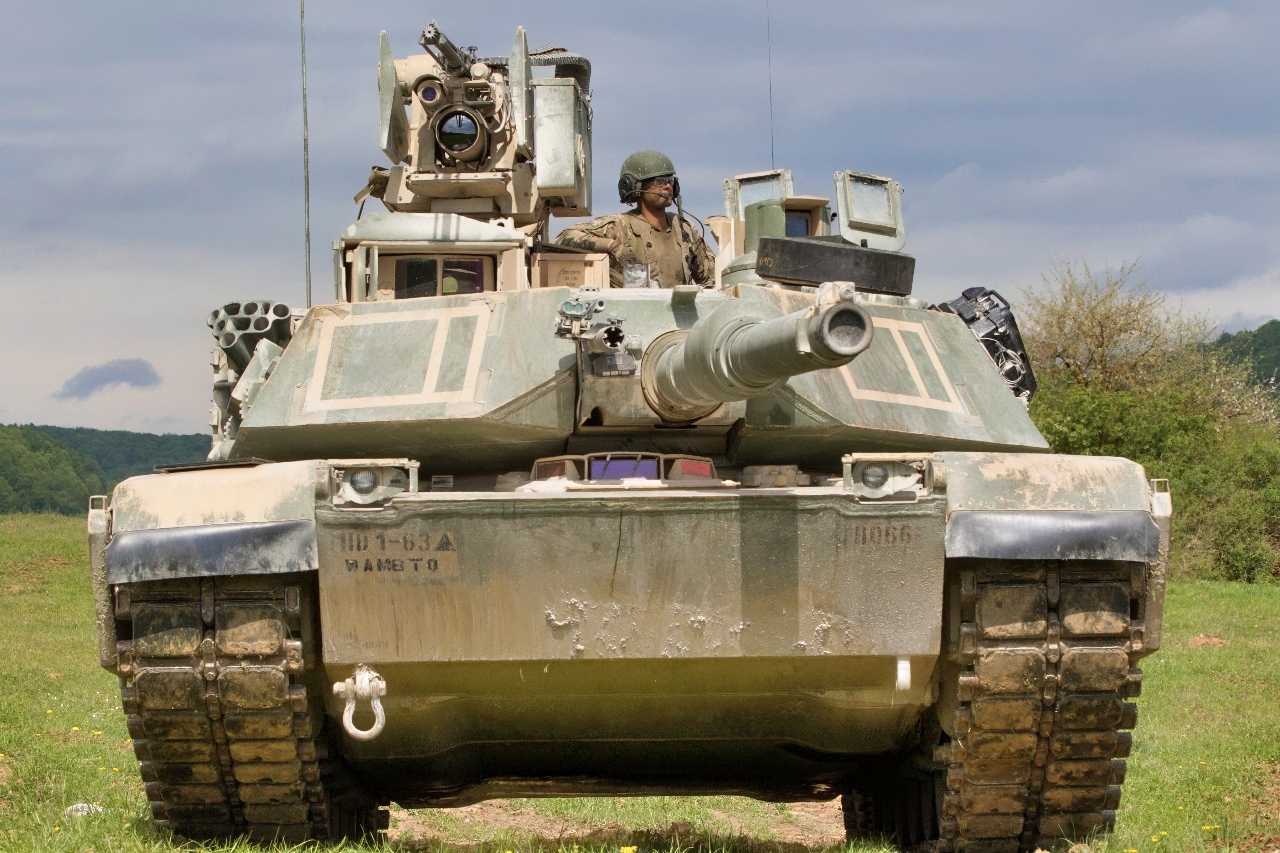
An M1A2 Abrams tank from 1st Battalion, 63rd Armor Regiment, “Dragons,” 1st Infantry Division, Fort Riley, Kansas, pulls during Combined Resolve X at the Hohenfels Training Area, Germany, May 1, 2018. Exercise Combined Resolve X is a U.S. Army Europe exercise series held twice a year in southeastern Germany. The goal of Combined Resolve is to prepare forces in Europe to work together to promote stability and security in the region. (U.S. Army photo by Spc. Andrew McNeil / 22nd Mobile Public Affairs)

A U.S. Army tank crew assigned to 2nd Battalion, 5th Cavalry Regiment, 1st Armored Brigade Combat Team, 1st Cavalry Division, maneuvers an M1A2 Abrams tank at a railhead in preparation to transport it to Hohenfels, Germany during a railhead operation, Corbu, Romania, October 24, 2018. The Battalion has deployed to Europe in support of Atlantic Resolve, an enduring training exercise between NATO and U.S. Forces. (U.S. Army National Guard photo by Sgt. Jamar Marcel Pugh, 382nd Public Affairs Detachment/ 1st ABCT, 1st CD/Released)
The M1E3 Abrams variant will weigh around 10 tons less than its predecessor — a boon to mobility.
It will also sport a new hybrid diesel-electric engine that the Army hopes will reduce fuel consumption by 50 percent — a massive boost to range.
Artificial intelligence may also play a role in M1E3 operations, enabling quick target identification on the battlefield. “As we fight through this very contested environment, just being able to shoot things that we can see is not enough,” Major General Feltey said. “We’ve got to be able to detect beyond line of sight.”
XM30 Mechanized Infantry Combat Vehicle — Other Options?
Less is known about the XM30 Mechanized Infantry Combat Vehicle, the M2 Bradley replacement.
The Army appeared poised to provide funding to the two firms vying for the XM30 contract, American Rheinmetall and General Dynamics Land Systems (also known by its acronym GDLS).

XM30. Image Credit: U.S. Army.
But United States Secretary of the Army Dan Driscoll and former Chief of Staff of the United States Army Randy George paused the program, ostensibly to allow space for other, alternative contenders for the XM30.
If so, it would be the seventh time the U.S. Army has sought a Bradley replacement vehicle.
“The Army is not going to rubber-stamp a process that has consistently failed to deliver the capabilities our warfighters need at the speed of relevance or locks us into a specific design that decreases flexibility,” Army spokesperson Major Pete Nguyen explained to Breaking Defense.
“We are actively assessing multiple, competing designs for the XM30 to foster a truly competitive environment,” Nguyen also added. “We continue to look for partners who can deliver cutting-edge solutions now, not decades from now. This is a deliberate and necessary step to ensure we assess and select the best approach to deliver a world-class vehicle today and into the future.”
The War in Ukraine
The ongoing war in Ukraine has transformed modern warfare.
The overwhelming majority of casualties inflicted are by drone, radically changing the deployment of infantry and armored vehicles, including the tank.
At this juncture, the war favors the defense and has given rise to a battlefield feature made infamous during the First World War: no-man’s land.
But today’s no-man’s land is less starkly defined than those of European battlefields more than a hundred years ago.
Instead, today’s front lines in Ukraine shift on an almost daily basis, marked in places not by miles-long lines of trench works, but instead pockmarked by fighting positions that may contain as few as one or two soldiers.
Rather than static, the front on both sides is ill-defined and malleable — but incredibly dangerous nonetheless.
“It’s not just a no-tank land. It’s like a no-anything land. Tanks are vulnerable, but so are infantry. I mean, there’s been over a million infantry casualties in the last four years, and nobody’s saying the infantry is obsolete just yet,” Major General Feltey explained.
“The problem we’re trying to solve is, how do we restore mobility to the armored brigade combat teams. How do we stay on the offense? How do we keep our tempo at a fast pace so that we don’t give the enemy a chance?”
About the Author: Caleb Larson
Caleb Larson is an American multiformat journalist based in Berlin, Germany. His work covers the intersection of conflict and society, focusing on American foreign policy and European security. He has reported from Germany, Russia, and the United States. Most recently, he covered the war in Ukraine, reporting extensively on the war’s shifting battle lines from Donbas and writing on the war’s civilian and humanitarian toll. Previously, he worked as a Defense Reporter for POLITICO Europe. You can follow his latest work on X.


Kent
April 29, 2026 at 12:46 pm
I hope a $3,000 drone can’t kill it.
Kenneth
April 29, 2026 at 9:20 pm
The modern battlefield in Ukraine like the wars of the US are a war of attrition because of the politics not equiptment. If the troops are ready and willing a decisive and quick victory is possible instead if trying to hide behind the trenches. First rule of war is never to do anything piecemeal, you are in it to win or die and the sacrifice that cost increase with time.