

Iran habitually claims that it has shot down American aircraft. Whenever the United States does anything with its military during this tenuous ceasefire period, the Islamic Revolutionary Guard (IRGC) is sure to come back with a propaganda statement that it has successfully reacted against the United States.
This happened again over the Memorial Day holiday. The IRGC boasted that it shot down an MQ-9 Reaper drone on May 26 and that it fired on an F-35 and may have damaged it. The Iranians said that the Lightning II was forced to leave Iranian airspace as the pilot fled in fear. An American RQ-4 Global Hawk reconnaissance drone was in danger of being hit by Iranian air defenses and also fled.

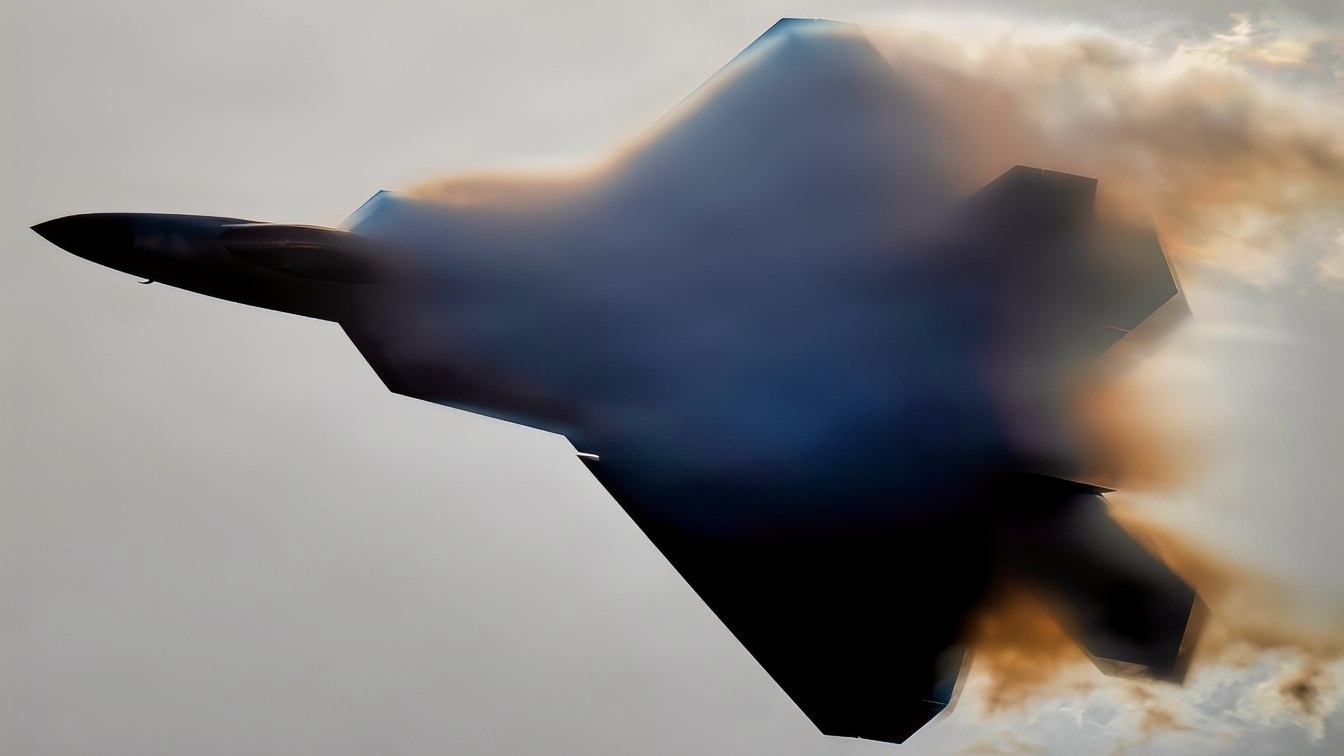
F-22 Raptors from the 1st Fighter Wing and 192nd Fighter Wing, participate in a total force exercise at Joint Base Langley-Eustis, Virginia, Feb. 28, 2019. Both wings partnered with the 633rd Air Base Wing during the Phase I exercise to showcase their readiness and deployability of the F-22s. (U.S. Air Force Photo by Tech Sgt. Carlin Leslie)
Iran Is Not Going Down Quietly: Attack the F-22 and F-35?
The IRGC said it had a “legitimate and definite” right to defend the country after the United States staged its own military strikes in “self-defense.” The American attacks were centered upon vessels that laid mines and missile launch facilities in southern Iran.
This action raises the question of whether the Iranians could shoot down an F-35 or an F-22. The airplanes are extremely stealthy and have enjoyed a good war. The pilots of these airplanes are expert and well-trained. They know how to dodge enemy missiles and other anti-aircraft systems.
Do the Americans Have Total Air Dominance?
The United States has claimed total air dominance in the skies over Iran, and Secretary of Defense Pete Hegseth said that all enemy air defenses have been suppressed. Before the ceasefire, Iran shot down an F-15E Strike Eagle. Both pilots were rescued in dramatic fashion. The Iranians were likely using a MANPAD shoulder-fired surface-to-air missile to destroy the Strike Eagle. This shows that the IRGC was not deploying its best air defenders.
The New York Times has estimated that 70 percent of Iran’s surface-to-air sites have been destroyed, Middle East Eye noted. This would mean there are still SAMs that could target an F-35 or F-22.

U.S. AIR FORCE ACADEMY, Colo. – Two F-22 Raptors perform a flyover and air demonstration during noon meal formation at the U.S. Air Force Academy in Colorado Springs, Colo., April 12, 2023. Events such as these aim to cultivate warrior ethos, a future-focused mindset, and supplement existing character, leadership, and officer development efforts with the cadets. (U.S Air Force Photo by Trevor Cokley)
Hiding SAMs
Iran has staged its SAM interceptors in caves, and while the Americans know this, the missile defenders have been able to survive U.S. strikes. The missiles trying to take these sites out have not been 100 percent successful. The Iranians dig themselves out of the rubble, and the air defenses remain intact, Middle East Eye reported.
Mosaic Defense Strategy
The main entity that conducts the effort against American planes is called the Islamic Republic of Iran Air Defense Force. These soldiers have a never-say-die attitude. The air defense force has executed the “Mosaic Defense Strategy.”
This means that command of the air defense network is decentralized. Each interceptor battery does not need an order from the higher echelons to continue the fight. The soldiers manning the systems believe in the need for asymmetric warfare against the United States. The air defense force has a David versus Goliath mentality in which they will fight on until they die at the hands of American air strikes.
Rundown of Iranian SAMs
To take on the F-35 and F-22 flights, Iran has enhanced its Mosaic Defense capabilities with Russia’s assistance.
They bought the TOR-M1 from Moscow to greatly improve the network of aid defenders. TOR-M1 can track 48 targets simultaneously at a range of 15 miles. TOR-M1 is specifically designed for stealth airplanes.
The Russians have also provided the adept SA-5 and SA-6 SAMs. China has exported systems to the Iranians, including the SA-2, which is built in the People’s Republic.

U.S. Air Force maintainers assigned to the 3rd Air Expeditionary Wing prepare F-22 Raptors for take-off on the flightline during exercise Resolute Force Pacific 2025 in Tinian, Northern Mariana Islands, July 19, 2025. The REFORPAC exercise is part of a first-in-a-generation Department-Level Exercise series, employing more than 400 Joint and coalition aircraft and more than 12,000 members at more than 50 locations across 3,000 miles. (U.S. Air Force photo by Airman 1st Class Tala Hunt)
Iran also depends on the S-300 and S-400 Russian-built SAMs, which have excellent range and shoot-on-sight capabilities. The Americans have rehearsed many counter-measures against the S-300 and S-400, and the F-22 and F-35 were made to avoid these defense systems.
Iran also has its own indigenously-produced air defense systems, such as the Bavar-373. This is a long-range mobile air defense system. The Bavar-373 utilizes advanced phased-array radar intended to detect and track low-observable and stealthy targets, and it can also engage multiple airplanes at long ranges.
The 3-Khordad mobile is a medium-range SAM system. It boasts a Phased Array radar and is particularly strong because it can be rapidly moved and concealed to ambush stealth airplanes.
These systems form the Mosaic Defense and are layered well to form a SAM wall against American fifth-generation airplanes.
But the Americans have a trick up their sleeve. The F-35 and F-22 have excellent electronic warfare suites that can foil and spoof the radars of the various SAMs.
Plus, the American pilots are trained to go up against these types of air defenders.
The Americans Are Taking On a Stalwart Air Defense Constellation
Many of the Iranian systems mentioned above have been destroyed, but there are still some left around the country.
The radar evasion capabilities of the F-35 and F-22 are among the best in the world, and while there is some concern when going up against Iranian SAMs, the Americans have a significant advantage in the multi-threat environment that creates a shield against U.S. stealthy aircraft.
Russia and China Are Allies
Notably, Russia and China have supplied many of these SAMs. This shows that Moscow and Beijing have a hand in the Iranian defense response and that the Chinese and Russians are firmly allied against the United States.
Damaging an F-35
Iran believes it has damaged an F-35 that caused it to make an emergency landing at an allied base. This reportedly happened in March.
Captain Tim Hawkins, a spokesman for US Central Command, said the F-35 was “flying a combat mission over Iran” when it was forced to make an emergency landing. Hawkins said the aircraft landed safely and the incident is under investigation, CNN reported.
Despite this, the Americans have been successful against Iranian air defenses. We will keep an eye on the F-35 and F-22 battle against Iranian SAMs. A ceasefire could collapse at any moment, and peace negotiations are not assured.
The F-35 and F-22 could threaten the Mosaic Defense strategy and the underground defenses, and those in caves have proven difficult to take out. This means the Americans will still have to fly air defense suppression missions.
The stealthiness of U.S. airplanes will be further tested, requiring excellent flying ability from American pilots.
About the Author: Brent M. Eastwood
Author of now over 3,500 articles on defense issues, Brent M. Eastwood, PhD, is the author of Don’t Turn Your Back On the World: A Conservative Foreign Policy and Humans, Machines, and Data: Future Trends in Warfare, plus two other books. Brent was the founder and CEO of a tech firm that predicted world events using artificial intelligence. He served as a legislative fellow for US Senator Tim Scott and advised the senator on defense and foreign policy issues. He has taught at American University, George Washington University, and George Mason University. Brent is a former US Army Infantry officer. He can be followed on X @BMEastwood.


