

Key Points and Summary – A potent mix of nationalist pride, strategic necessity, and a perceived threat from the West drives China’s aggressive aircraft carrier program.
-Beijing needs carriers to project power in its “dangerous neighborhood,” enforce territorial claims in the South China Sea, and protect its global trade routes.
-The presence of U.S. and NATO carrier groups fuels a “security dilemma,” pushing an unconstrained Xi Jinping to match the U.S. Navy “ship for ship.”
-Ultimately, these carriers are symbols of prestige and might, designed to ensure China cannot be “bullied” on the world stage.
Does China’s Navy Need Aircraft Carriers?
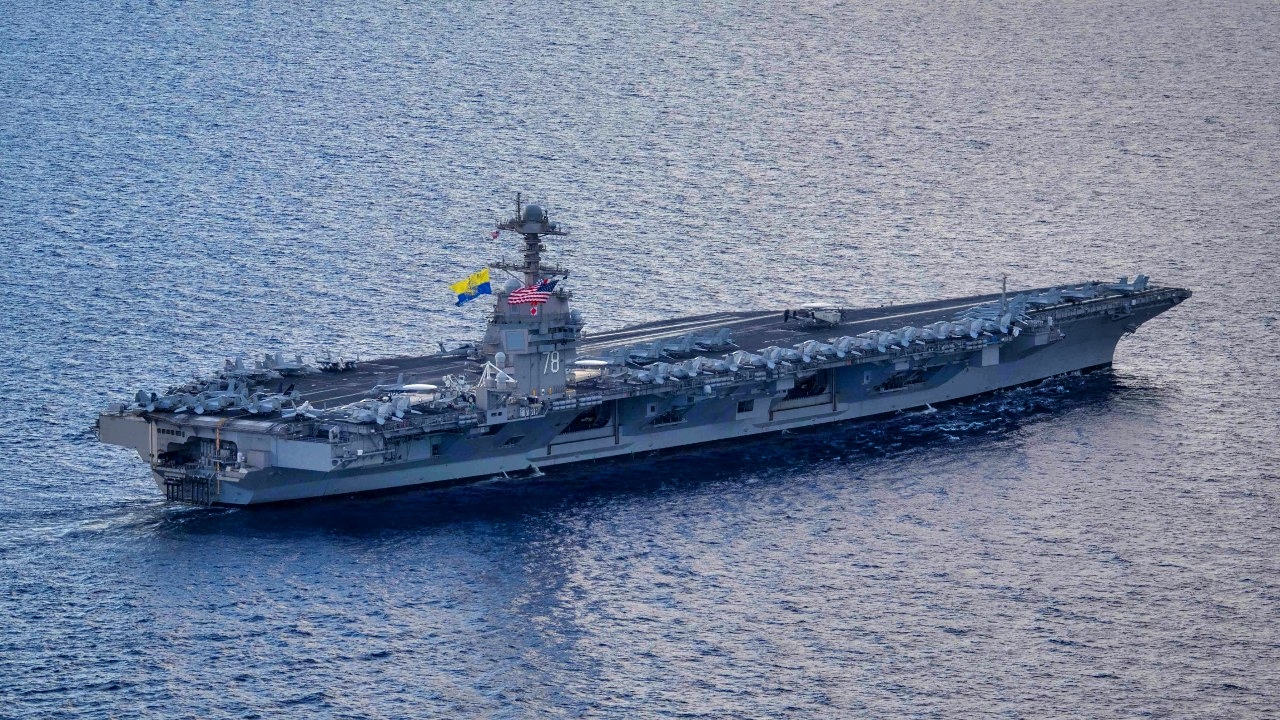
Military advisors to China’s dictator Xi Jinping are surely telling him to build more aircraft carriers. China has three in service – the Liaoning, the Shandong, and the Fujian. The country is building the fourth carrier, the Type 004, which may be nuclear-powered. This could challenge the U.S. Navy’s Gerald R. Ford-class super carriers.
Why Is China So Belligerent?
China has a prickly form of sovereignty, which means the government is susceptible to what it perceives as slights and insults. It despises arms sales to U.S. allies, especially new weapons exported to Taiwan. Combined military exercises with East Asian nations acting with American partners – no matter how small – are hated with a passion by Xi, and his onerous military spokesmen spew out venomous rhetoric in the Chinese media, castigating these drills.
There is a Burning Nationalistic Fervor
There is a heightened sense of national pride and patriotism. Additionally, there is a need to match the United States in terms of lethality and capability. That is why aircraft carriers are so important. These stoke the fires of propaganda and public relations efforts.
Every time the state-run media releases an article or broadcasts a news package about a Chinese carrier steaming around East Asia, the public rejoices.
There Goes the Neighborhood
Plus, China considers itself to be in a dangerous neighborhood surrounded by U.S. allies such as Taiwan, South Korea, Japan, the Philippines, Singapore, and Vietnam. China needs to project power over great distances and defend its territorial claims in various islands, rocks, and reefs in the East and South China Seas.
Needs to Protect Commerce and Trade
China desperately wants that Type 004 nuclear-powered carrier to be able to realize its ambitions for a “Blue Water” navy that can patrol regularly outside its region. There is a need for Beijing to protect its sea lanes for trade and commerce.
Additionally, projecting power requires sea lines of communication to remain intact, allowing for the continuous delivery of oil and other energy products from the Middle East.
Then, China aims to conduct more joint military exercises with Russia. These have occurred at least 100 times over the last decade, most of them taking place since 2022. The Russian navy does not have a functioning aircraft carrier; thus, Moscow is seen as a junior naval partner. Xi loves that. It allows him to remind Vladimir Putin that Russia needs a powerful Chinese military to prop up the Kremlin.
Even the Europeans Threaten China
China also sees maritime threats coming from NATO. European navies from the United Kingdom, France, and even Italy (to add insult to injury) have sent carrier strike groups in China’s backyard. China blames the United States for fueling anti-China sentiment within NATO. This makes Xi furious, and the Chinese feel they are being unfairly punished for pursuing their own form of sovereignty thousands of miles away from Europe.
If China regularly sent its carriers to Hawaii, Alaska, and Washington state, there would be mass anger among ordinary Americans, the White House, and Congress. China feels the same way when U.S. and NATO carriers patrol close to Taiwan and beyond the First Island Chain to box in China.
Therefore, the People’s Liberation Army Navy will not just stop with four carriers; it will continue to build and copy the U.S. Navy’s Ford-class ship for ship.
This is a simple form of what international relations theorists call neorealism. All countries struggle to accrue power in a dangerous world. The inclination for these states is to engage in military self-help practices that create an arms race—a condition known as the security dilemma. China would like to maintain a harmonious existence in which all its territorial claims are respected globally.
However, it faces naval threats in all directions, which upsets the balance of power. No longer can China pursue a peaceful rise. It is now engaging in an armed struggle to keep its sovereignty intact. These power imbalances encourage the military to assume a more significant role in international affairs and geopolitics.
Xi Jinping feels frustrated, and the Chinese people are aware that other navies are a threat. Aircraft carriers are a means by which the People’s Republic can sustain national prestige and project power. There is no way that Xi and his admirals will stop building carriers despite the high cost.
China boasts the world’s best shipbuilding industry. Workers are motivated by patriotism and feel that they are making a significant contribution to the security of their country.
Xi is also not constrained by an independent legislature or a free media that can criticize an arms buildup. There are no checks and balances in this respect. He is free to command the navy to deploy carriers throughout the Indo-Pacific and even to sail outside the region, demonstrating to the world his seriousness about global reach and the ability to strike at any time and from any location.
Therefore, China needs its aircraft carriers. They are a symbol of military might and prestige. They protect Chinese sovereignty. These mighty ships can face down threats coming from the United States and NATO.
They overawe smaller U.S. allies such as Taiwan, Japan, and South Korea. The carriers defend Chinese territorial claims in the First Island Chain. And they increase military power to send the message that China will not be bullied. These are all reasons that Beijing will pursue even more carriers in the future.
About the Author: Dr. Brent M. Eastwood
Brent M. Eastwood, PhD is the author of Don’t Turn Your Back On the World: a Conservative Foreign Policy and Humans, Machines, and Data: Future Trends in Warfare plus two other books. Brent was the founder and CEO of a tech firm that predicted world events using artificial intelligence. He served as a legislative fellow for U.S. Senator Tim Scott and advised the senator on defense and foreign policy issues. He has taught at American University, George Washington University, and George Mason University. Brent is a former U.S. Army Infantry officer. He can be followed on X @BMEastwood.
More Military
We Almost Touched the F-117 Stealth Fighter


taco
July 24, 2025 at 9:30 am
Pheckin’ pheckin’ stupid to dream of a fleet of aircraft carriers. Never mind actually building and maintaining one.
China’s leadership is truly stupid.
A modern aircraft carrier costs massive dollops of money to operate, and especially in the case of china’s currently carriers, they are far too easily sinkable in any coming sea battle due to dearth of adequate gatlin cannon stations.
Any impressive wave or salvo of missiles launched by a capable adversary and straightaway they are going down to davy jones’ locker.
The aircraft carriers are strictly only useful if xi wants to build and develop an island (or a group of islands) in the taiwan strait.
In the MIDDLE of the taiwan strait. That is.
Jim
July 24, 2025 at 10:10 am
Why is China so belligerent?
First, you have to consider China’s history in the second half of the 19th Century and into the first half of the 20th Century when it was subject to Western colonialism which the Chinese, themselves, call “The Century of Humiliation.”
Also because of the self-perception of the centrality of Chinese Civilization to World History, they have referred to themselves as the Heavenly Kingdom, although, this terms has dropped from use under the atheist Communists.
China suffered greatly in the war against Japan before and during World War Two. An interesting fact to note is that China suffered more casualties than any country in the fight against the Axis Powers other than the Soviet Union.
We, here, in America hardly even think of that, but China fighting Japan in mainland China tied up several Japanese armies which then couldn’t be use against U. S. sailors & soldiers in the Western Pacific.
Finally, Taiwan was conquered by Japan from China in the 1890’s and as a result ceded it to Japan to become a colony.
The Cairo Conference of 1943 where China was represented by Chiang Kai-shek set the stage as all parties agreed Formosa (Taiwan) would be returned to China after Japan was defeated.
The United States has never repudiated the Cairo Conference agreement and starting in the 1970’s formally reaffirmed the One China Policy by diplomatic agreement and Congressional Statute or Law.
So, China sees the U. S. reneging on their agreement much as colonial powers often arbitrarily changed terms of their status in China as it suited them.
China’s military buildup, the greatest in China’s modern history and in the last 500 years is focused on reversing China’s falling behind and being colonized by aggressive Western Powers, including the U. S. Did you know U. S. Marines were stationed in “settlements” in China during the first half of the 20th Century?
In Chinese minds they want to right the historical relations and perceived geopolitical power imbalance they have had with the West particularly during the Century of Humiliation.
Taiwan is a symbol of all the above… being reunified to China completes the repossession and sovereignty lost during the Century of Humiliation.
The computer simulated war games over Taiwan against China always result in the U. S. having to resort to tactical nukes to prevail or sometimes they’ll simply adjust the parameters in the computer program until the U. S. wins.
Objective military affairs analysts know war over Taiwan against China is like the U. S. S. Titanic sailing straight ahead for the Taiwanese iceberg.
The “Unsinkable” Titanic was sunk in part by the arrogance to full-steam ahead through an iceberg strewn area of open ocean, damn the risk, it won’t happen, but it did.
There’s a lesson we can learn from the Titanic tragedy.