


Key Points and Summary – The U.S. Navy’s next-generation F/A-XX stealth fighter program is on the brink of cancellation, a casualty of a new Pentagon budget battle.
-The Trump administration has officially prioritized the Air Force’s F-47, slashing the Navy’s funding and citing concerns that the industrial base can’t handle two sixth-generation programs at once.
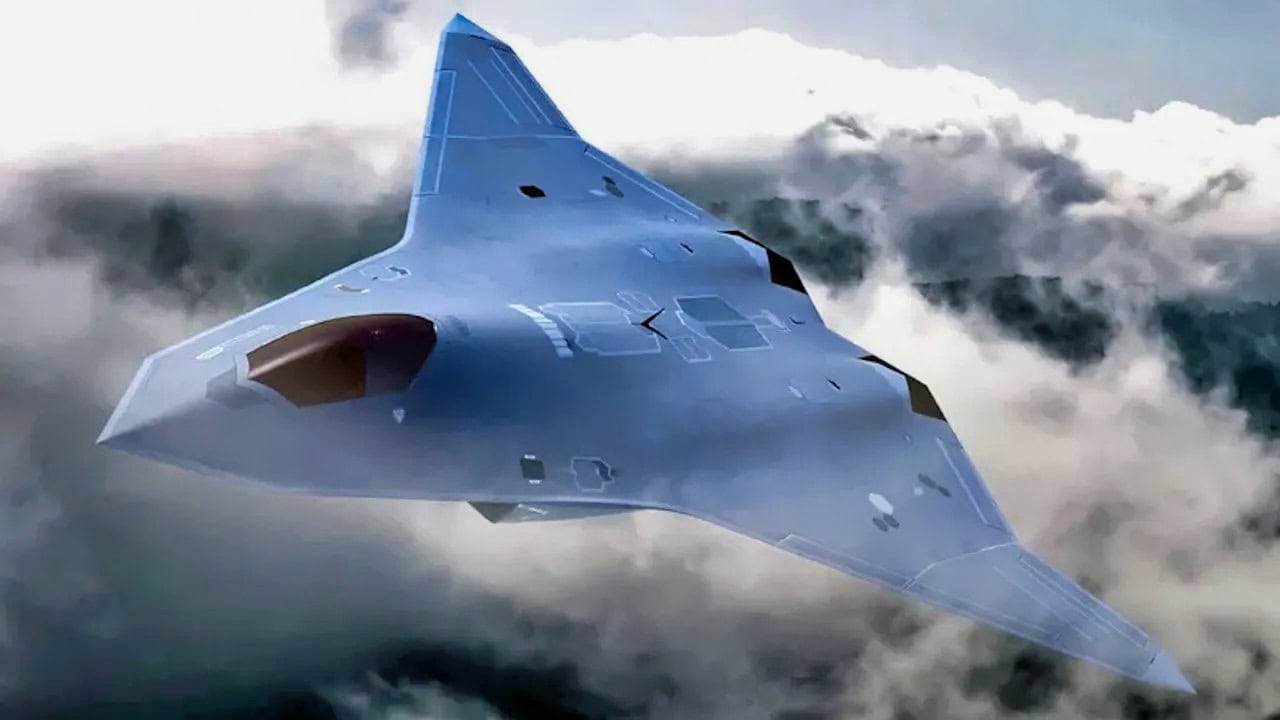
F/A-XX Fighter Mockup. Image Credit: Creative Commons.
-This move has dire implications, potentially leaving the Navy’s aircraft carriers without a modern replacement for the aging F/A-18 Super Hornet.
-The decision raises a terrifying question: Is the Pentagon signaling the beginning of the end for the American supercarrier?
The F/A-XX Challenge Could Mean Problems for Navy Aircraft Carriers
Is the Navy’s new fighter done before it had the opportunity to get off the ground?
The Pentagon’s decision to request substantial funding for the Air Force’s F-47 fighter project while nearly zeroing out the Navy’s project has raised serious concerns about how the Department of Defense views the aircraft carrier fleet, which has long been the centerpiece of the Navy’s fighting power.
Is this the first step on the long road of de-emphasizing the US Navy’s fleet of supercarriers?
F/A-XX: What It Was Supposed To Be?
The F/A-XX was intended to be a sixth-generation multirole carrier-based strike fighter.
It would have replaced the Navy’s F/A-18 Super Hornet fleet as the latter reached the end of its natural life in the 2030s, serving alongside the F-35C.

Members of the US Navy F/A-18F Super Hornet Demo Team performs a maneuver at the Wings Over South Texas Air Show. This year’s air show marks the first return of Wings Over South Texas to Naval Air Station Corpus Christi since 2019.
In concept, the F/A-XX resembles the Air Force’s F-47, featuring stealth, supercruise, long-range capabilities, an advanced sensor suite, and the ability to control a group of unmanned aerial vehicles. The aircraft was designed with an open architecture concept in mind, allowing for the possibility of significant upgrades throughout its life cycle.
Essentially, the F/A-XX would extend and modernize the reach of the US Navy’s carrier air wings, while also replacing the obsolescent Super Hornets.
The Process
The decision on a prime contractor for the F/A-XX was supposed to arrive in March 2025.
News first emerged that Lockheed Martin had been eliminated from the competition, leaving Northrop Grumman and Boeing (the latter the contractor for the F-47) as the remaining candidates. But a different choice was made.
Rather than decide between Boeing and Northrop Grumman, the Pentagon decided to substantially slow down the F/A-XX program in favor of additional work in the Air Force’s F-47 sixth-generation fighter project.
In June, news arrived that the Pentagon would dramatically reduce the appropriation for the F/A-XX (to a paltry $76 million) while investing over three billion dollars in the F-47.
The reason, evidently, was concern that the US defense industrial base could not simultaneously handle two large fighter projects, an odd claim given that the US has continuously had more than one fighter project in development since the dawn of the jet age.

NGAD. Image Credit: Creative Commons
The Future of F/A-XX
What does this mean for the future of the aircraft?
Unfortunately for the Navy, the answer may be “not much.”
With the Trump administration committed to the F-47 and Congress more deferential than usual towards the White House, finding ways to re-fund the F/A-XX may prove difficult. $76 million is a trivial amount for a major modern fighter project, and seems intended to close out the new jet rather than lay a foundation for producing it.
This has potentially grim implications for the future of the Navy’s carrier air wing.
We don’t yet know enough about the future of the F-47 to determine whether it can be made carrier-compatible.
Still, experience suggests that while most land-based fighters can be converted for carrier operations, the results can be less than ideal. The process of bringing the two projects together would presumably also make Boeing the huge winner in the sixth-generation fighter sweepstakes.
What Happens Next?
Most worrying for the Navy, the Trump administration may have determined that the aircraft carrier has a limited future lifespan, and that the lifespan does not warrant the development of an expensive new manned fighter to replace the Super Hornet and complement the F-35C.

Two F-35C Lightning II carrier variant joint strike fighters conduct the first catapult launches aboard the aircraft carrier USS Nimitz (CVN 68). The F-35 Lightning II Pax River Integrated Test Force from Air Test and Evaluation Squadron (VX) 23 is conducting initial at-sea trials aboard Nimitz. (U.S. Navy photo courtesy of Lockheed Martin by Dane Wiedmann/Released)
Questions of vulnerability have surrounded the aircraft carrier almost since its inception, but they have become particularly acute in recent years due to the development of a range of new threats to surface vessels.
If so, the decision runs of the risk of putting a deadline on the supercarrier as a form. Aircraft carriers depend for their continued effectiveness on the development and sophistication of their air groups.
The difference between the USS Nimitz of today and the USS Nimitz of 1977 is the difference between F-14 Tomcats, A-6 Intruders, and A-7 Corsairs on the one hand and F/A-18 Super Hornets and F-35C Panthers on the other. This makes the decision to curtail the F/A-XX quite ominous.

F-14 Tomcat Museum Photo. Image Credit: Creative Commons.
If innovation in the carrier air group slows, then the effectiveness of the carrier also slows.
The obsolescence of the aircraft carrier then becomes a self-fulfilling prophecy, as the older Nimitz-class carriers slowly leave service and the fleet as a whole shrinks, presumably to be replaced by other platforms. It’s a vision that some will find bold, while others will find it horrifying.
About the Author: Dr. Robert Farley, National Security Journal Contributing Editor
Dr. Robert Farley has taught security and diplomacy courses at the Patterson School since 2005. He received his BS from the University of Oregon in 1997, and his Ph. D. from the University of Washington in 2004. Dr. Farley is the author of Grounded: The Case for Abolishing the United States Air Force (University Press of Kentucky, 2014), the Battleship Book (Wildside, 2016), Patents for Power: Intellectual Property Law and the Diffusion of Military Technology (University of Chicago, 2020), and most recently Waging War with Gold: National Security and the Finance Domain Across the Ages (Lynne Rienner, 2023). He has contributed extensively to a number of journals and magazines, including the National Interest, the Diplomat: APAC, World Politics Review, and the American Prospect. Dr. Farley is also a founder and senior editor of Lawyers, Guns and Money.
More Military
We Almost Touched the F-117 Stealth Fighter


waco
July 22, 2025 at 1:11 pm
US pacific aircraft carriers, in the future, will carry unmanned aerial vehicles lugging nuke warheads.
A carrier could easily carry fifty or more of such unmanned machines controlled by AI, and in the next pacific war or taiheiyo senso 2.0, the US Navy will surely be able to wreak total nuclear havoc.
That’s the ultimate dream of all naval genghises, and US is certainly no exception.
Already, in the recent talisman sabre exercise, the Navy launched a SM-6 from its typhon attack system at a target and totally successfully obliterating it.
In the coming ww3, it will obliterate a whole city Instead.
Pingback: No New Navy Fighter... - Lawyers, Guns & Money
Matthew J Schilling
July 23, 2025 at 8:59 am
Improve what you’ve got. Upgrade F-35C’s with AETP engines.
If that dam breaks, customers will clamor for the engines on F-35A’s, too (which will improve the price of the engines).
RTColorado
July 23, 2025 at 10:13 am
It is difficult, if not impossible to write a serious comment in response to this article as it’s basic idea is so preposterous. The US Navy would abandon it’s entire Aircraft Carrier fleet if it didn’t get the 6th generation fighter? If the Navy did that, what would it have left to push it’s remaining F/A 18’s overboard off of? How would it crash it’s remaining aircraft? There are thousands of Container ships just floating around out there waiting to be run into, the Suez Canal is not just going away, it needs a ship to block it and without Aircraft Carriers there would that fewer ships to relieve skippers of command of for “Lack of Confidence”. Besides, without Aircraft Carriers, Tom Cruise wouldn’t be able to make “Top Gun, the Final Adventure 12”.
AZ
July 23, 2025 at 12:50 pm
AETP will be a MUST HAVE, and gets the F-35C the additional 25%-30% range the F/A-XX was supposed to provide. Lockheed has offered to roll much of its NGAD developments into the F-35 to provide 80% of NGAD at 50% of the price. I know the F-35 is also getting its nose modified to fit a larger, upgraded radar. I think that is as close to F/A-XX as the Navy is going to get. Navy has repeatedly screwed the pooch on new development by promoting the wrong “yes” men who make bad strategic decisions and can’t manage programs successfully.
Then, despite the Navy fighter mafia’s attempt to kill offensive UAS, Add to this several versions of Boeing’s MQ-25 including ISR and AEW versions and that’s your future air wing. Uncrewed UAS take the high risk deep strike / day one targets (much to the Navy fighter mafia’s chagrin) and F-35Cs follow them in.
Finally, remember, the USAF was/is all in on stealth. They feel stealth provides 100% of the answer. The Navy has always been skeptical about stealth solving all and have insisted on retaining and improving electronic attack / jamming capability. They are also more forward leaning on IRST. Given that, an upgraded F-35C + MQ-25 would work for them, and losing the F/A-XX would damage the Carrier Air Wing’s offensive abilities far less than the USAF losing NGAD/F-47.
chrisford1
July 23, 2025 at 9:27 pm
Don’t think the aircraft matter. All US current and proposed fighter jets lack the range of carrier killer missiles, hypersonic, maneuverable missiles launched from shore, air, sub.
So they can’t secure carriers anymore with a CAP. And the fall of Israels Iron Dome, the whole mountain of Kiev air defenses, the non-high tech Houthis nearly hitting carriers with a ballistic missile and drone in each case and running through billions in defense missiles until forced to flee – show aircraft carriers cannot be defended.
Waco -“US pacific aircraft carriers, in the future, will carry unmanned aerial vehicles lugging nuke warheads.”
Right, WACO – carriers are now giant, easy to find targets. Using a 15-20 billion nuke carrier as a nuclear missile barge means in a war, any underway or in port get smoked in the 1st half hour of a war.
Whereas the Chinese and Russians can carry 50 nuke tipped AI drones on any one of 3800 container ships.
Good luck!
The 1980s are over. And the 100 year reign of the carrier is over, whether the USN realizes it or not. 1st one was the Japanese Hosho, then the Langley, converted into one in 1922 for tests. Even China has said it’s carriers are to employ on less sophisticated, non-peer nations and they won’t bother sinking so much cost and people into carriers that would confront a peer Navy, and survive a day or so in a war with America,
1KoolKat
July 24, 2025 at 5:48 am
US law dictates the composition of the Navy: 10 U.S. Code § 8062 – United States Navy: composition; functions, thus having an aircraft carrier fleet is a legal mandate.
However, none of that matters because US shipbuilding is broken, and the US Navy is and will eventually shrink through attrition.
ps. If you haven’t figured it out yet, the US is in deep trouble.
Adam Perry
July 24, 2025 at 12:04 pm
Look for the F-55, twin engined F-35. The demise of the carrier is being exaggerated. The value of a mobile airfield can’t be overstated.The coming naval air wing will be a mix of manned and unmanned.