
The Iran war is approaching its six-month anniversary and looks nothing like U.S. President Donald Trump suggested it would when the strikes began in February.
When U.S. and Israeli forces launched attacks in February, Trump was still famous for campaigning against America’s endless overseas wars.
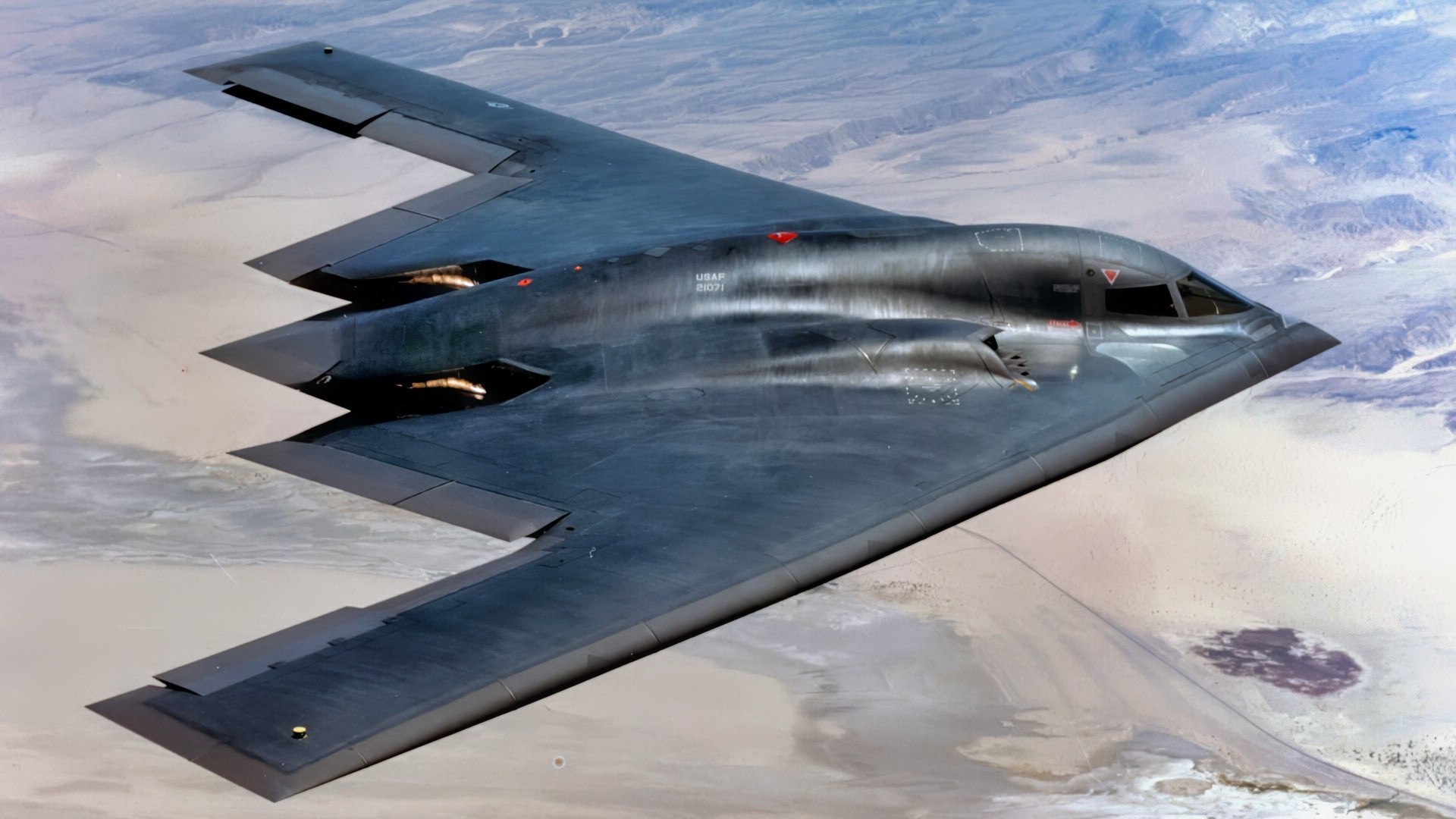
FILE PHOTO — The B-2 Spirit is a multi-role bomber capable of delivering both conventional and nuclear munitions. A dramatic leap forward in technology, the bomber represents a major milestone in the U.S. bomber modernization program. The B-2 brings massive firepower to bear, in a short time, anywhere on the globe through previously impenetrable defenses. (U.S. Air Force photo)

U.S. Airmen from the 393d Bomber Generation Squadron inspect and secure protective covering on the B-2 Spirit stealth bomber at Whiteman Air Force Base, Mo., July 25, 2024. Crew chiefs directly support the B-2 by inspecting and maintaining it daily to ensure its mission ready at a moment’s notice. (U.S. Air Force photo by Airman 1st Class Bryce Moore)
It was a campaign message he has pushed since his first run for the 2016 presidential election, and in an October 2024 campaign rally in Pennsylvania, Trump promised, “I will not send you to fight and die in a foolish, never-ending foreign war.”
The Iran conflict, however, seems to be becoming precisely the kind of open-ended military entanglement that the president said he wanted to avoid.
The administration has even moved on from predicting victory within weeks to publicly advocating for a strategy of strangling Iran economically in the long term.
And it could last indefinitely.
Expectations for this war, it seems, have changed—both within the administration and among Gulf governments.
The Original Plan
Two days after the war began, President Trump told Americans how long he expected the conflict to last.
Speaking at a Medal of Honor ceremony at the White House on March 2, Trump said that planners had projected between four and five weeks for the conflict to conclude, and added that the United States had the capacity to keep fighting for far longer than that.
Within another week, the president suggested the timeline might prove unnecessarily long.
On March 9, just 10 days into the conflict, Trump said the war would be over “very soon” and added that Iran was “all gone” and that the military campaign could already be described as a success.
It is a claim that has also been made several times since, even as Iran proves it can hold the Strait of Hormuz hostage.
Two days later, Trump then told Axios that there was “practically nothing left to target” and that the war could end “any time I want it to end.”
On March 12, Trump then said that Iran was “pretty much at the end of the line.” And on March 24, he again went further, claiming, “We’ve won this war. This war has been won.”
White House Press Secretary Karoline Leavitt then said on March 25 that the U.S. was “very close” to achieving Operation Epic Fury’s core objectives, and Secretary of State Marco Rubio also told G7 foreign ministers in France on March 27 that the operation should conclude within a matter of “weeks, not months.”
Then It Became Months
By March 31, the original estimate of four to five weeks had expired, but Trump kept promising it would end soon.
“We’ll be leaving very soon,” Trump told reporters in the Oval Office and again estimated that American forces could finish the operation within “two weeks, maybe two weeks, maybe three.”
Then the following night, the president told the country that the U.S. was again close to ending the war but would spend another two to three weeks bombing Iran “back to the stone ages” if necessary.
Diplomatic efforts waxed and waned, and Trump always insisted that the end was imminent.
A two-week ceasefire began on April 7, and that failed.
Trump extended it on April 21 while negotiations continued, and those negotiations ultimately failed.
On May 1, he notified Congress that the hostilities that began on February 28 had been “terminated,” although the conflict remained unresolved.
Then, on May 23, Trump said an agreement to end the war would be announced soon. Five days later, Vice President JD Vance said that Washington and Tehran were “very close” to an agreement.
In June, Washington and Tehran agreed to a memorandum of understanding that formally called for an end to hostilities and established a 60-day window to negotiate a permanent nuclear agreement.
That deal failed, too.
Washington Now Wants to Wait
Not only has every diplomatic effort failed so far, but the process has taken far longer than it needed because Washington chose to pause strikes and return to negotiations, only for them to fail again.
And now, not only is the war approaching its six-month anniversary, but Washington isn’t even promising a quick end anymore.
On August 9, Trump told Axios, “We are low-keying it,” adding that the U.S. was watching Iran struggle with inflation and a lack of money.
The strategy now appears to be waiting Tehran out while maintaining military and economic pressure, and then came news that Tehran described as the beginning of that campaign.
On August 18, the UAE suspended all trade and financial transactions with Iran, potentially closing one of Tehran’s most important economic lifelines.
No clear end is in sight, and the White House is no longer promising it will end soon.
The big question now is how the United States intends to ensure traffic continues to flow through the Strait of Hormuz as Iran’s newly reshuffled military leadership promises to escalate.
About the Author: Jack Buckby
Jack Buckby is a British researcher and analyst specializing in defense and national security, based in New York. His work focuses on military capability, procurement, and strategic competition, producing and editing analysis for policy and defense audiences. He brings extensive editorial experience, with a career output spanning over 1,000 articles at 19FortyFive and National Security Journal, and has previously authored books and papers on extremism and deradicalization.


