


Iran is reportedly set to receive hundreds of portable anti-air missile systems from China, as peace talks with the United States stall.
Reuters says three sources informed it of the impending plans, which China’s Foreign Ministry has firmly denied.
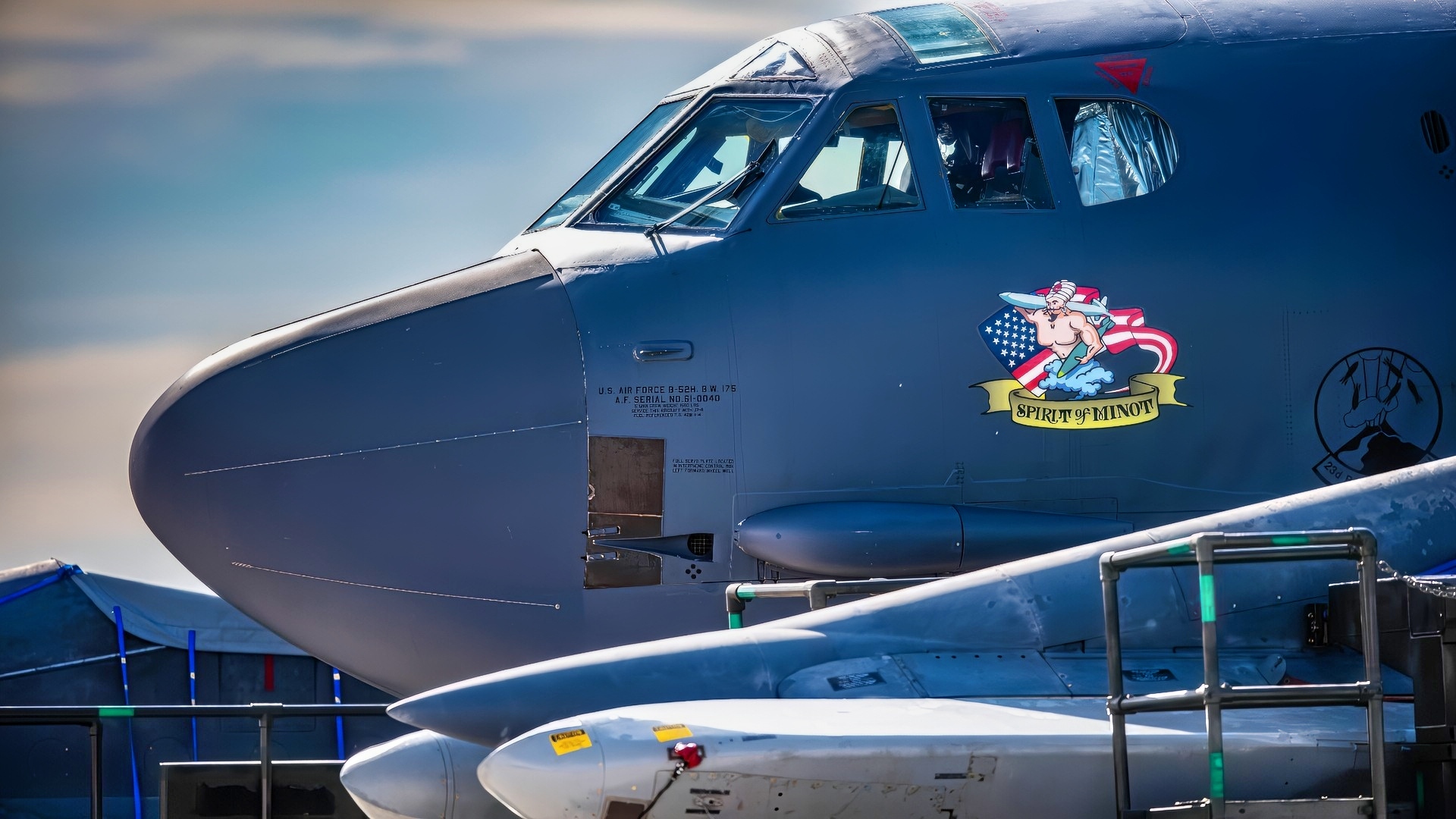
A U.S. Air Force B-52H Stratofortress assigned to the 23rd Bomb Squadron sits on the flightline during exercise Prairie Vigilance 25-1 at Minot Air Force Base, North Dakota, April 12, 2025. Vigilance series exercises are conducted with a focus on the safe and secure handling of equipment. (U.S. Air Force photo by Senior Airman Kyle Wilson)

A B-52H Stratofortress sit parked on the flight line at Minot Air Force Base, North Dakota, Aug. 8, 2022. The B-52 is capable of dropping or launching gravity bombs, cluster bombs, precision-guided missiles and joint direct attack munitions. (U.S. Air Force photo by Airman Alysa Knott)
The Islamic Republic is gearing up to repair air defenses targeted by extensive United States and Israeli strikes.
U.S. President Donald Trump previously said that Chinese President Xi Jinping had assured him Beijing would not “partake” in the war on Iran’s behalf.
China has condemned U.S.-Israeli strikes on Iran since the conflict broke out earlier this year. However, Beijing’s public involvement in the war has been limited.
Is Chinese Tech Aiding Iran?
Chinese satellite imagery has allegedly been used by Iran to help identify targets on US bases and other Gulf locations.
In May, Washington sanctioned a trio of Chinese entities: Meentropy Technology Co. Ltd, The Earth Eye and Chang Guang Satellite Technology Co., Ltd, over the accusations.
Reuters said Iran and Zhongqing Baoshang International Investment, a Hong Kong-based intermediary, had a $60-70 million deal to buy up to 400 shoulder-fired man-portable air defense (MANPAD) systems.
These kinds of weapons are portable and can be rapidly dispersed and relocated, making them much harder to destroy than Iran’s conventional fixed air defenses.
U.S. Maintains Iran Blockade
On Tuesday, the U.S. military fired missiles to disable “the steering gear” of a cargo ship attempting to circumvent its blockade of Iranian ports.
Posting to X on Tuesday, Centcom said: “forces disabled the steering gear of Panama-flagged M/V Vela Nova as the cargo vessel attempted to transit the Gulf of Oman and violate the U.S. blockade against Iran by sailing toward an Iranian port.”
It said the ship’s civilian crew ignored repeated warnings from American forces. The U.S. said that its blockade “remains in full effect”.
A U.S. blockade of Iranian ports was reimposed on July 14 after their “memorandum of understanding,” which Trump declared “over” on July 7.
Tehran’s retaliations to the war have included attacks on Israel and US-allied states across the Middle East, along with its effective closure of the Strait of Hormuz.
Around one-fifth of global oil and liquefied natural gas (LNG) passed through the key waterway prior to the war.
Anti-American States Deepen Links
In their new book Axis of Aggressors, Rear Admiral (Ret.) Mark Montgomery and his co-authors, Bradley Bowman and Elaine Dezenski, warn against underestimating ties between Iran and China.
The volume documented 600-plus instances of cooperation between China, Russia, Iran and North Korea.
“Europe still looks at this conflict and says these are two co-equal belligerents: Iran and the US. That’s ridiculous. Iran is backed by Russia. It’s backed by China. In the past, it has been backed by North Korea. Yet we still cannot get Europe to support us against Iran,” Montgomery recently told Radio Liberty.
Writing for The Guardian, Simon Tisdall suggested that “Many now view the US as an unreliable partner,” due to strained ties with Trump. He claimed this had emboldened China.
He warned about China’s domestic human rights abuses and noted that: “It is already materially assisting Russia’s aggression against Ukraine. And an emboldened Beijing is deploying the sort of trade weapons beloved of Donald Trump.
“Last year it restricted exports of vital rare earth minerals, to Washington’s great alarm.”
He also noted American anxieties that China could be poised to overtake them in the Artificial Intelligence race.
U.S. Applies ‘Maximum Pressure’ Strategy
The U.S. is set to ramp up the Army’s 2027 budget, with calls for major investment in missile interceptors.
The Pentagon’s Requirements Oversight Council agreed to quadruple its PAC-3 MSE acquisition objective last April amid rising tensions with both Iran, Russia and China.
“The problem is 25 years of not buying enough munitions,” retired Rear Adm. Mark Montgomery, a senior fellow at the Foundation for Defense of Democracies, told Fox News on Wednesday.
Ludovic Hood, a Senior Fellow at the Center for Peace and Security in the Middle East, wrote: “Crucially, this ‘maximum pressure’ strategy is underpinned by the use of tactical yet large-scale air strikes and other military measures designed to do additional damage to the Islamic Revolutionary Guard Corps (IRGC) and other military targets across Iran.
“Its goal is to keep the regime in Tehran on its back heels while intermediaries (such as the Pakistani and Qatari governments) pursue efforts to reach a deal on a sustainable cessation of hostilities.”
About the Author: Georgia Gilholy
Georgia Gilholy is a journalist based in the United Kingdom who has been published in Newsweek, The Times of Israel, and the Spectator. Gilholy writes about international politics, culture, and education.


