

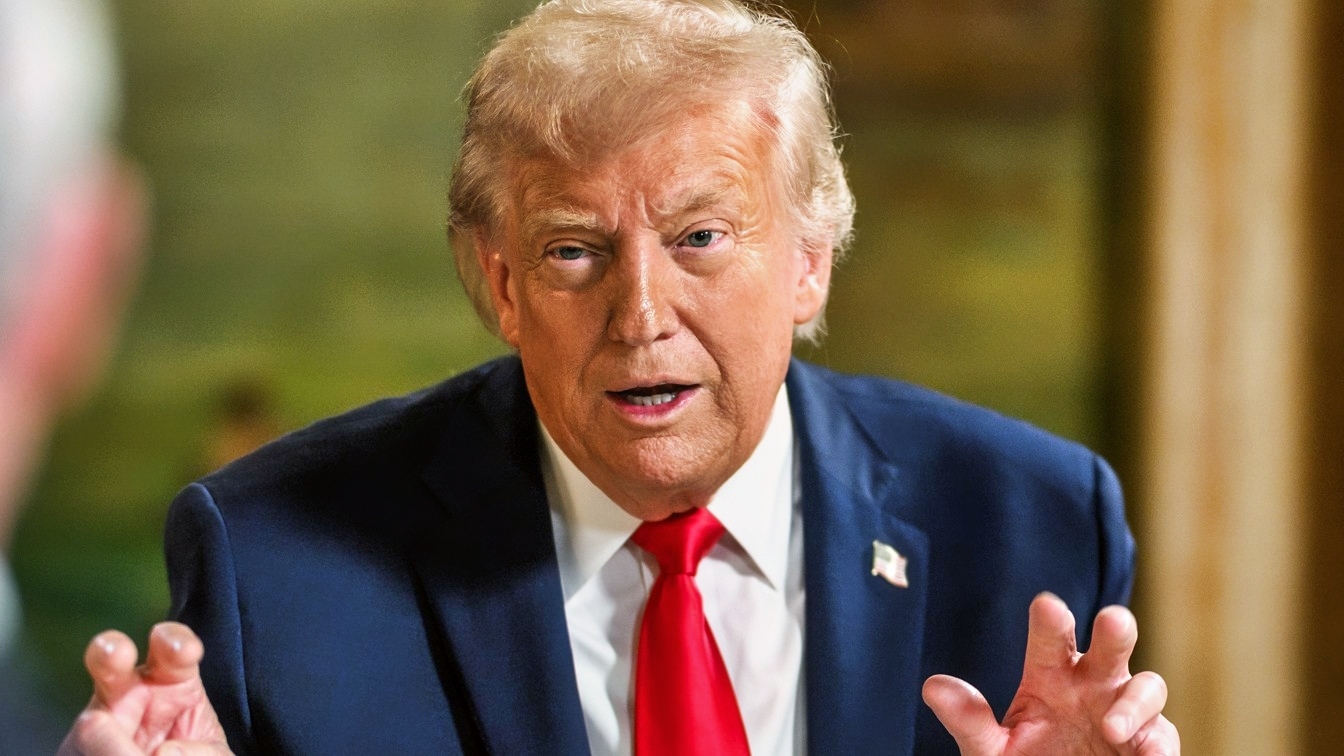
Iran threatens “devastating” response to the U.S – The United States and Iran aren’t quite in a shooting war right now, but they’re certainly not at peace, either. In the place of both, at least in recent weeks, there has been a lot of tension and many threats.
According to Reuters, President Donald Trump on Thursday promised economic consequences to countries that offer “any type of lifeline to Iran.”

President Donald Trump plays golf in the Senior Club Championship at Trump National Golf Club Jupiter, Sunday, April 6, 2025, in Jupiter, Florida. (Official White House Photo by Molly Riley)

President Donald Trump signs executive orders alongside Secretary of Education Linda McMahon and wounded warriors in the Oval Office, Wednesday, April 23, 2025. (Official White House Photo by Daniel Torok)
In a Truth Social post on Thursday, the president promised the “MOST CRUSHING ECONOMIC OPERATION EVER TAKEN AGAINST ANY COUNTRY,” directed at Iran. He went on to threaten “Economic Warfare and Isolation on an unprecedented scale.”
Calling it an “ECONOMIC D-DAY,” Trump added that the attention will turn to any country that helps Iran, including by providing access to “financial institutions, businesses, airports, or government entities.” He also called for U.S. allies to join those measures.
Per Reuters, this would seem to put the U.S. in direct economic conflict with China and Russia, both of which assist Iran.
Later on Thursday, in an interview with CNBC, U.S. Treasury Secretary Scott Bessent joined the threats, adding that the economic response would likely negate the need for further military action. Those measures, he added, probably mean “there will not be a large-scale kinetic restart.”
The new economic measures, Bessent told the network, would represent “the greatest coordinated economic isolation in the history of the world.” This will be paired, Bessent told CNBC, with the existing blockade of the Strait of Hormuz.
Per CNBC, oil prices rose after Bessent’s interview.
Iran Responds
Iran, in turn, talked tough in response to Washington’s threats.
According to Reuters, the chief of staff of Iran’s Armed Forces, Maj. Gen. Ali Abdollahi threatened a “devastating” response to any action the U.S. might take.
“With preparedness across land, sea, air, air defense and cyberspace, Iran’s armed forces will respond to the enemy’s new threats with crushing, punishing and devastating responses,” Abdollahi said on Thursday.
Iran’s parliament speaker Mohammad Bagher Ghalibaf, meanwhile, interpreted Washington’s latest move as the U.S. concluding that it cannot prevail militarily.
“We must make plans to deal with the unjust sanctions so that we can overcome them,” the speaker said this week during a visit to Iraq, Reuters reported.
Regime Change Talk
At the start of the war, which began in February with the strike that killed Supreme Leader Ali Khameini and other Iranian leaders, there was much talk that the United States and Israel were attempting to topple the Iranian regime. This was especially the case after street protests, brutally repressed by the regime, in the months before the war.
Throughout the war, the regime has proved resilient, and there’s been less talk about that from U.S. leaders in the months since.
However, Bessent raised the topic again in his CNBC interview.
“It is going to work in Iran, and we are going to collapse this regime,” the Treasury Secretary said. “It is time for our allies and the rest of the world to make a decision.”
Will the Pressure Work?
Trump, Bessent, and other U.S. leaders seem to have, as their latest strategy, a major economic push that will lead the Iranians to capitulate and produce a positive outcome in the war.
However, none of the previous efforts in the war, military or economic, have produced even a hint that the Iranians will give up.
In an analysis published this week by the Atlantic Council, Andrew L. Peek and Jonathan Panicoff looked at why Iran hasn’t backed down yet.
The key, they write, is that Iran’s leaders are IRGC veterans who cut their teeth on the Iran-Iraq War. But that doesn’t mean they won’t ever give up.
“They are hard men who will shoot back before they fold. Their strategy depends on inflicting sufficient pain on the United States in the short term to force a bad deal, and on scrambling regional alliances to prevent greater coordination against the Iranian regime,” the authors write. “But their hand will eventually be forced by a collapsing economic situation.”
About the Author: Stephen Silver
Stephen Silver is an award-winning journalist, essayist, and film critic, and contributor to the Philadelphia Inquirer, the Jewish Telegraphic Agency, Broad Street Review, and Splice Today. The co-founder of the Philadelphia Film Critics Circle, Stephen lives in suburban Philadelphia with his wife and two sons. For over a decade, Stephen has authored thousands of articles that focus on politics, national security, technology, and the economy. Follow him on X (formerly Twitter) at @StephenSilver, and subscribe to his Substack newsletter.


