

After about six weeks of relative calm, the United States and Iran traded salvos earlier this week, with the U.S. striking Iran’s Larak Island, and Iran then attacking military bases where U.S. troops are stationed in Jordan and the United Arab Emirates.
With President Donald Trump posting an AI-generated video of a U.S. plane destroying Iran’s energy export hub Kharg Island, things looked a lot like the war was about to escalate again.

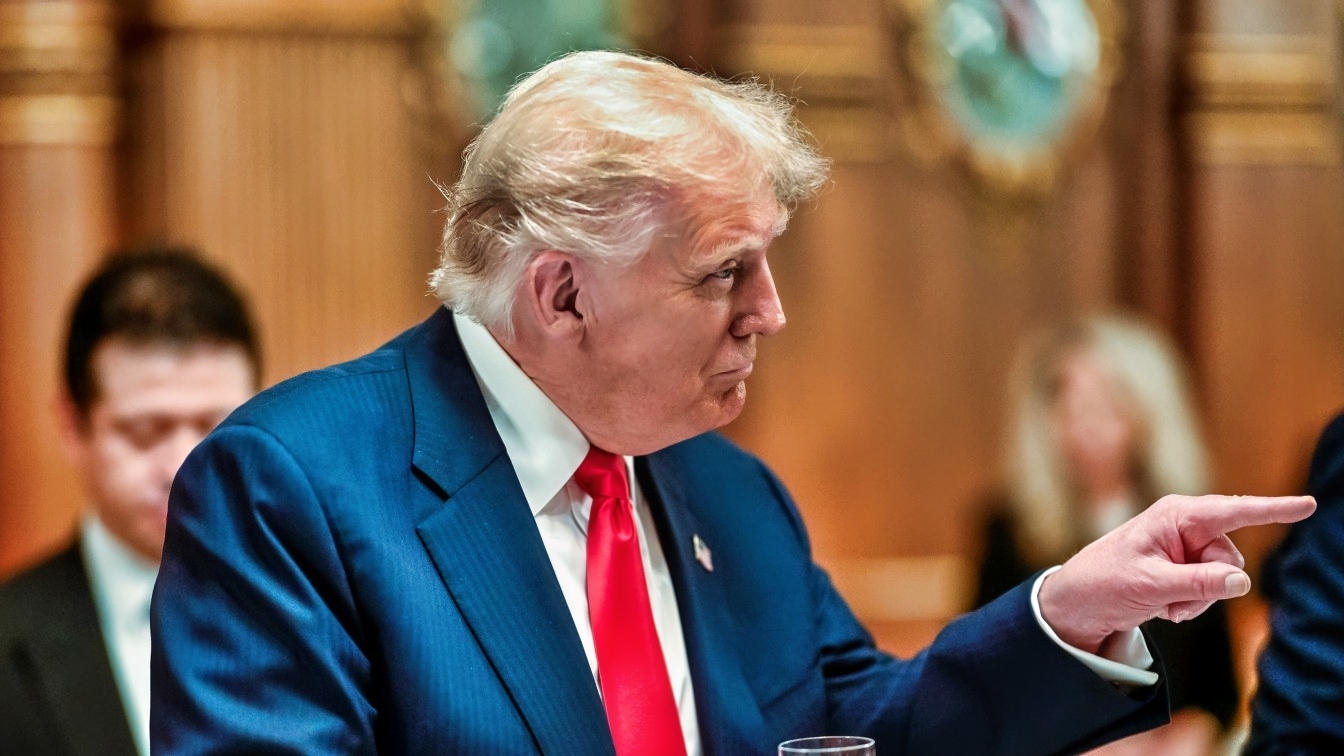
President Donald J. Trump delivers remarks at the 450th mile of the new border wall Tuesday, Jan. 12, 2021, near the Texas Mexico border. (Official White House Photo by Shealah Craighead)
But now, comments from Iran’s president indicate that there could be a way out of the war.
Back to the Memorandum?
Masoud Pezeshkian, Iran’s president, said Tuesday at the Shanghai Cooperation Organization summit in Kyrgyzstan that if the U.S. were willing to return to June’s Memorandum of Understanding agreement, Iran would do so as well.
“If the U.S. returns to its commitments in the memorandum of understanding, the Islamic Republic of Iran will immediately reciprocate,” the Associated Press quoted Pezeshkian as saying, citing Iranian state media.
The Iranian president also accused the U.S. of “reneging on its commitments” to the deal.
At that meeting in Kyrgyzstan, the AP report said, Iran’s foreign minister met with Russian President Vladimir Putin, as well as his Chinese counterpart. The New York Times describes the SCO as “a 10-nation political and security grouping,” whose meeting is taking place at the same time, on the other side of the world, as the G20 summit in North Carolina this week. The member nations are China, India, Iran, Belarus, Pakistan, Kazakhstan, Kyrgyzstan, Tajikistan and Uzbekistan.
Easier Said Than Done
So now that Iran’s president has said that, does it mean there’s an easy path to the conflict being over on those terms?
Probably not. Mostly because the original Memorandum of Understanding was so flawed that it didn’t work the first time.
The Memorandum of Understanding included several points, including a ceasefire, a reopening of the Strait of Hormuz, and a pathway to further talks to discuss other outstanding issues, but misunderstandings between the sides over exactly what they had agreed to complicated things and led to the agreement’s collapse.
Therefore, returning to the previous agreement wouldn’t be quick or simple; it would likely require further negotiations. And such negotiations, at least in the last two months, have led nowhere.
There’s another reason to doubt that Iran’s president making that announcement would lead to a swift end to the war: While Pezeshkian “has long favored a negotiated end to the war,” as Iran’s president, he doesn’t necessarily call the shots, and the much more hardline Islamic Revolutionary Guard Corps might have some other opinions on how to move forward with the war.
So What’s Next?
No one on the U.S. side appears to have responded to Pezeshkian’s offer yet.
The Washington Post reported Monday night that Trump said in the Oval Office that the U.S. might still “smack” Iran, but that major new escalations were unlikely.
“They’re a failed nation. They’ve got 350 percent inflation. They have no currency. They’re not paying their soldiers. Their leaders are largely dead. Their navy is gone. Their air force is gone. Their surveillance equipment is almost entirely gone. That doesn’t mean we won’t smack them. We’ll see what happens,” Trump told reporters during a Monday press availability.
Trump also said, per the Post, that he would rule out using a nuclear weapon against Iran.
“Well, I would never say that, but the answer is yes,” the president said.
With the Trump Administration, last week, launching a campaign of economic pressure on Iran and its allies, which it called “Economic D-Day,” the Post pointed to “a new status quo that appears to be settling over the region, neither peace nor full-scale war.”
This seems driven, at least in part, by U.S. concerns about munitions shortages, as well as the idea that American forces are being stretched too thin. That was the key part of the recent reports that Defense Secretary Pete Hegseth has been warned, according to the leaked mid-August Secretary of Defense Orders Book, that U.S. resources have become dangerously limited. The Pentagon, according to the Washington Post, has reacted with outrage to the leaks.
About the Author: Stephen Silver
Stephen Silver is an award-winning journalist, essayist, and film critic, and contributor to the Philadelphia Inquirer, the Jewish Telegraphic Agency, Broad Street Review, and Splice Today. The co-founder of the Philadelphia Film Critics Circle, Stephen lives in suburban Philadelphia with his wife and two sons. For over a decade, Stephen has authored thousands of articles that focus on politics, national security, technology, and the economy. Follow him on X (formerly Twitter) at @StephenSilver, and subscribe to his Substack newsletter.


