
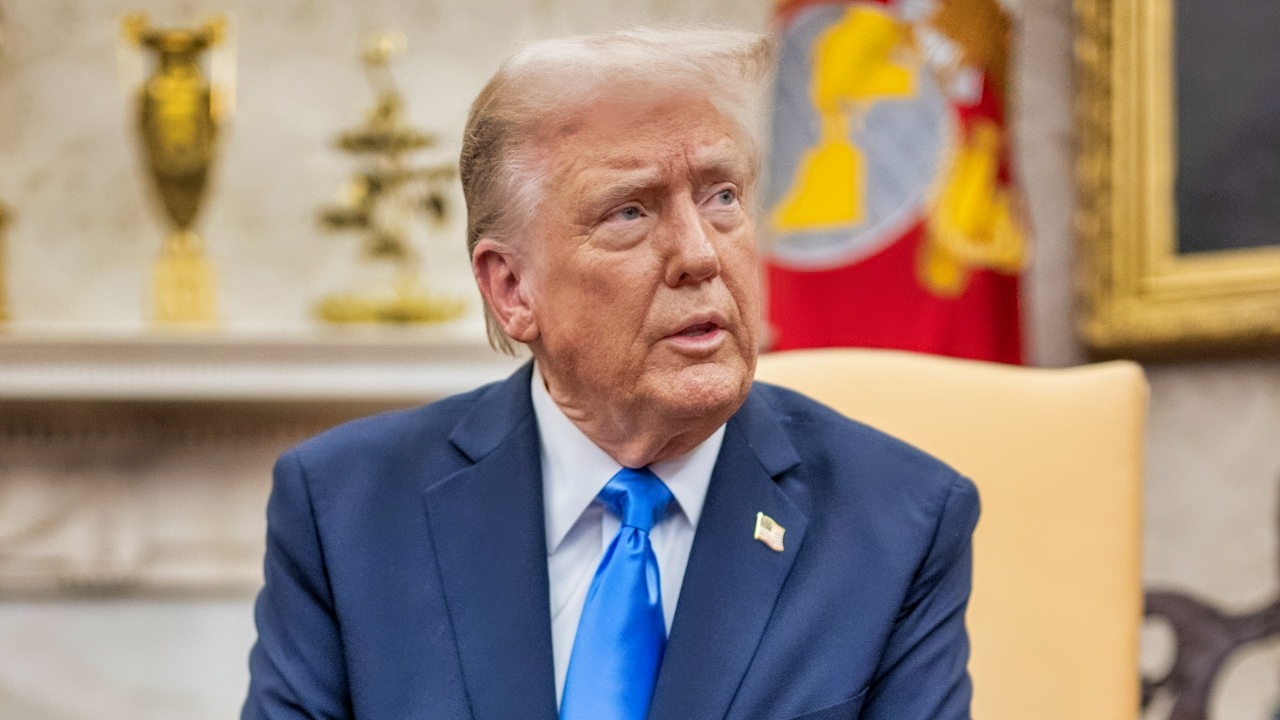
Donald Trump’s Next Big Decision on Iran – President Donald Trump faces a major decision.
A war that he claimed would be completed in a matter of weeks is now entering its seventh month. Iran, battered militarily, shows no sign of giving in to U.S. demands. Even though mass bombardment has made way for economic sanctions, the authoritarian regime still holds leverage in the war and has proven it can still reach U.S. military targets in the Middle East despite its weakened position.

Aircraft Carrier USS Nimitz Coming Home. Image Credit: Creative Commons.

A U.S. Navy MH-60S Seahawk helicopter with Helicopter Sea Combat Squadron (HSC) 9 transfers ammunition between aircraft carriers USS George H.W. Bush (CVN 77), foreground, and USS Harry S. Truman (CVN 75) in the Atlantic Ocean Feb. 17, 2011. (U.S. Navy photo by Mass Communication Specialist 3rd Class Leonard Adams/Released)
Trump must now make his next steps carefully.
An Unconventional Conflict
Upon launching Operation Epic Fury, the U.S. and Israel sought to wipe out the Iranian regime in a matter of weeks. Bombs rained down day and night across the Persian state for weeks on end, decimating Iran’s military capability. When it could respond, Iran saw its missiles often intercepted by either Israel’s Iron Dome or the air defenses of countries that host U.S. military bases. That’s not to say that Iran’s attack was completely redundant, but in a conventional war many would argue the nation had been defeated.
But this is not a conventional war, if such a term even exists in the 21st century. The Iranian regime may have new faces at the table of power – even if some of them have not been seen in months – yet the authoritarian decision-makers still hold the power as they have done since 1979.
Had the war been won, we’d likely be talking about forthcoming democratic elections in Iran, rather than wondering how to reach a permanent solution to the conflict.
Money Replaces Military
Since April, both sides have used economic leverage rather than ballistic missiles to claim victory. The U.S. has used further economic sanctions, possibly extending to Iranian trading partners, as well as a blockade of Iranian ports to cripple its enemy’s economy.
Tehran too has waged economic conflict. By closing the Strait of Hormuz, Iran has brought other nations – many of whom possess little interest in the military conflict – into the war. 20% of the world’s oil cannot pass through the key waterway, with knock-on effects on Middle Eastern countries that export oil and on others worldwide that import it. This cost-of-living increase is being felt in America just as it is around the world.
It’s this leverage that has kept Iran in the conflict. There’s hardly any worldwide support for Tehran; likewise, few Western allies have urged the U.S. to continue its campaign, let alone join it. While Iran says what goes in the Strait of Hormuz, it still has a (relatively slim) fighting chance.
Retaliation at the Ready
Even since fighting largely ceased back in April, the two warring nations have exchanged military strikes across much of the summer. Although a month passed without incident, the U.S. and Iran clashed on Sunday, 30th August, when the former struck two missile launchers on Larek Island, citing concerns over the deployment of sea mines in the Strait of Hormuz. In retaliation, Iran targeted a U.S. military base in Jordan, with the country’s armed forces intercepting eight missiles in its airspace.
This tit-for-tat fighting creates major uncertainty. Trump vowed to retaliate against strikes that Tehran sees as retaliation in itself, and a vicious circle can soon form as both sides retaliate against the other’s retaliation.
Trump’s Big Decision
There is always a political element in conflict, and the President faces midterms in just two months. 55% of Americans oppose the conflict in Iran, with Trump’s own approval ratings dropping below 30% in some polls.
This electoral cycle will see Senators first elected in 2020 fight for their seats, and the President can take some comfort in the fact that those defending their place in Congress last did so when Trump was voted out of office. The House, of course, is entirely up for grabs on its two-year cycle, and so Trump faces the prospect of a difficult final two years as the nation’s Commander-in-Chief.
An end to the war and its associated ramifications could bolster the GOP’s chances this November. Trump has mostly maintained the economic approach to try to force Iran into capitulation, but the past five months suggest that is unlikely to happen in the forthcoming two. His only alternative, therefore, would be through military action. And that, given the war’s already deepening unpopularity, is a huge risk to take.
About the Author: Shay Bottomley
Shay Bottomley is a British journalist. He has written for the Western Standard, Business Insider, Maidenhead Advertiser, Slough Express, Windsor Express, Berkshire Live and Southend Echo.