

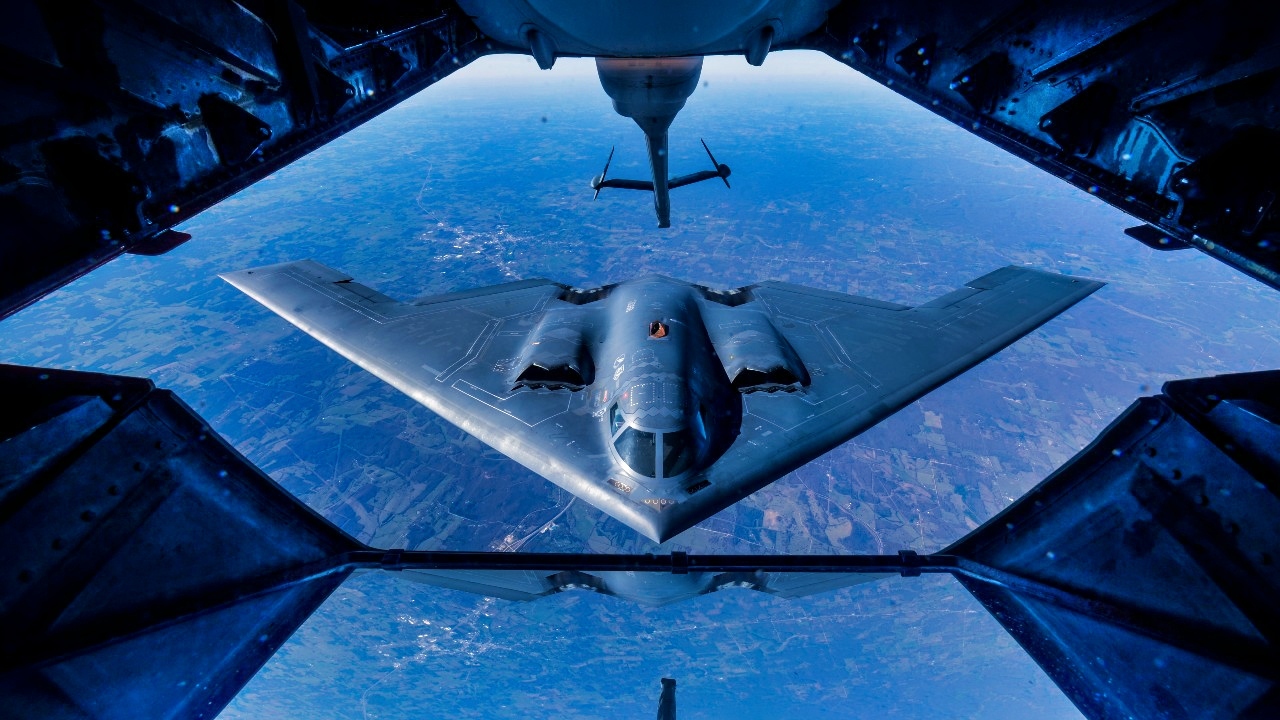
President Donald Trump warned Wednesday that the United States would “wipe out” Iran if Tehran carried out an alleged plot to detonate a radioactive bomb on American soil.
Speaking to reporters in Shenzhen, China, during the APEC summit, Trump was asked whether Washington residents should fear an Iranian dirty-bomb attack. “I don’t think so, no,” Trump replied. “I mean, look, if it does happen, we’ll wipe them out.” The comments followed reports that American intelligence had identified possible Iranian plans to target senior administration officials.
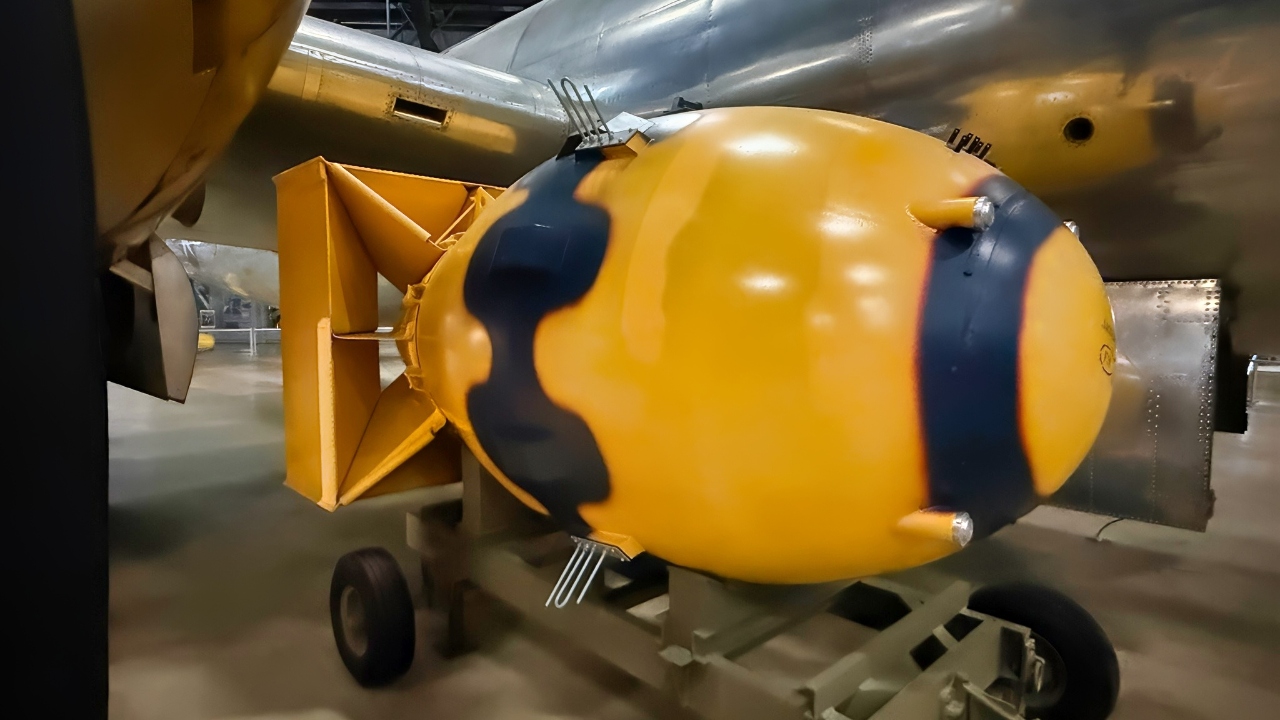
Fat Boy Near B-29 At USAF Museum. National Security Journal Photo.
Trump’s language raises the possibility of overwhelming military retaliation, potentially including nuclear weapons, although he did not explicitly threaten a nuclear strike.
What is Iran Planning?
According to CNN reporting summarized by The Hill, US intelligence suggests Iran has explored plans involving a dirty bomb targeting senior American officials.
The reported threats have prompted conflicting assessments from the Trump administration.
Trump said Tuesday that he took the allegations “very seriously” and warned Iran would pay an unprecedented price. On Wednesday, Trump also claimed there were indications Iran was considering chemical or biological attacks. Director of National Intelligence Jay Clayton reportedly told lawmakers that Iranian threats against American personnel had increased substantially.
However, Homeland Security Secretary Markwayne Mullin characterized the reported planning as “aspirational” and said there was no new threat.
What is a Dirty Bomb?
A dirty bomb is a radiological dispersal device, or RDD. Unlike a nuclear weapon, it does not produce a nuclear chain reaction. Instead, it combines a conventional explosive with radioactive material.

A United States Air Force B-2 Spirit Bomber from Whiteman Air Force Base, Missouri, undertook a hot pit refueling operation at Lajes Field, on September 12, 2023. The B-2 Spirit Bomber stop at Lajes highlights the readiness and capability of the men and women of the 65th Air Base Group to support global operations when called upon. (U.S. Air Force photo by Cristina Oliveira)

Airman 1st Class Tommy Day (left), Senior Airman Phillip Ruiz (center) and Tech. Sgt. Dwayne Bolles prepare to load a BDU-56 bomb on a B-2 Spirit bomber at Andersen Air Force Base, Guam, on April 11, 2005. The airmen are Air Force weapons specialists deployed from the 509th Aircraft Maintenance Squadron, Whiteman Air Force Base, Mo.
(DoD photo by Master Sgt. Val Gempis, U.S. Air Force. (Released))
When the explosive detonates, it can scatter radioactive contamination into the surrounding environment.
The immediate danger generally comes from the conventional explosion itself, which can kill or injure people nearby.
Radioactive contamination could create additional exposure risks and force authorities to restrict access to affected areas.
The severity would depend on the radioactive material involved, the amount dispersed, environmental conditions, and the location.
Dirty bombs are generally considered far less destructive than nuclear weapons, and their potential impact includes, in part, public fear, expensive cleanup operations, and collateral disruptions (i.e., transportation and commerce, etc.).
How Realistic is the Attack?
Unlike nuclear weapons, dirty bombs do not require the ability to produce a nuclear explosion. A state or terrorist organization would nevertheless need access to suitable radioactive material and a means of dispersing it. Could such an organization obtain radioactive material?
It’s possible, as radioactive materials have legitimate medical, industrial, and scientific applications, making them harder to secure.
However, acquiring material does not automatically translate into an effective weapon; radiation exposure from a dirty bomb is highly dependent on circumstances, and many plausible attacks would cause only limited immediate radiological harm.

B-2 Stealth Bomber at USAF Museum July 19 2025. Image Credit: Harry J. Kazianis/National Security Journal.
The larger consequences could relate to evacuations, public anxiety, or prolonged cleanup efforts.
It’s also important to note that no successful dirty bomb attack has ever been documented in the United States.
Is Trump Threatening Nuclear War?
Trump’s threat to “wipe out” Iran is unusually severe language from an American president.
The phrase could be interpreted as threatening overwhelming conventional military force, or it could possibly be interpreted as threatening nuclear retaliation.
But Trump did not specify what weapons the United States would employ in retaliation for a dirty bomb attack. Were Iran to launch a successful dirty bomb attack, that would not constitute a nuclear detonation, and American nuclear policy has historically reserved the possibility of nuclear retaliation for extreme circumstances.
The distinction matters because a US nuclear strike against Iran would represent a massive escalation.
Trump’s warning therefore creates strategic ambiguity, as Tehran cannot know exactly what he meant.
Iran Denies the Allegations
Iranian officials have categorically rejected the reported dirty bomb plot, with foreign ministry spokesperson Esmaeil Baghaei describing the allegations as baseless and fabricated.
Foreign minister Abbas Araghchi dismissed the reporting as “RUBBISH” and compared it to propaganda preceding the Iraq War.
The denials do not disprove the plot.

B-2 Bomber Attacking with Bombs. Image Credit: Creative Commons.
At the same time, the Trump administration has not publicly provided evidence that establishes the alleged plot.
Trump’s warning puts Iran on notice, and an attack involving radioactive material could trigger a devastating American retaliation.
But important questions remain about the alleged plot, its feasibility, and the nature of the threat.
And of course, President Trump often speaks off the cuff without thinking, and without necessarily linking his words to his intentions.
About the Author: Harrison Kass
Harrison Kass is a writer and attorney focused on national security, technology, and political culture. His work has appeared in Tablet, City Journal, The Hill, The Spectator, and The Cipher Brief. He holds a JD from the University of Oregon and a master’s in Global & Joint Program Studies from NYU. More at harrisonkass.com.


