

After an historic (iconic, some might even say) meeting between the leaders of the world’s three greatest powers–the United States, China, and Russia–U.S. President Donald J. Trump has indicated that he is again considering not striking the Islamic Republic of Iran.
While there have been no inputs stating that the president was moved by whatever he may have been told at the trilateral conference in Shenzhen, it is clear that the Chinese and Russian leaders had some impact on his war fever (just as the decisive defeat in the Midterms at the hands of the Democratic Party did).
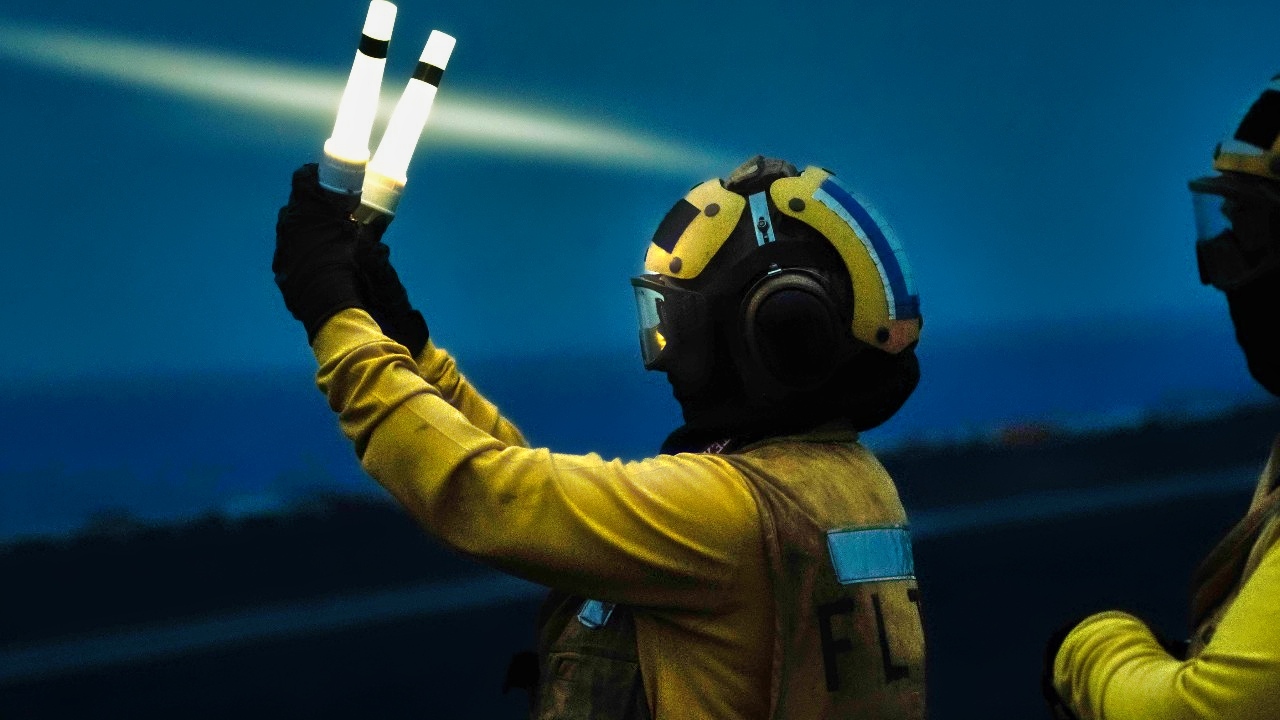
U.S. 5TH FLEET AREA OF OPERATIONS (Aug. 6, 2024) An Aviation Boatswain’s Mate (Handling) signals aircraft on the flight deck of the Nimitz-class aircraft carrier USS Theodore Roosevelt (CVN 71), Aug. 6. Theodore Roosevelt is deployed to the U.S. 5th Fleet area of operations to support maritime security and stability in the U.S. Central Command area of responsibility. (Official U.S. Navy photo)

(Jan 31, 2009) An F/A-18 Super Hornet assigned to the Tomcatters of Strike Fighter Squadron (VFA) 31 launches from the flight deck of USS Theodore Roosevelt (CVN 71). The Nimitz-class aircraft carrier and embarked Carrier Air Wing (CVW) 8 are operating in the 5th Fleet area of responsibility and are focused on reassuring regional partners of the United States’ commitment to security, which promotes stability and global prosperity (U.S. Navy photo by Mass Communication Specialist 3rd Class Jonathan Snyder/Released)
Trump Favors Avoiding Renewed War Now
Trump is clearly seeing that diplomacy remains the best of bad options.
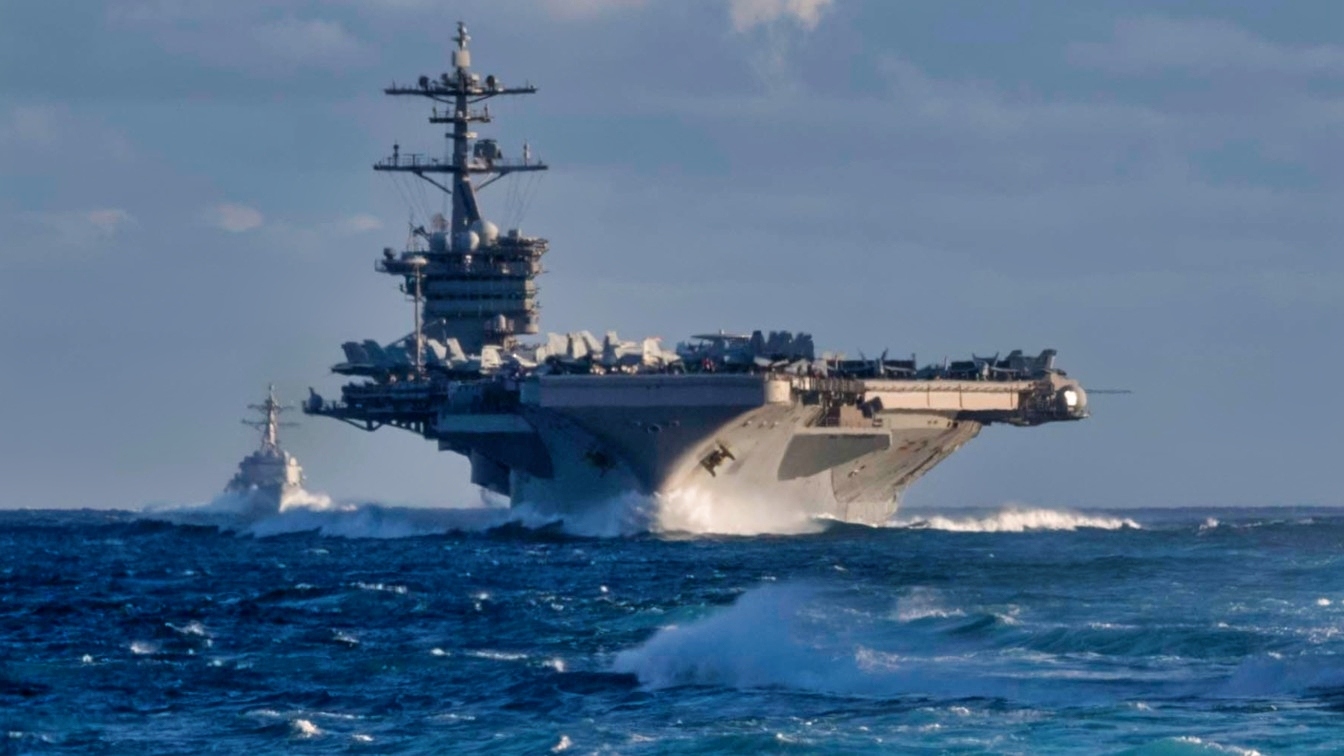
Even the USS George Washington, one of the three aircraft carriers operating in the Middle East, was pulled out of the region after the USS Theodore Roosevelt entered.
In effect, the Navy reduced its presence in the region.
In fact, it wasn’t only the carrier that left for the PACOM area of responsibility.
She took her escorts with her. So, while the Navy maintains a large flotilla in the Middle East, it is now down one of three aircraft carriers and several escort ships.
This likely indicates that President Trump is contemplating a de-escalation. That’s not a guarantee.
The president is highly mercurial, and he is surrounded by war hawks who constantly whinge about the need for more war. Trump could reverse course and restart hostilities with Iran.
But there is no strategic upside to doing so. Fundamentally, the country’s military leadership knows this. On some level, Trump knows this to be true as well.
That’s another reason why, despite his bluster, Trump resists restarting the war.
Writing in Axios, Barak Ravid insists that Trump has not yet made up his mind. Indeed, at the conference in Shenzhen, Trump publicly alluded to wanting to fend off the war, not simply secure a ceasefire.
He stated that he wanted a lasting deal with Tehran that would outlast his presidency and be stronger than what came before. Interestingly, this is precisely what the Iranians want.
They do not want a temporary ceasefire that would allow for the Americans and/or Israelis to restart the conflict at a more fortuitous moment for them.
While everyone is fixated on Trump’s bellicosity before the conference, they miss the signal that Trump is looking for another route other than a return to full war.
That doesn’t mean that there will be a deal.
It just means that it is not a fait accompli, contrary to what the neoconservatives claim, that the Americans are returning to war.
The Israelis, too, keep saying that the war is all but restarted.
These are incredibly self-serving claims for the Israelis and their neoconservative allies in the United States, who are desperate for the United States to restart the war in full before the political conditions both in Washington and Tel Aviv change dramatically (beyond how they already have changed).
Political Conditions Matter
President Trump’s party received a thrashing in the Midterms. We are talking about a historic, generational defeat the likes of which we probably haven’t seen since the Watergate scandal in the 1970s.
In January, which is right around the corner, the entire political scene in Washington changes in ways that are not conducive to the 47th president waging another long war in the Middle East.
There are already rumblings among the Democrats that, if Trump does restart the war before the Democratic majorities are sworn in, the Democrats will push through a war powers vote and will subject the Trump administration to the most onerous investigations possibly ever experienced by Trump and his team.
This is not like the 2006 Midterms, where the Republicans still had some maneuvering room to wage the Iraq War.
It isn’t like the first Trump term, when even after the Democrats won the House in 2018, the Republicans still had enough seats to slow down what the Democrats want to achieve legislatively and in terms of oversight.
That is not the case in the next Congress.
The Democrats have such majorities that the Trump administration really cannot wage the war beyond this year (if the Democrats are serious about living up to the will of the voters, who overwhelmingly voted for the Democrats to end Trump’s war of choice in the Middle East).
Trump knows this, too, and it seems he wants to refocus on partisan battles (such as sending Vice President JD Vance to hunt down alleged corruption in Blue Cities and elevating Stephen Miller to White House Chief of Staff).
Netanyahu Is Boxed In (and Boxed Out)
On the flip side, in Israel, Prime Minister Benjamin Netanyahu is a mere caretaker prime minister. Of course, he still retains the full power of his office.
But he is unpopular (even if his party is not), and Gadi Eisenkot is working efficiently to finalize the establishment of a new coalition government, meaning the Israeli government’s ability (or will) to restart conflict with Iran is low.
In fact, Jonathan Schanzer of the Foundation for the Defense of Democracies (FDD) told me in an interview on the Mario Nawfal Show on Twitter/X that he was skeptical Netanyahu could restart the war even though the Israeli caretaker prime minister clearly wants to.
Given that, it is strange that there is any pressure whatsoever on the American president to restart the war from the American side, considering that the Israelis and their allies in Washington are the only ones who want the war to restart.
Trump is hesitant because he understands the implications and risks of restarting the unpopular war. Netanyahu is hemmed in because Eisenkot is clearly readying to succeed him after winning the recent Israeli elections.
There is simply no incentive or way for the US to restart the war and have any meaningful chance of winning it.
Trump Will Huff-and-Puff But He Won’t Blow The House Down
And for all the fears over Trump launching nuclear weapons, he seems to have dispelled that notion at the Shenzhen conference, when he spent much time–and agreed with–the shared sentiment on the need to denuclearize between the three great powers.
If he’s talking like that and agreeing to that, why assume that he will so willingly employ nuclear weapons in Iran?
While we can never discount the chances that the incredibly unpredictable Trump changes his mind on striking Iran, we must remember that the political and military factors are working against the restarting of the conflict.
Thus, it is unlikely that the war will resume, no matter how much encouragement the neocons in the press give Trump.
About the Author: Brandon J. Weichert
Brandon J. Weichert is the Senior National Security Editor. He also manages The Weichert Brief on Substack. Weichert is the co-host of The Mario Nawfal Show on Twitter/X. He is the author of four bestselling national security books, most recently A Disaster of Our Own Making: How the West Lost Ukraine (Encounter Books). His next book, Fortress Americas: A New Monroe Doctrine (Tucker Carlson Books), is due out December 8. Follow him via Twitter/X @WeTheBrandon.


