


For the first time since the fighting in Iran reerupted again two weeks ago, the United States has used a B-1B Lancer bomber in combat operations against Iran’s Islamic Revolutionary Guard Corps.
Although not explicitly mentioned in U.S. Central Command’s updates about the course of the war, aviation websites spotted the bomber, which launched from an airbase in the United Kingdom, according to Axios.

A U.S. Air Force B-1B Lancer departs after conducting aerial refueling with a 28th Expeditionary Air Refueling Squadron KC-135 Stratotanker during a mission in the U.S. Central Command area of operations, Oct. 25, 2019. The B-1B flew directly from its home station of Ellsworth Air Force Base, S.D., demonstrating the U.S. Air Force’s ability to rapidly deploy strategic bombers anywhere in the world. (U.S. Air Force photo by Master Sgt. Russ Scalf)

The Oklahoma City Air Logistics Complex at Tinker Air Force Base, Oklahoma, is the largest depot repair complex in the Air Force. The Complex’s depot Artisans perform award-winning program depot maintenance and modifications on B-1 Lancer aircraft, supporting the sustainment of combat-ready airpower. (U.S. Air Force photo/Gina Anderson)
“CENTCOM assets targeted Iranian military operations centers, maritime capabilities, aircraft hangars, drone storage facilities, and military logistics infrastructure to further degrade Iran’s ability to threaten commercial shipping in the Strait of Hormuz,” U.S. Central Command explained.
“Over the past three months, Iran has attacked more than 30 commercial vessels transiting the international waterway vital for regional and global trade. The unwarranted attacks have endangered hundreds of innocent mariners and undermined freedom of navigation.”
“Despite Iranian aggression,” U.S. Central Command added, “the Strait of Hormuz remains open for commercial vessel transit. Since early May, CENTCOM forces have helped facilitate the transit of approximately 900 commercial vessels and 450 million barrels of crude oil.”
The United States previously employed B-1B Lancer bombers during earlier stages of Operation Epic Fury, leveraging the Lancer’s large payload capacity to target a wide variety of Iranian military infrastructure.
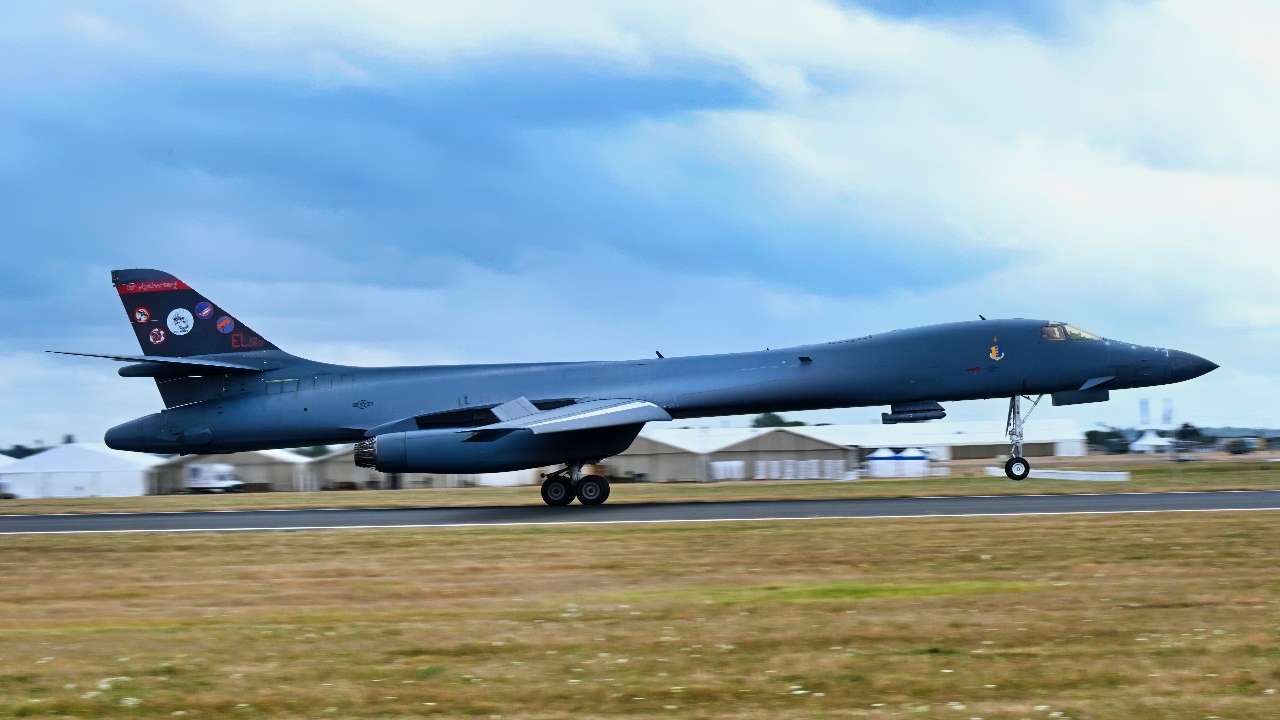
B-1B Lancer Bomber. Image Credit: Creative Commons.
B-1B Lancer
The B-1B Lancer was conceived during the Cold War as a strategic nuclear bomber that was to penetrate some of the world’s most dense, sophisticated air defense networks.
In the late 1960s, the United States began considering a successor to the B-52 Stratofortress, that workhorse of the Cold War. At the time, Soviet advances in radar technology, fast interceptor aircraft, and long-range surface-to-air missiles eroded confidence in high-altitude bomber survivability — an absolutely vital pillar of nuclear deterrence.
To preserve the American edge in the air, a different kind of bomber was needed, one that could reliably evade Soviet air defenses and survive. Such a platform would have to combine multiple qualities, including a high top speed, respectable range and payload capacity, as well as the ability to fly at low altitude, following the ground and evading enemy radar. The resultant aircraft design was the B-1.
The bomber’s variable-sweep wings allowed it optimal flight characteristics for a variety of flight profiles. For efficient cruising and take-off, the jet bomber could sweep its wings forward. When at altitude, or during penetrative bombing runs, its wings would then be swept back for high-speed flight. Propelled by a total of four afterburning turbofan engines, the B-1 could exceed Mach 1.2 while simultaneously carrying one of the largest payloads of any combat aircraft. Unlike the later B-2 Spirit, which relied on stealth, the B-1 relied on a combination of speed, electronic countermeasures, and low-level flight to reliably reach its target and return to base.
A War with Expanding Fronts
On Wednesday this week, the Houthis, the Iran-backed Shia terror group based in Yemen, made good on their pledge to enforce an embargo on Saudi Arabia, one of Iran’s chief rivals in the region, by blocking access to the Bab al-Mandab Strait, a narrow maritime bottleneck that links the Red Sea and the Gulf of Aden.
Thanks to Iran’s blockage of the Strait of Hormuz, Saudi Arabia has leveraged Yanbu, its port on the Red Sea, to transport oil out to the wider world. Accessed via the East-West oil pipeline, Riyadh has been able to bypass the Strait of Hormuz and keep some of its exports flowing. But Houthi strikes against the Saudi tankers upend that equation — and raise the prospect of expanding the current war to a nearby but distinct front.

A U.S. Air Force B-1B Lancer assigned to the 37th Bomb Squadron receives maintenance during Red Flag 24-3 at Nellis Air Force Base, Nev., July 24, 2024. Red Flag is an exercise that provides Airmen and Guardians with the opportunity to work alongside allied air forces in a realistic combat training environment. (U.S. Air Force Photo by Senior Airman Yendi Borjas)
Against the backdrop of the Houthis’ actions is the American President and his recent comments about bringing Tehran back to the negotiation table through overwhelming force. On Friday, the president left the door open to further negotiations with Iran, though he also raised the distinct possibility of further use of force.
“There’s a military exit where we just keep going just the way we are, and we can even make it a heavier dose, and it’s knocking out everything they have. Or there’s a smarter strategy that you make a deal. And they want to make a deal,” President Trump said to a group of reporters. “As we speak, we’re talking to them.”
Just days ago, the president threatened Iran in his signature style during a separate interview with Axios. ”I am considering a massive attack. Bigger than ever before. I am close to making a decision. We are all set for it,” Trump said. It is unclear if furthering the military campaign will force Iran to make serious concessions. But to the American president, at least, it is an avenue for exploration.
About the Author: Caleb Larson
Caleb Larson is an American multiformat journalist based in Berlin, Germany. His work covers the intersection of conflict and society, focusing on American foreign policy and European security. He has reported from Germany, Russia, and the United States. Most recently, he covered the war in Ukraine, reporting extensively on the war’s shifting battle lines from Donbas and writing on the war’s civilian and humanitarian toll. Previously, he worked as a Defense Reporter for POLITICO Europe. You can follow his latest work on X.


