

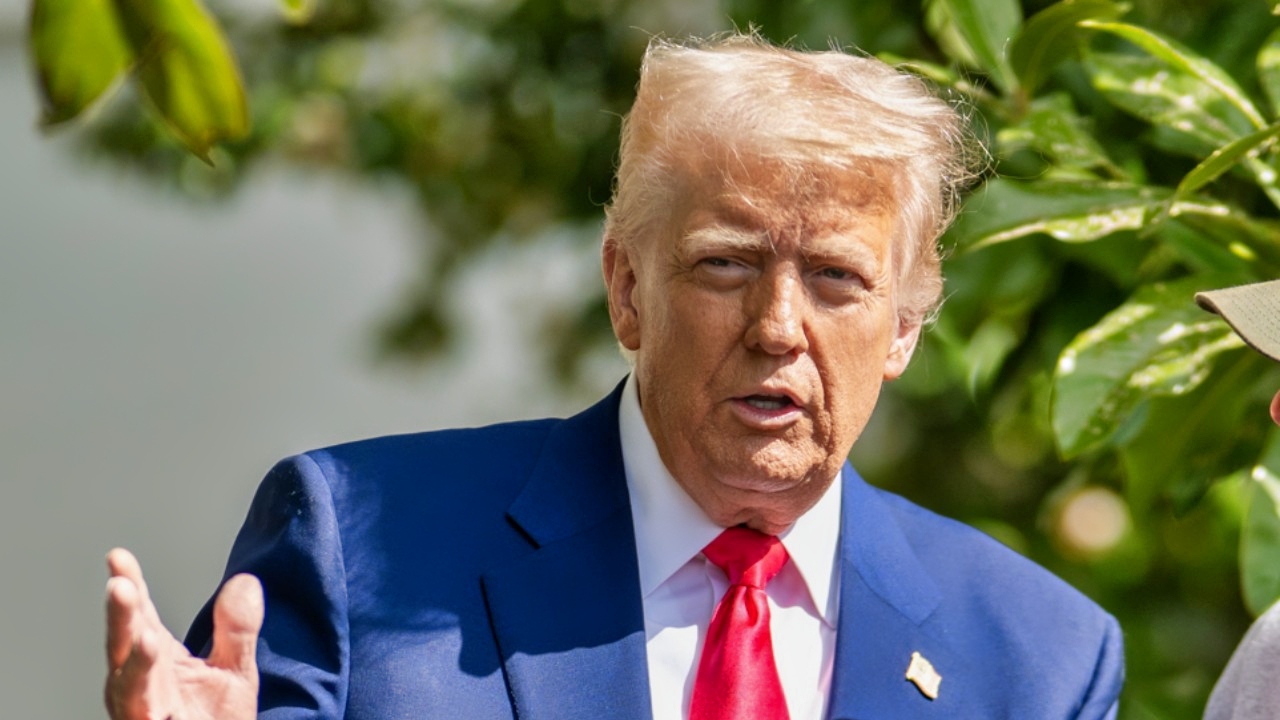
The Trump Administration’s tariff policy, which was announced a week ago today, has started to hit the presidency somewhere that he cares about: His approval rating.
Enough, in fact, that Trump on Wednesday announced a drop to 10 percent on most of the non-China tariffs.
That’s according to a new The Economist/YouGov Poll, taken between April 5 and 8 — entirely after the tariffs were announced — and released on Wednesday.
Up at the top, the poll finds that Trump has an approval rating of 43 percent, compared to 54 percent unfavorable, although if it’s any consolation for the president, Vice President J.D. Vance’s approval rating is just 38 percent, while Elon Musk comes in at 40 percent.
The favorability ratings for a pair of cabinet secretaries associated with the tariffs, Treasury Secretary Scott Bessent and Commerce Secretary Howard Lutnick, are both in the teens, as is that of Sen. Mitch McConnell (R-KY), a man not especially liked at this point by members of either party.
The poll also finds that 54 percent of respondents see things in America as “off on the wrong track,” while 35 percent say the nation is “Generally headed in the right direction,” while 12 percent answered “not sure.”
Tariff Issues: Is This a Good Economy?
The numbers also aren’t very positive for the president when it comes to the economy specifically.
When asked how important certain issues are to them, a full 98 percent answered yes to “Jobs and the economy,” and when they were asked what issue is most important to them, the top two answers were “inflation/prices” and “jobs and the economy.” And when asked specifically how Trump is handling jobs and the economy, 41 percent approved while 51 percent disapproved.
The survey also asked respondents what they consider the best measure of how the economy is doing. While just 11 percent answered “the stock market index,” 50 percent answered “The prices of goods and services you buy.”
Unfortunately for Trump, the tariffs seem likely to hurt both, in a way that large numbers of Americans are likely to notice.
Testing the Tariffs
The survey also asked what respondents think specifically about Trump’s handling of foreign trade. To that question, 39 percent said they approved, while 50 percent said they disapproved, which were similar to the numbers on the question about the economy itself.
When asked whether the U.S. should trade more or less with other countries, 27 percent answered “increased,” 34 percent said “kept the same,” and just 15 percent said “decreased,” which seems to be the path Trump has chosen.
When they were asked whether free trade agreements have been a good or bad thing for the United States, 42 percent said “good,” 22 percent said “bad,” and 36 percent said “not sure.”
When respondents to the poll were asked whether tariffs on foreign goods brought into the U.S. should be increased, decreased or kept the same, 20 percent answered “increased,” 28 percent answered “kept the same” and 34 percent said “decreased.” And 18 percent said “not sure.”
And finally, when asked what effect on prices tariffs would have, 77 percent answered “increases prices,” while 13 percent said “not sure.”
The Bottom Line and What Comes Next for Trump
As evidenced by that “not sure” number, large numbers of Americans likely don’t have an expert understanding of trade policy and how tariffs work. Many have argued that Trump and his advisers don’t have such a great understanding of those things either.
However, Americans are very likely to notice the effects of those trade policies, whether they mean higher prices on things they pay for every day or a big hit to their stock portfolio or retirement account.
Trump came back into office, in large part, because inflation was too high under the Biden presidency and it had an effect on people’s day-to-day lives. The direction that those things go could ultimately determine the direction of Trump’s second presidency.
About the Author:
Stephen Silver is an award-winning journalist, essayist and film critic, and contributor to the Philadelphia Inquirer, the Jewish Telegraphic Agency, Broad Street Review and Splice Today. The co-founder of the Philadelphia Film Critics Circle, Stephen lives in suburban Philadelphia with his wife and two sons. For over a decade, Stephen has authored thousands of articles that focus on politics, technology, and the economy. Follow him on X (formerly Twitter) at @StephenSilver, and subscribe to his Substack newsletter


Michael Rozelle
April 9, 2025 at 3:38 pm
Collapsed is exaggeration. President Trump’s poll number has slipped from 51% approval to 47%. The narrative from the left has been and will always be negative towards Trump. He could cure cancer and bring world peace the left and the media would still berate the man.
Pingback: Bad News Thanks to Trump's Tariff War: The U.S. Dollar Is in Trouble - National Security Journal
Pingback: Trump Has a Problem: The 'Foundation of His Power' is Disintegrating - National Security Journal