


PUBLISHED on August 16, 2025, 09:04 AM EDT – Key Points and Summary: The U.S. Senate is proposing a new Pentagon “Economic Defense Unit” to counter “gray zone” warfare, particularly economic coercion from China.
-This move comes after incidents where Beijing punished countries like South Korea and Lithuania for policy decisions.
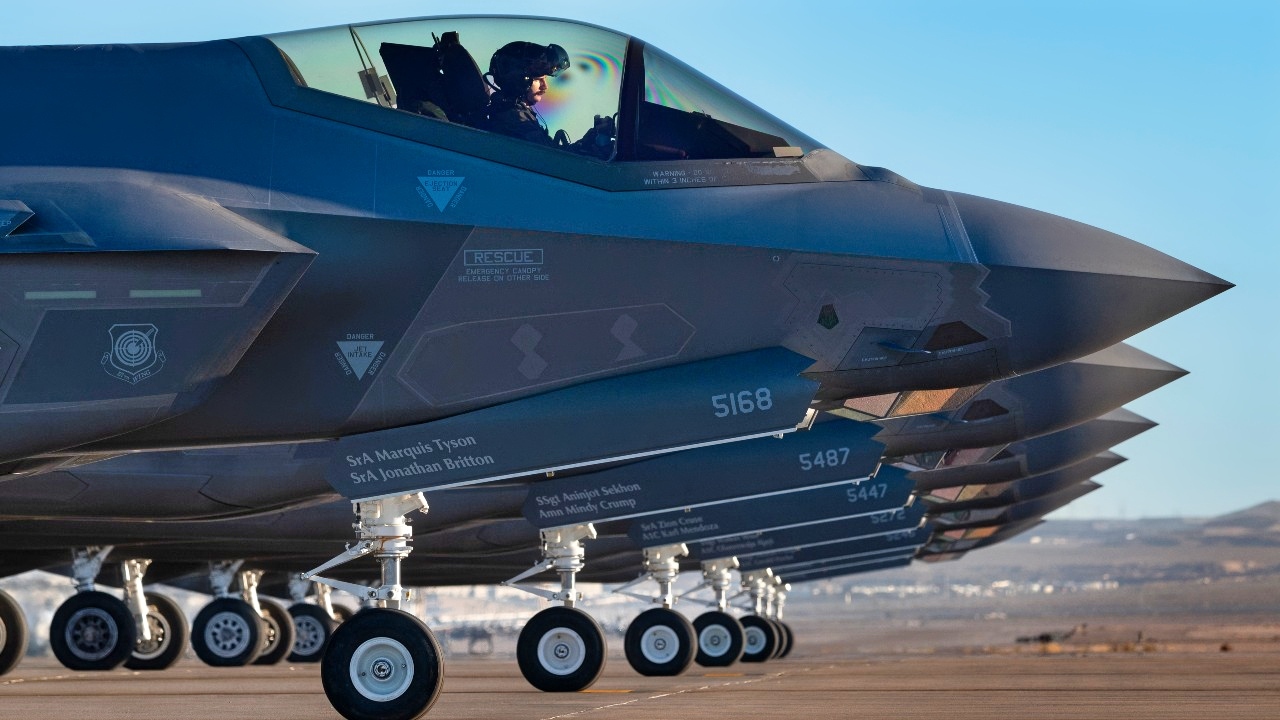
Seven F-35 Lightning II aircraft wait to take off for a U.S. Air Force Weapons School training mission at Nellis Air Force Base, Nevada, Jan. 31, 2024. The U.S. Air Force Weapons School teaches graduate-level instructor courses that provide advanced training in weapons and tactics employment to officers and enlisted specialists of the combat and mobility air forces. (U.S. Air Force photo by William R. Lewis)
Economic Defense Unit: An Idea Whose Time Has Come
It is the Department of Defense’s job to think about war. It is also the Pentagon’s job to think about war avoidance. Military leaders use terms such as “the gray zone” to describe a state of operations that sits somewhere between peace and war.
Uncle Sam defines gray zone activities as “coercive or subversive actions to achieve objectives at the expense of others in contravention or in the absence of international norms.” These nefarious actions are undertaken by adversaries to strike at U.S. interests while avoiding direct conflict. Methods can include lawfare, political warfare, information and disinformation operations, debt trap diplomacy, sanctions evasion, economic coercion, cyber and space challenges, and support for proxy forces.
Congress has been worried about gray zone activities and competition for years—especially economic coercion by China against states, entities, and companies. One example of economic coercion, cited by the Council on Foreign Relations, took place when South Korea accepted the U.S.-made Terminal High Altitude Area Defense (THAAD) antiballistic missile system after various North Korean ballistic missiles launches and nuclear weapons tests in 2016–17. With THAAD too close for comfort, Beijing retaliated by forcing a major South Korean department store chain, Lotte, “which had provided some land for THAAD, to sell its stores in China for a fraction of its investment.”
Another example of China’s deeply damaging retaliation occurred after Lithuania allowed the Taiwanese representative office in Vilnius to call itself Taiwan, rather than Chinese Taipei, in 2021. According to CFR, Beijing “stranded shipments of Lithuanian goods to China and then publicly pressured global multinationals not to do business with Lithuania.” The result was an 80 percent drop in Lithuanian exports to China that year.
Working together across the United States government, and closely with allies and partners, is the key to beating back China’s gray-zone efforts and imposing pain upon Beijing when it employs these destructive tactics. As Beijing acts with increasing aggressiveness and enjoys significant impunity, the U.S. Senate is poised to debate the annual defense policy bill. This mammoth legislation includes many laudable reforms, changes, rescissions, and recommendations.
Among them is a Senate proposal to establish a new Pentagon “Economic Defense Unit” office. This fresh organization would coordinate and harmonize economic competition activities and develop a campaign plan to shore up America’s gray zone toolkit.
Congress defines economic competition activities as actions taken to “reinforce military advantage in and through the economic domain.” That includes actions taken to
-leverage private capital and market actors;
-acquire or procure items and equipment;
-protect or enhance the economic or technological advantage of the United States or allies of the United States;
-protect or disrupt in the information environment or cyber domain or other sensitive operations; or
-leverage interagency authorities.
The Senate wants the U.S. military to get more immersed in the business of economic competition. Examples of activities that will be developed and maintained by the new Unit include requirements for:
-access, basing, and overflight rights;
-countering mobilization of adversaries;
-countering defense industrial base activities by enemies; and,
-ensuring American access to critical materials and capabilities.
As the West begins rebuilding its depleted defense industrial base, the League of Darkness countries—China, Russia, Iran and North Korea—are busy cooperating on tech sharing, industrial capacity, sanctions evasion, and military equipment swapping. When Russian President Vladimir Putin’s forces were low on artillery, North Korean leader Kim Jong Un was quick to ship him an estimated 8 million shells to kill more Ukrainians; eventually, Kim sent North Korean soldiers to die for Putin. America and her allies simply must do more in the economic domain, and this office cannot stand up fast enough.
The Pentagon Economic Defense Unit’s new director would advise the Secretary and Deputy Secretary of Defense on all the above-proposed activities, as well as “coordinate economic competition requirements or programs into joint and interagency planning activities.” This includes working with relevant private-sector actors and companies; sponsoring regular tabletop exercises related to assess the economic impacts of Pentagon decisions during crises and conflicts; evaluating the economic tools available to the U.S. government to augment military capabilities; and, analyzing planning scenarios and developing concepts, including to test proposed doctrine and tactics.
Importantly, the Economic Defense Unit would be able to fund projects to bolster America’s economic competition for deterrence and warfare, working closely with the still-expanding Office of Strategic Capital. Together, the two organizations would seek to plug related gaps identified by combatant commanders, address industrial base shortfalls, identify key investment opportunities, and help implement breakthroughs discovered during experimentation.
Uncle Sam needs the military to be more active and competitive in the economic domain. Hopefully, the Senate provision will prevail to stand up the new unit.
About the Author: Mackenzie Eaglen
Mackenzie Eaglen, now a National Security Journal Contributing Editor, is a senior fellow at the American Enterprise Institute (AEI), where she works on defense strategy, defense budgets, and military readiness. She is also a regular guest lecturer at universities, a member of the board of advisers of the Alexander Hamilton Society, and a member of the steering committee of the Leadership Council for Women in National Security. Ms. Eaglen is also one of the 12-member US Army War College Board of Visitors, which offers advice about academic program objectives and effectiveness, and serves on the US Army Science Board, an advisory body that provides guidance on scientific and other matters to the Army’s senior leadership. In 2023, she became a member of the Commission on the Future of the Navy, established by Congress to study the strategy, budget, and policy concerning the future strength of the US Navy fleet.
More Military
Su-57 vs. J-20 Fighter: Who Wins?



D-O-Y-L-E
August 16, 2025 at 9:59 am
The US doesn’t hold a candle to china’s clout against US vassals.
Even though washington night and day threatens serious economic strangulation of all types against countries that refuse to obey its orders.
All china needs to do is ban all flights crossing its territorial air-space and let’s see How the economies of US vassals like south korea and japan and germany react.
Kaput to them. But today, for them, china’s xi jinping fortunately listens to deep state-linked entities like reuters for special advice.
So, they are saved. For now.
PseudoExpertent
August 16, 2025 at 3:44 pm
Gray zone, yeah. Both US & china like to operate in the gray zone. Especially US.
Thus, Russia today can’t trust both.
Russia today, must know that both china and US operate a fractious, duplicitous and multi-hydra-headed fp (foreign policy), and so Russia must distance itself from them.
Now that Putin has successfully sidetracked trump, he must wipe out the enemy nazis ASAP.
Otherwise, he must expect trump to do a very quick move into the gray zone, and starts to up the supply of deadly US weapons to kyiv. Game over, then.
John Slep
August 17, 2025 at 12:59 pm
Don’t forget all the economic planning involved to sustain production of key common household and other critical goods once China doesn’t send their goods for American and I venture a guess European allies and probably world wide markets since world war 3 has begun.. In fact, they need to figure out what are the consequences of the entire global trade shutting down due to the risks and other realities of such a conflict.. Also, even if domestic production is able to fill some of the critical gaps in production, what is plan B when America’s adversaries decide to knock down American electric and petroleum production and distribution infrastructure, in order to severely stunt or disable American industrial capacity, as that would be a priority if they were to stand a much better chance of winning this conflict..? A much more important war effort related economic consideration than just countering grey zone operations..