

A recent New York Times report examined imagery from several US military facilities following Iranian missile and drone attacks.
Images appear to show damage incurred at multiple installations across Jordan, Bahrain, and Iraq.

F-22 and F-35 and the Flag. Image Credit: Creative Commons.

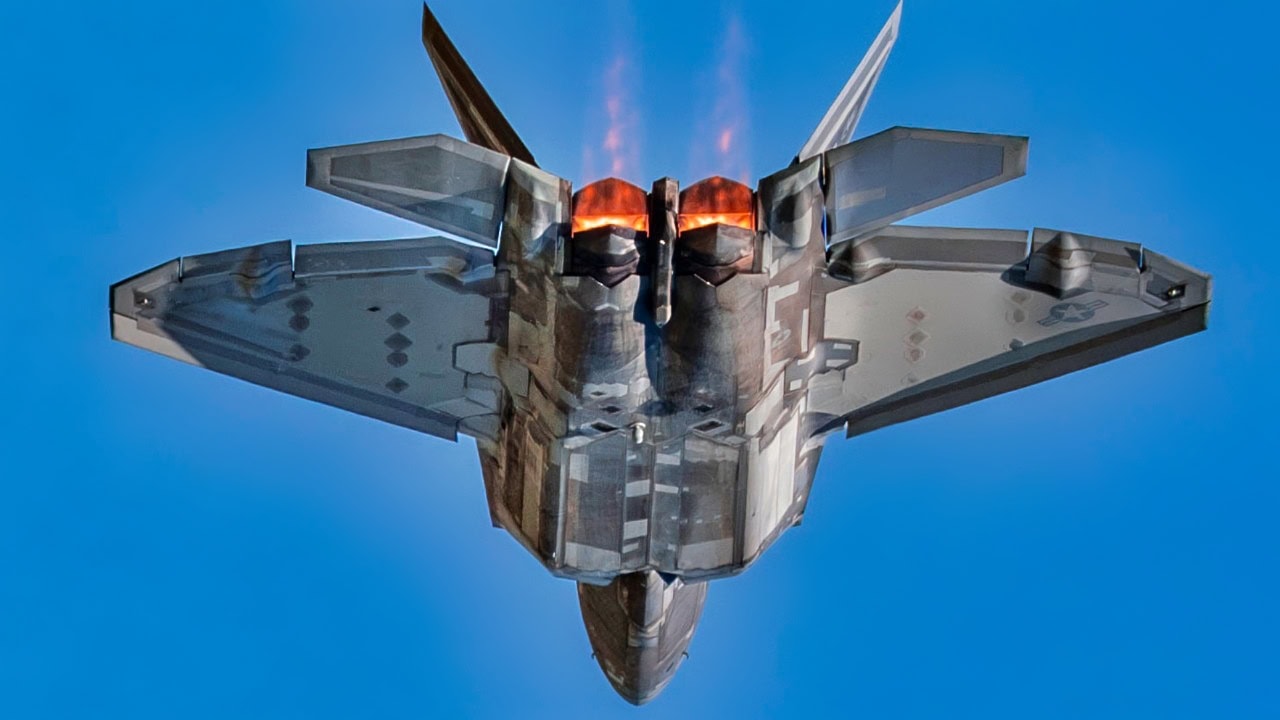
F-22 Raptor. Image Credit: Creative Commons.
While governments often disclose limited operational details, satellite imagery allows outside analysts to independently assess physical damage, and that physical damage raises a larger question: what are the strategic implications of Iran being able to physically harm US bases in the Middle East?
What the Images Showed
The NYT examined imagery before and after strikes. Several installations appeared to sustain structural damage, with the report identifying damage at Muwaffaq Salti Air Base in Jordan, Naval Support Activity Bahrain, and Al Asad Air Base in Iraq.
The damage reportedly included aircraft shelters or hangars, logistics buildings, support infrastructure, and fuel-related facilities.
The imagery clearly showed physical damage—but the images do not necessarily reveal the extent to which operational readiness was degraded.
Why These Bases Matter
Salti Air Base in Jordan is an important hub for US regional air operations. It supports coalition aircraft and is useful for operations across Syria, Iraq, and the surrounding region.
Al Asad is one of America’s best-known Iraqi installations, serving as a large logistics and aviation hub. It was previously targeted by Iranian missiles in 2020 following the Soleimani strike.
Naval Support Activity Bahrain is the headquarters of the US Fifth Fleet. It is central to US naval operations in the Persian Gulf, supporting maritime security and freedom of navigation missions.

A U.S. Air Force F-22 Raptor assigned to the 422nd Test and Evaluation Squadron at Nellis Air Force Base, Nevada, is seen on the flightline during Weapons System Evaluation Program 25.09 at Tyndall Air Force Base, Florida, Sep. 8, 2025. WSEPs are formal, two-week evaluation exercises designed to test a squadron’s capabilities to conduct live-fire weapons systems during air-to-air combat training missions. (U.S. Air Force photo by Airman 1st Class Zeeshan Naeem)
What the Strikes Demonstrate
What’s notable about the Iranian strikes is that Iranian missiles and drones were capable of reaching heavily defended facilities.
These attacks appear to have struck military infrastructure—not just empty desert.
This suggests that Iran has improved the precision of its weaponry relative to earlier generations, when missile attacks were far less reliable.
Indeed, Iran appears to have improved its long-range strike capability.
The strikes also underscore how air defense systems, even when sophisticated, struggle to intercept every single incoming weapon.
Even highly capable systems can be challenged by complex attacks; modern missile defense systems can reduce the risk and the damage of missile attacks, but not eliminate the risk or the damage entirely.
Air bases are especially difficult to defend because they are fixed. Runways cannot easily be moved. Fuel farms occupy known locations.
Maintenance hangars are permanent, as are command facilities.
This creates predictability, which Iran can exploit.
Modern precision weapons benefit from GPS guidance, terrain-following cruise missiles, and one-way attack drones. All of these tools are increasingly capable of striking fixed, predictable targets like an air base.
The strikes also reinforce something that has become obvious across multiple recent conflicts in Ukraine and the Middle East: inexpensive drones can threaten expensive infrastructure.
Large numbers of small targets can complicate air defense. Bases increasingly require layered defenses rather than a single interceptor system.
In the future, aircraft may need to be dispersed to avoid becoming such easy targets.
Moving Forward
Modern militaries may have to rethink how they operate fixed installations. Some analysts argue that strikes expose vulnerabilities in America’s regional posture.
Possible concerns, of course, are concentrating aircraft on large bases. Logistics hubs are also becoming attractive targets.
And with a widespread footprint, defending every installation becomes quite expensive.
The solution may include some combination of greater dispersal, hardened infrastructure, mobile logistics, and expanded counter-drone capability.
Other analysts are cautious not to over-conclude from the existing imagery. Satellite photographs only offer one snapshot, not a comprehensive picture.
They do not reveal sortie generation or repair timelines or classified defense successes.
They only show damaged infrastructure in the moments after that infrastructure is struck.
Temporary damage does not necessarily equal the loss of combat effectiveness.
In sum, satellite imagery definitely provides a transparent look at the physical effects of modern missile warfare.
And recent imagery suggests that Iranian strikes are capable of damaging important military infrastructure.
But photographs alone cannot determine broader operational impact.
The larger takeaway, perhaps, is that precision missiles and cheap drones are forcing militaries to rethink the value of fixed bases.
About the Author: Harrison Kass
Harrison Kass is a writer and attorney focused on national security, technology, and political culture. His work has appeared in Tablet, City Journal, The Hill, The Spectator, and The Cipher Brief. He holds a JD from the University of Oregon and a master’s in Global & Joint Program Studies from NYU. More at harrisonkass.com.


