

The United States launched a second consecutive day of strikes against Iran on Wednesday, July 9, as Washington responded to Tehran’s attacks on commercial ships in the Strait of Hormuz and the memorandum of understanding (MOU) ceasefire collapsed.
Overnight, U.S. fighter aircraft struck around 90 military targets throughout southern Iran, targeting missile batteries and drone facilities, as well as Iranian logistics hubs and naval infrastructure.
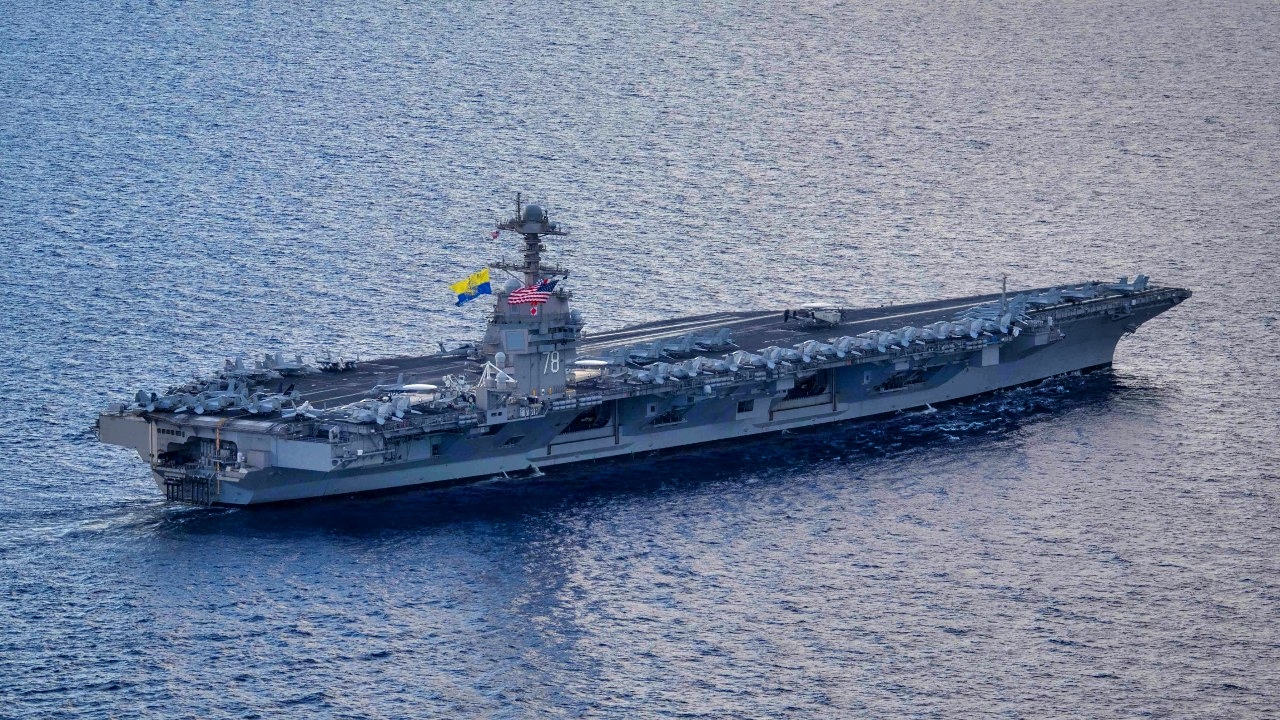
The world’s largest aircraft carrier USS Gerald R. Ford (CVN 78) sails in the Mediterranean Sea, Dec. 31, 2023. The U.S. maintains forward deployed, ready, and postured forces to deter aggression and support security and stability around the world. (U.S. Navy photo by Mass Communication Specialist 2nd Class Jacob Mattingly)

(Aug. 8, 2017) The Nimitz-class aircraft carrier USS George H. W. Bush (CVN 77) at sea during exercise Saxon Warrior 2017, Aug. 8. Saxon Warrior is a United States and United Kingdom co-hosted carrier strike group exercise that demonstrates allied interoperability and capability to respond to crises and deter potential threats. (U.S. Navy photo by Mass Communication Specialist 1st Class Theron J. Godbold /Released)
The strikes against Islamic Revolutionary Guard Corps (IRGC) targets came just hours after U.S. President Donald Trump declared in Ankara that he saw the MOU as “over” following Iran’s latest aggression.
Dramatic Reversal
The latest U.S. operations, which saw far heavier strikes than the last U.S. retaliation, represent a dramatic reversal compared to the week before, when Washington attempted to avoid reigniting the conflict as funeral ceremonies were held throughout Iran for the country’s late supreme leader.
The U.S. president had publicly said that he was prepared to give Tehran “a week off” during the mourning period – but Iranian forces still opted to launch drone attacks against commercial vessels transiting the Strait of Hormuz, prompting the United States to resume military operations.
Commercial Ships Under Attack
Iranian forces this week attacked three commercial vessels transiting the Strait of Hormuz.
One of the ships, the LNG tanker Al Rekayyat, remains stranded near the Omani coast after sustaining damage during the attack.
The other two vessels were reported to have been struck by projectiles while sailing through the strait, but no fatalities or significant environmental damage were reported.
The United Kingdom Maritime Trade Operations (UKMTO) center reported that a commercial vessel sailing around eight nautical miles east of Limah, Oman, was struck on its port side by a projectile.
A fire broke out on board but was extinguished by the crew, and no injuries were reported.
The attacks immediately disrupted shipping, with Reuters reporting that tanker traffic through the Strait of Hormuz had slowed to a “near standstill” by the morning of Thursday, July 9.
“Just two tankers had so far sailed through the strait in the early hours of Thursday. They included the crude supertanker Berg 1, which had loaded at Iran’s Kharg Island and is subject to U.S. sanctions, according to analysis from Kpler,” the outlet reported.
Tehran’s Interpretation of the MOU
Arguably, Tehran believed it was justified in launching attacks in the Strait of Hormuz, even with the MOU in place, because both sides interpreted the agreement differently.
Rather than simply seeing the MOU as a mechanism to reopen the Strait of Hormuz following months of conflict, as both sides worked toward a permanent peace deal, the regime seemed to believe it had established a new system in which it played a central role in administering shipping.
Iranian negotiators believed, or at least insisted, that all vessels must follow routes approved by Tehran rather than freely choose lanes on either side of the strait.
When announcing the MOU on June 15, President Trump described the Strait of Hormuz as being permanently reopened and said that ships would once again be able to transit the waterway “toll-free.”
There was no indication from Washington that Iran would gain the authority to dictate routes or charge commercial vessels for passage. Tehran, however, soon began describing a very different arrangement.
Speaking during negotiations in late June, Iranian chief negotiator and parliament speaker Mohammad Bagher Ghalibaf said:
“Everyone should know that the administration of the Strait of Hormuz will never go back to the way it was before the war.”
Ghalibaf said that Iran and Oman would assume a greater role in managing navigation through the strait and argued that shipping companies should be required to pay for the security and environmental services provided by the two coastal states. Iranian officials effectively argued in favor of a de facto toll, but this week Omani authorities notified the United Nations that they do not support introducing transit fees in the strait, adding further confusion to the matter.
The Gulf Pushes Back
Overnight, Iran responded to U.S. strikes by launching fresh attacks against neighboring Gulf states.
Iranian forces targeted sites across Kuwait, Bahrain, Qatar, and Jordan, with the IRGC claiming that it had launched missiles and drones at Patriot air defense systems in Kuwait and an early warning system in Qatar. Fuel storage facilities were also reportedly targeted in Bahrain.
Jordan confirmed that it had intercepted Iranian missiles headed toward Azraq Air Base, where U.S. forces are stationed, while reports also said that eight missiles were shot down.
Bahrain also activated air raid sirens and told residents to shelter before confirming that its defenses had intercepted incoming Iranian rockets and drones.
U.S. officials say that the barrage caused no significant damage to American forces or facilities, but as of Thursday evening, the hostilities continue with no sign of them coming to an end.
MORE – Putin Could Make the Ukraine War Even More Dangerous
About the Author: Jack Buckby
Jack Buckby is a British researcher and analyst specializing in defense and national security, based in New York. His work focuses on military capability, procurement, and strategic competition, producing and editing analysis for policy and defense audiences. He brings extensive editorial experience, with a career output spanning over 1,000 articles at 19FortyFive and National Security Journal, and has previously authored books and papers on extremism and deradicalization.


