

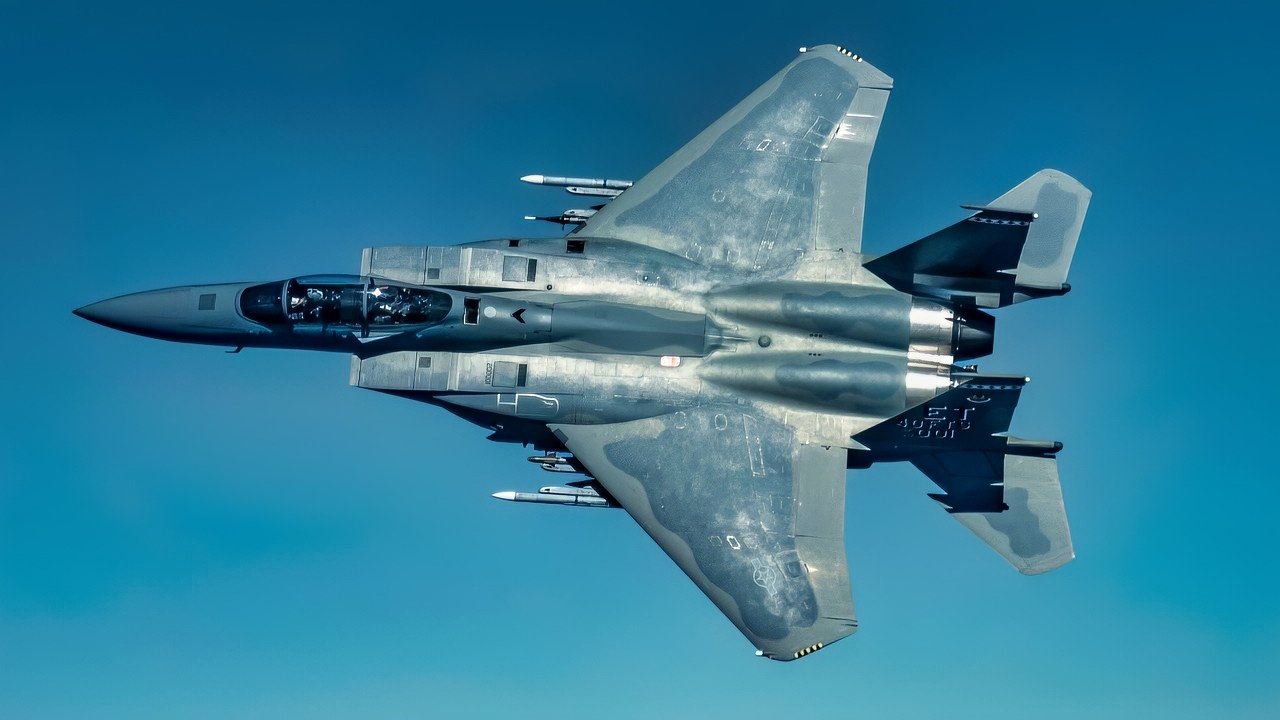
Key Points and Summary – This analysis provides a head-to-head comparison of two top-tier fourth-generation fighters: the American F-15EX Eagle II and the Swedish JAS 39 Gripen.
-The article details their different design philosophies. The F-15EX is a large, twin-engine heavyweight designed for long-range, beyond-visual-range combat with a massive missile payload.
-In contrast, the Gripen is a small, single-engine lightweight prized for its exceptional agility in close-range dogfights and its ease of maintenance.
-While the Gripen holds an edge in a turning fight, the author concludes the F-15EX is the more robust platform overall.
American F-15EX Eagle II vs. the Swedish JAS 39 Gripen
Both the American F-15EX Eagle II and the Swedish JAS 39 Gripen are mature fourth-generation fighters. But direct comparisons between aircraft are inherently complex, given the different operational environments and needs they are designed and built to address.
A direct comparison between the F-15EX II, the most advanced F-15 variant currently in production, and the JAS 39 Gripen, Sweden’s current fighter jet, is challenging. Both aircraft cater to different service needs, and don’t really compete in the same categories. Furthermore, both aircraft serve with countries that are friendly, not adversarial. However, their abilities can be rather roughly compared.
Here’s how they stack up:
F-15EX Eagle II
The F-15 is a large, heavy, twin-engine multirole fighter.
The design is one of the most mature in fourth-generation fighters. Thanks in part to its enormous size, the F-15 can carry far more weapons—in some configurations, up to 22 air-to-air missiles. It also has a very long range and endurance in the air, further augmented by the ability to take on additional fuel while in the air.
The newest F-15’s sensor and radar suite is very sophisticated. Equipped with powerful active electronically scanned array (AESA) radar and an advanced electronic warfare (EW) suite, the jet boasts excellent sensor fusion. The jet is high-performance, boasting very high thrust ratios, a top speed of Mach 2.5+, and the ability to supercruise.
Some F-15 arrangements also incorporate additional space in the fuselage for a Weapon Systems Officer (WSO), tasked with operating weapons in more challenging battle space situations. Lastly, the F-15 excels in beyond-visual-range, or BVR, combat. In a long-range missile fight, the F-15EX retains an edge thanks to its radar reach and the extensive range of missiles it can be equipped with, like the AIM-120D, and in the near future, the AIM-260 JATM.
JAS 39 Gripen
The Gripen, built by Swedish aerospace company Saab, for the Swedish Air Force, is a significantly different platform. That jet is a small, single-engine, multirole fighter. However, it does have several strengths in its favor.
Thanks to its canards forward and large delta wing, the Gripen is very agile, a boon for close-in dogfights. Although it lacks dedicated stealth features, it reportedly has a relatively small radar cross-section and a rapid turn rate. The jet also carries a relatively modern Raven ES-05 AESA radar and an advanced electronic warfare and jamming suite, considered world-class or near-world-class.
A massive part of the Gripen’s strength, however, is the environment in which it was designed to operate. Sweden’s air basing strategy during the Cold War saw small groups of Gripens widely dispersed throughout Sweden, rather than concentrated on several large air bases. This dispersal decision would have significantly complicated Soviet efforts to launch a knock-out blow against Sweden. And to that end, the Gripen is prized for its simplicity and low maintenance requirements compared to other aircraft—a crucial design feature for a military that relies heavily on lightly trained recruits for operations and service. It is also a boon to logistics.
Head to Head
At long, beyond-visual-ranges, the F-15EX Eagle II retains a distinct edge, thanks to its robust radar suite, large missile carriage, and the ability to launch multiple salvoes at other aircraft. Particularly when paired with multiple aircraft, the F-15EX Eagle II is particularly powerful.
At close range, however, the Gripen retains some advantages. Thanks to its much smaller size, the aircraft’s agility is exceptionally high, although it cannot achieve the same speeds or weapons loadout as the F-15 due to its single-engine design.
Another significant factor is cost and logistics, and in this regard, the F-15EX Eagle II stands alone. That jet can call upon one of the world’s most robust defense industrial bases for parts, munitions, fuel, and other crucial components to air operations. It can do so from virtually anywhere in the world. The Gripen, on the other hand, relies largely on the Swedish defense industry. Though certainly robust by European standards, it pales in comparison to that of the United States.
No aircraft, or any platform really, exists in a vacuum. Not only do F-15EX Eagle IIs as well as Swedish Gripens operate with other aircraft, they also fly combat missions with a diverse set of assets on the ground, including land-based radars, satellite sensors, and other assets in the air in tandem.
Seen in this more realistic contest, the F-15EX Eagle II is clearly a more robust platform, with numerous additional aids to lean on for an advantage against an adversary in the air.
About the Author: Caleb Larson
Caleb Larson is an American multiformat journalist based in Berlin, Germany. His work covers the intersection of conflict and society, focusing on American foreign policy and European security. He has reported from Germany, Russia, and the United States. Most recently, he covered the war in Ukraine, reporting extensively on the war’s shifting battle lines from Donbas and writing on the war’s civilian and humanitarian toll. Previously, he worked as a Defense Reporter for POLITICO Europe. You can follow his latest work on X.
Military Affairs
China’s Stealth Air Force Has 1 Mission


