

The Kuwait Airport Strikes Explained – Summary and Key Points: Iran’s missile and drone strikes on Kuwait International Airport mark a dangerous escalation in the Iran war and threaten to unravel a fragile ceasefire Washington has worked to preserve. Kuwait says the attack killed at least one person, injured dozens, damaged diplomatic missions, and forced flight suspensions. Tehran claims it acted in retaliation for U.S. strikes tied to Qeshm Island and an Iranian oil tanker, while warning Gulf governments against helping American military operations. The attack now puts pressure on President Donald Trump to decide whether a strike on a long-standing U.S. partner demands a direct military response.
The Iran War: Ceasefire Over?
As the White House scrambles to restrain Israel from launching strikes against Lebanon in the hopes of a peace deal with Iran, fresh attacks were launched by Iran against Kuwait on Wednesday. The attacks, which risk the ceasefire amid intensifying peace negotiations, resulted in the death of at least one person. The strikes also caused flight suspensions, and 60 people were injured.
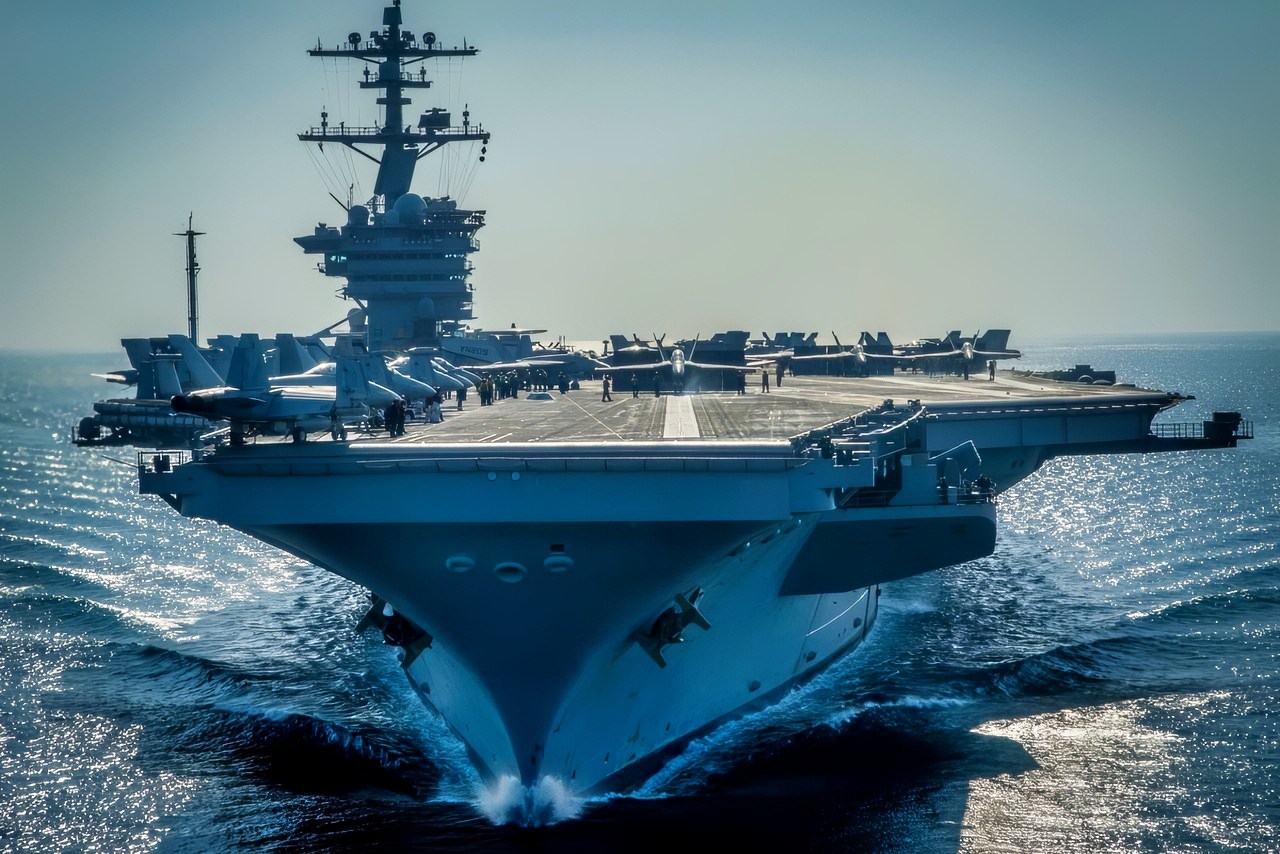
141208-N-WD464-386 ARABIAN GULF (Dec. 8, 2014) The Nimitz-class aircraft carrier USS Carl Vinson (CVN 70) prepares for flight operations in the Arabian Gulf. Carl Vinson is deployed in the U.S. 5th Fleet area of operations supporting Operation Inherent Resolve, strike operations in Iraq and Syria as directed, maritime security operations, and theater security cooperation efforts in the region. (U.S. Navy photo by Mass Communication Specialist 2nd Class Alex King/Released)
What Just Happened
Reports describe how missile and drone strikes hit the Kuwait International Airport. The attack was described by a Kuwait defense ministry spokesman as “criminal Iranian aggression.” The Foreign Ministry also confirmed that the diplomatic missions had been damaged in the attacks.
The Iranian Islamic Revolutionary Guard Corps (IRGC) claimed the attack, describing it as retaliation for U.S. strikes on an Iranian oil tanker and other targets on Qeshm Island.
According to Kuwaiti statements, the attack involved a combination of ballistic missiles and drones that were launched from Iranian territory. While Kuwait International Airport appears to have been the primary target, reports indicate that several projectiles either struck or landed near civilian and government facilities in the surrounding area. Images also appeared on social media, showing significant damage near the airport, with thick smoke visible from parts of the complex.
The strikes prompted the temporary suspension of air traffic and forced airlines to divert and delay flights. Emergency services were deployed across the airport and nearby areas.
It is one of the most significant direct Iranian strikes against a Gulf state since the Iran War began and is a dramatic escalation of the conflict. Until now, the war has been fought largely in Iran, Israel, Lebanon, and the Strait of Hormuz.
By targeting Kuwait, Tehran appears to be sending a message to Gulf governments that they are in danger of being struck by Iranian forces if they believe they are facilitating American military operations in the region. The decision will also now force Washington to decide whether attacks against its regional partners warrant a direct military response, and if it is considered a breach of the ceasefire that was agreed in April.
Iran’s Accusations
On Wednesday, the Iranian Foreign Ministry accused the United States of striking an Iranian oil tanker in the Strait of Hormuz and destroying a communications tower on Qeshm Island. The strikes are believed to have been launched from bases located in Bahrain and Kuwait.
“These aggressive actions not only violate the ceasefire understanding of April 9 but also constitute a flagrant violation of the fundamental principle prohibiting the use of force under Article 2, Paragraph 4 of the United Nations Charter and international law,” the statement reads.
Iranian officials also criticized what they called the United States’ “colonial use of the territory and facilities of regional countries” to carry out strikes against Iran, and said that Tehran holds the leaders of Bahrain and Kuwait responsible for the attacks.
“The action of any country in allowing aggressor parties to use its land, sea, or air territory or facilities and bases located within their territory to carry out or support military aggression against Iran constitutes a clear violation of fundamental rules of international law and the principle of good neighborliness,” the statement continued.
The statement also cited United Nations General Assembly Resolution 3314, claiming that the strikes were an “act of aggression against Iran.” It also pointed the finger at “American-Zionist aggressors and all parties that assist them in committing acts of aggression against Iran,” and said that Iran is “exercising its inherent right to defend its territorial integrity and national sovereignty.”

(Jan 31, 2009) An F/A-18 Super Hornet assigned to the “Tomcatters” of Strike Fighter Squadron (VFA) 31 launches from the flight deck of USS Theodore Roosevelt (CVN 71). The Nimitz-class aircraft carrier and embarked Carrier Air Wing (CVW) 8 are operating in the 5th Fleet area of responsibility and are focused on reassuring regional partners of the United States’ commitment to security, which promotes stability and global prosperity (U.S. Navy photo by Mass Communication Specialist 3rd Class Jonathan Snyder/Released)

(Dec. 7, 2024) LT Steven Holcomb, attached to the Gunslingers of Strike Fighter Squadron (VFA) 105, operates a F/A-18E Super Hornet on the flight deck during flight operations, Dec. 7, 2024. USS George H.W. Bush is in the basic phase of the Optimized Fleet Response Plan conducting flight deck certification.(U.S. Navy photo by Mass Communication Specialist Seaman Jayden Brown)
The strikes were then described as an effort to “confront aggressive actions.”
Will the Ceasefire Survive?
The question now is whether the Kuwait attack will derail the fragile diplomatic process that Washington has spent weeks trying to preserve – with President Donald Trump even going as far as reportedly lashing out at Israeli Prime Minister Benjamin Netanyahu over the telephone. The strike also comes only days after U.S. Secretary of State Marco Rubio indicated that a breakthrough with Tehran could be reached within a matter of days.
The problem is this: Kuwait is a long-standing American partner that hosts U.S. military facilities. It serves as a logistical hub for American operations throughout the Gulf. An attack on Kuwait could easily be interpreted as an attack against the United States and puts political pressure on Washington that did not exist when the hostilities were confined to Iran, Israel, and the Strait of Hormuz.
How Will the U.S. Respond?
As of Wednesday afternoon, the White House has not issued a formal statement addressing the strike itself, though the U.S. military, through U.S. Central Command (CENTCOM), confirmed that it had carried out strikes on an Iranian military ground-control facility in Qeshm Island – the strikes that appear to have prompted Iran’s response.
“U.S. forces successfully defeated multiple Iranian ballistic missiles and drones, and conducted self-defense strikes on Qeshm Island in response to attempted attacks by Iran across the Middle East, June 2,” a CENTCOM statement explains.
About the Author: Jack Buckby
Jack Buckby is a British researcher and analyst specializing in defense and national security, based in New York. His work focuses on military capability, procurement, and strategic competition, producing and editing analysis for policy and defense audiences. He brings extensive editorial experience, with a career output spanning over 1,000 articles at 19FortyFive and National Security Journal, and has previously authored books and papers on extremism and deradicalization.


rosy dawn
June 4, 2026 at 12:26 am
Other reports said the damage to the Kuwait international airport was caused by an errant US interceptor missile, which is something more likely than an alleged barrage of drones and projectiles.
After all, only one person was killed. Looks like the US couldn’t care less about war collaterals in this Persian gulf war.
The US needs to get the hell out of the region.
What did jimmy ‘born-again’ Carter say during his state of the union address in Jan 1980.
“The Persian gulf’s interests are our interests. Anything happening there is same as it happening here. We’ll do anything to defend our interests in the gulf region.”
Apparently, peace for the people of the gulf isn’t one of the region’s top interests as far as Washington is concerned.
The US needs to get the hell outta there. ASAP.