

The Russian S-500 “Prometheus” is a mobile surface-to-air and anti-ballistic missile system designed to counter a wide range of threats, including aircraft, ballistic missiles, and even low-orbit satellites.
It is the next generation of Russian air defense systems, intended to supplement and eventually replace the S-400. The S-500 is developed by Almaz Antei and is known for its ability to intercept hypersonic missiles and its potential anti-satellite capabilities.

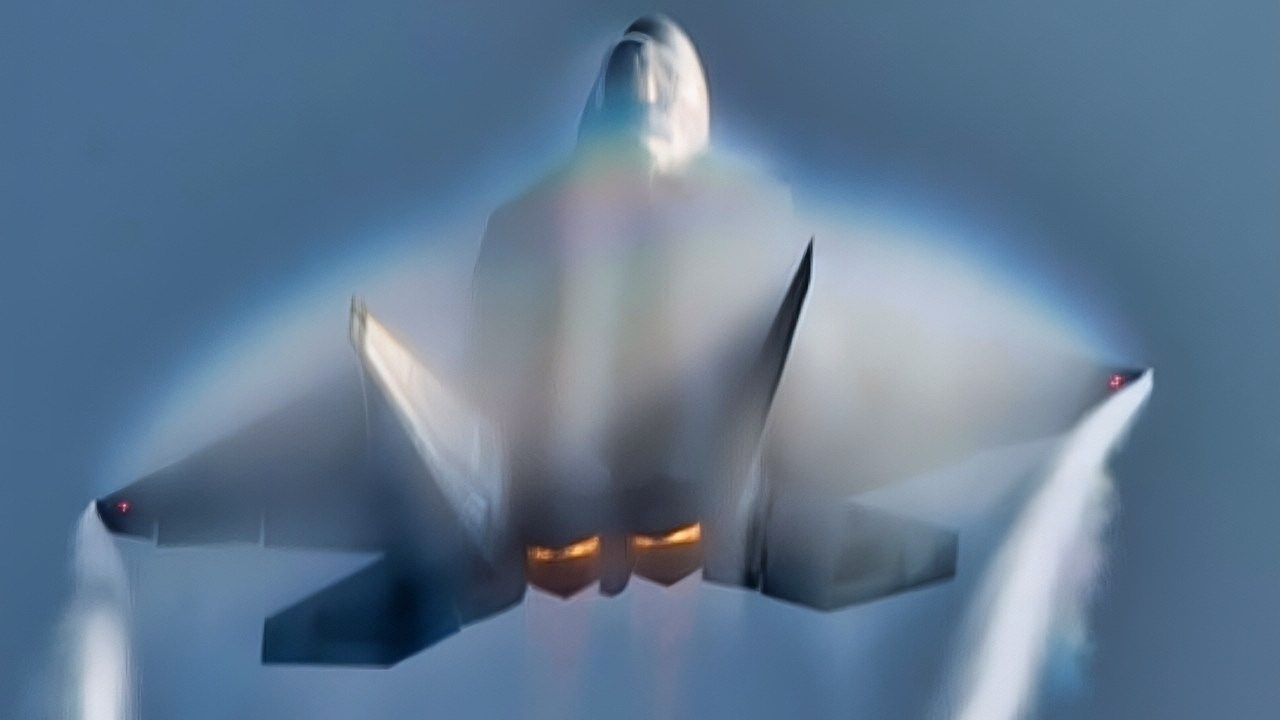
A U.S. Air Force F-22 Raptor performs a vertical climb during the 2025 Marine Corps Base Hawaii (MCBH) Kaneohe Bay Air Show, at MCBH, Aug. 9, 2025. The Kaneohe Bay Air Show provided an opportunity to showcase the aircraft, equipment, and capabilities of the armed forces in the Indo-Pacific region to the local community. The air show, which contained aerial performances, static displays, demonstrations, and vendors, was designed to celebrate MCBH’s longstanding relationship with the local community. (U.S. Army photo by Pfc. Peter Bannister)

F-22 Raptor Flying in the Dark Clouds. Image Credit: Creative Commons.
Is The S-500 A Game-Changer Or More Russian Bluster?
The Russians claim it is a game-changer, with a range of 600 km. It is designed to detect and shoot down 5th-generation stealth aircraft, such as the American F-22 and F-35.
“Our potential adversaries simply do not possess systems with the long-range missile capabilities of the S-500,” Alexander Mikhailov, the head of Moscow’s Bureau of Military-Political Analysis, told state-run news agency TASS.
“While they have long-range systems designed to intercept various offensive weapons, the specific characteristics of the Prometheus remain unrivaled by our closest competitors.”
“It can detect targets up to 600 kilometers away and engage them with surface-to-air missiles at ranges reaching 500 kilometers. This includes not only ballistic missiles but also aerodynamic targets such as NATO’s supersonic aircraft, as well as various missile types. Notably, it can target medium-range missiles and low-orbit satellites involved in reconnaissance and communication,” Mikhailov added.
But, like anything else with the Russian military, one must take the boasting about the capabilities of their newest weapon with a healthy dose of salt.
Russia Creates The First New Regiment For the S-500:
As of last December, they have outfitted one regiment with the S-500, marking the first time Russia has combined air and missile defense into a single system.
“The Aerospace Forces have formed their first air defense and missile defense division,” Russian Defense Minister Andrei Belousov said.

A U.S. Marine Corps F-35B Lightning II aircraft with Marine Fighter Attack Squadron (VMFA) 242 conducts a low pass next to the Japanese Ship Izumo off the coast of Japan, Oct. 3, 2021. U.S. Marines and Sailors embarked aboard the Japanese Ship Izumo in support of the first ever F-35B Lightning II operations aboard a Japanese vessel. The U.S. and Japan continue to work closely together to broaden their operational capabilities, support the Treaty of mutual Cooperation and Security, and maintain a free and open Indo-Pacific. (U.S. Marine Corps photo by Lance Cpl. Tyler Harmon)

The 187th Fighter Wing unveiled the new Alabama Air National Guard’s F-35 Lightning II fighter jet during an event at Dannelly Field, Alabama, today. The red tails are a historic tribute to the Tuskegee Red Tails, the famed WWII squadron, which lives on as the 100th Fighter Squadron within the wing. “The red tail you will see is a reminder to all that through excellence we will overcome any obstacle and threat regardless of gender, race, or religion, “ said Col. Brian Vaughn, the wing’s commander, during the ceremony. “We are all here for the same mission: to protect our nation, defend our constitution, and to form a more perfect union as the Tuskegee Airmen did.” (U.S. Air Force photo by Tech. Sgt. William Blankenship)
“The first regiment, equipped with the unique S-500 anti-aircraft missile system, capable of striking targets in near space, has entered combat duty.”
India is exploring the possibility of acquiring the S-500 Prometheus.
According to a report by Indian Defense News, the move is driven by growing concerns over China’s expanding arsenal of hypersonic glide vehicles, ballistic missiles, and stealth aircraft.
Meet The S-500 Missile System:
Russia began developing the S-500 in 2010, shortly after the S-400 systems were deployed. It was designed to work alongside the S-400 and other systems.
Launchers for the S-500 system deploy two rather than four surface-to-air missiles, compared to the S-400 system. The S-500 missiles can engage targets up to 600 kilometres away, compared to 400km for the S-400 and 200km for the rival American THAAD and Patriot systems.
Each S-400 regiment comprises two battalions of eight launchers, though this may differ for the S-500. The new air defense system was intended to provide a new layer to Russia’s air defense network between the more tactical-level S-300 and S-400s and the strategic-level A-235 system, which was designed for defense against ICBM attacks.
S-500’s Increased Interception Range:
The S-500 boasts an impressive range, with some sources claiming it can intercept targets at up to 600 km, a significant increase compared to the S-400.
It’s designed to intercept hypersonic missiles, including those traveling at speeds up to Mach 7. Russian military sources say the S-500 can potentially target and destroy satellites in low Earth orbit, a capability that is not fully verified.
It can intercept ballistic missiles during their mid- or terminal-stage flight and may have access to multiple missile types, depending on its intended target.
Improved Radar System:
The system features a sophisticated radar complex that can simultaneously track multiple targets, including stealth aircraft and hypersonic threats. The radar system allows the S-500 to detect ballistic missiles at ranges up to 2,000 km and airborne targets at up to 800 km.
It was also reported by Russian media in Jun 2021 that the S-500 system will be equipped with interceptors capable of intercepting supersonic weapons.
The S-500 is a mobile system that enables rapid deployment and redeployment to various locations.
There are four radar vehicles per battery: 91N6E(M) S-Band acquisition radar, 96L6-TsP C-Band acquisition radar, 76T6 multi-mode engagement radar, and Yenisei 77T6 Anti-Ballistic Missile engagement radar.
It is designed to work in conjunction with other Russian air defense systems, such as the S-400, S-350, and Pantsir, forming a multi-layered defense network.
S-500 Development and Deployment:
The S-500’s development and design are overseen by the Russian enterprise Almaz Antei. It has faced significant delays in its development. After its design development was completed in 2011, its serial production was shifted from 2014 to 2017, to 2021, and finally to 2025.
It has been speculated that the Russians are deliberately delaying the induction of the S-500 to maintain S-400 production lines and continue their exports. Serial production started around 2021, with deliveries to the Russian armed forces confirmed in 2022. As of December 2025, the first regiment of the system has been operationally deployed, primarily to protect critical assets and strategic regions.
Military Watch magazine wrote that the system’s very long engagement range allows it to pose a serious threat to force-multiplier assets such as tankers and AEW&Cs, which are vital to the functioning of NATO air power.
The S-500 represents a significant advancement in Russia’s air and missile defense capabilities. Its ability to intercept hypersonic missiles and potentially engage satellites would give it a strategic advantage in modern warfare. The system is also seen as a key component of Russia’s overall air defense network.
There Is No Evidence To Believe It Can Track F-35s:
The Russians boasted it can track American F-35s at long ranges. However, they’ve offered no proof it can target the F-35 or other fifth-generation stealth fighters. It would probably be used to target support aircraft (air refueling tankers) at long ranges.
And it is likely to be even less effective against sixth-generation systems, such as the Northrop Grumman B-21 Raider stealth bomber and the future Boeing F-47 NGAD fighter.
While the Russians tout their performance, they haven’t announced if it’s been used in combat yet, during their invasion of Ukraine.
The project has been plagued by production delays, an issue affecting all of Moscow’s defense industries. It is unlikely that Russia can currently produce the S-500 Prometheus in sufficient numbers to replace existing systems, as production is limited to a small number of units.
While serial production started around 2021-2022, output is restricted by manufacturing capacity, high costs, and a focus on supporting ongoing military operations with existing, less complex systems, such as the S-400.
About the Author: Steve Balestrieri
Steve Balestrieri is a National Security Columnist. He served as a US Army Special Forces NCO and Warrant Officer. In addition to writing on defense, he covers the NFL for PatsFans.com and is a member of the Pro Football Writers of America (PFWA). His work was regularly featured in many military publications.


