


Summary and Key Points: Russia argues its S-400—and especially the newer S-500—can detect and defeat stealth aircraft, but the more important question is whether detection can become a reliable engagement-quality track.
-Low-frequency surveillance radar may reveal a stealth presence, yet maintaining a continuous track on a fast-moving aircraft with fire-control radar is a far harder problem.

An F-22 Raptor assigned to the 1st Fighter Wing, Joint Base Langley-Eustis, Va., takes off for a training mission during Northern Lightning, a training exercise held annually at Volk Field, Wisc., Aug. 12, 2020. This is the first time the 158th has participated in the exercise with the F-35s, which sees them working with F-22 Raptors assigned to the 1st Fighter Wing, Joint Base Langley-Eustis, Va., F/A-18E Super Hornets assigned to VFA-151, Naval Air Station Lemoore, Calif., F-16 Falcons assigned to the Wisconsin National Guard, as well as T-38 Talons and L-159Es from Draken International acting as aggressor aircrafts conducting simulated combat missions in a joint-service environment. (U.S. Air National Guard photo by Airman 1st Class Jana Somero)
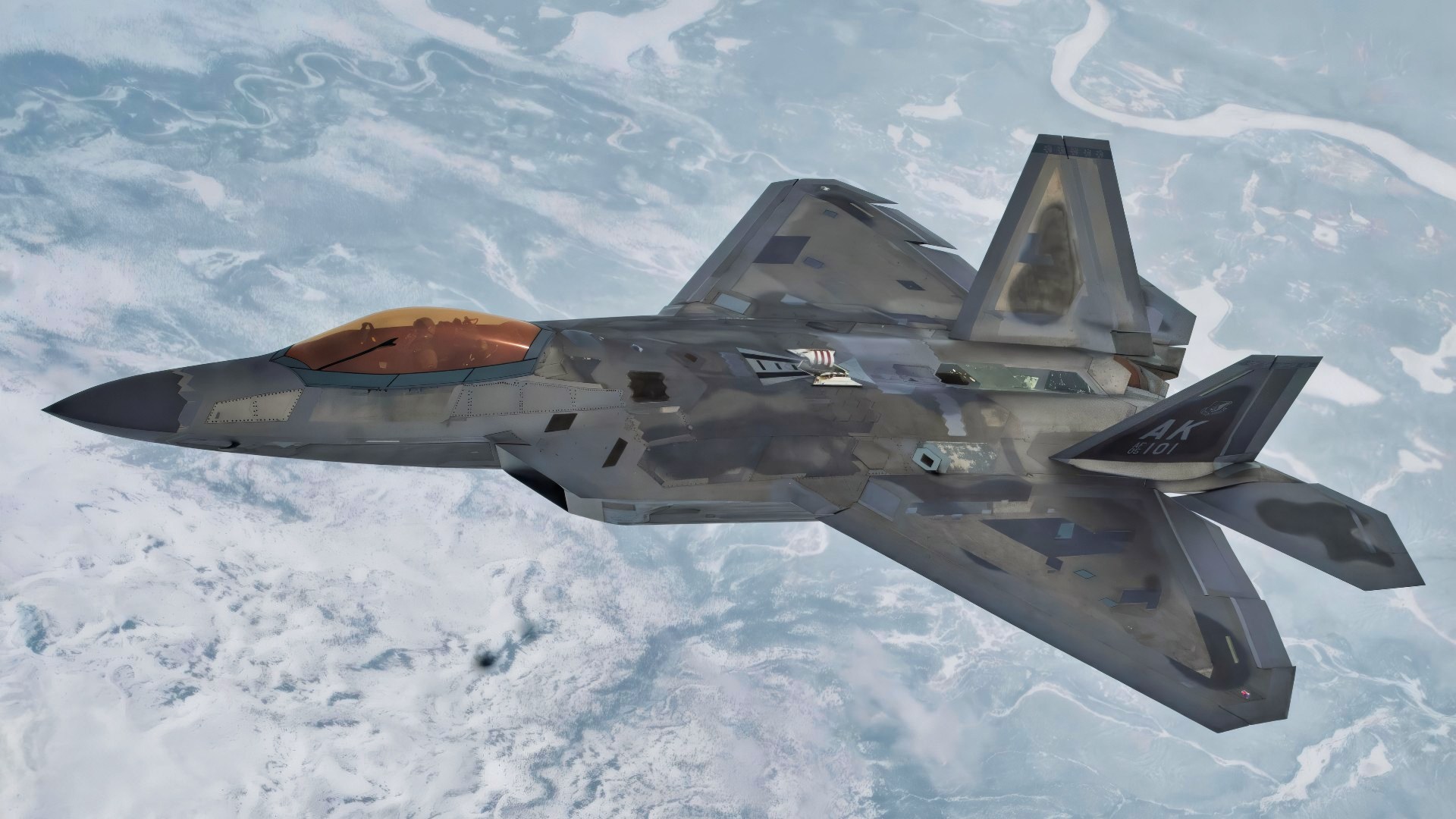
A U.S. Air Force F-22 Raptor assigned to Joint Base Elmendorf-Richardson, Alaska flies over the Alaskan mountain range during Northern Edge 23-1, May 10, 2023. NE 23-1 allows the U.S. Joint Force to more fully develop Joint All-Domain Operations (JADO) concepts through exercises and experimentation for application in operations around the world. (U.S. Air Force photo by 2nd Lt. Ariana Wilkinson)
-If reported S-500 specs are accurate, its long-range networking and sensor fusion could complicate NATO air operations by extending monitoring and cueing across large areas, potentially reducing the advantage created by hundreds of NATO F-35s.
-Reports of potential S-500 exports to China and India raise additional concerns about technology diffusion, coordination, and escalation risk.
Russia’s S-500 Claims a 370-Mile Reach—Can It Really Track Stealth Jets Like the F-35?
Russia insists that its advanced S-400 surface-to-air missile system—and now the new S-500—has been upgraded to track and defeat stealth aircraft.
The claim is as ambitious as it is unverified.
Russia’s S-500 air defenses do appear to present a threat to U.S. and allied fighter jets. The systems integrate advanced digital multi-node networking and employ precise, long-range radar.
These attributes enable the system to detect aircraft at greater distances on a broader range of frequencies.
However, detecting the presence of a stealth jet with lower-frequency surveillance radar is different from establishing a target track on a moving stealth jet with engagement radar.
Advanced S-500s might be able to detect that something is there, but they are less likely to be able to track and engage a stealth jet.
S-500 vs U.S. 5th-Gen Stealth (F-22, F-35 and Even B-21 Raider Bomber)
If the available specs of the S-500 are accurate, the system is a threat to the West.
RIA Novosti claims the S-500 has an operational range of approximately 370 miles and can detect and counter up to 10 supersonic ballistic-missile warheads flying at speeds of 4.34 miles per second. The most pressing question relates to the S-500’s networking range—the speed and fidelity of digital processing.
Radar nodes must be able to quickly share target track details across distances. Only an integrated system could establish a continuous track on a jet flying at high speeds from one radar’s field of view to another’s.

A U.S. Air Force F-22 Raptor performs a vertical climb during the 2025 Marine Corps Base Hawaii (MCBH) Kaneohe Bay Air Show, at MCBH, Aug. 9, 2025. The Kaneohe Bay Air Show provided an opportunity to showcase the aircraft, equipment, and capabilities of the armed forces in the Indo-Pacific region to the local community. The air show, which contained aerial performances, static displays, demonstrations, and vendors, was designed to celebrate MCBH’s longstanding relationship with the local community. (U.S. Army photo by Pfc. Peter Bannister)

An F-22 Raptor performs an aerial demonstration at Naval Air Station Oceana, Virginia, Sept. 19, 2025. Rapid changes in angle of attack create visible vapor around the aircraft, providing a clear view of its aerodynamic performance. This demonstration highlights the F-22’s advanced maneuvering capabilities, showcasing its speed, agility, and thrust-vectoring performance. (U.S. Air Force photo by Staff Sgt. Lauren Cobin)

The F-22 Raptor performs a demonstration at the Mather Airshow in Sacramento, California, Sept. 23, 2018. The P-38 is a World War I-era fighter aircraft that was developed for the Army Air Corps. (U.S. Air Force photo by Senior Airman Lauren Parsons/Released)
If the S-500 does operate with a range of 370 miles, it might be able to monitor airspace in Eastern Europe, which would complicate NATO efforts to maintain air supremacy in any engagement with Russia.
In the event of a potential war, this could offset Russia’s large air-superiority deficit relative to NATO.
NATO operates hundreds of F-35s positioned to easily acquire and maintain air supremacy against Russia’s small number of Su-57 fifth-generation stealth fighters.
If S-500s could neutralize or at least greatly lessen the U.S. and NATO advantage in the air, it could change the balance during a Russia-NATO conflict.
S-500 to China & India?
Sputnik has reported that Russia intends to sell the S-500 to China and India—a move that could influence the balance of power for the U.S. and its allies in the Pacific.
A sale of the S-500 could provide China with valuable technological insights. Even if Russia held back the system’s most sensitive features, Chinese engineers could study its radar, sensors, and integration concepts to enhance indigenous systems.
Over time, this could erode the technological edge the United States has worked to maintain in stealth, electronic warfare, and missile defense, especially if Chinese systems are designed specifically to counter U.S. platforms.
By selling the S-500 to China, Moscow would also deepen its military cooperation with Beijing and signal a more coordinated challenge to U.S. global influence.
A tighter Russia-China defense relationship could complicate U.S. strategic planning by forcing the Pentagon to consider simultaneous or linked crises in Europe and Asia.
This would strain U.S. resources and alliance commitments, particularly if adversaries perceived the United States as overstretched.
Finally, the proliferation of advanced air defense systems increases the risk of miscalculation.
As U.S. aircraft and ships operate closer to Chinese-defended areas, the chance of an incident or escalation grows.
About the Author: Kris Osborn
Kris Osborn is the President of Warrior Maven – Center for Military Modernization. Osborn previously served at the Pentagon as a highly qualified expert in the Office of the Assistant Secretary of the Army—Acquisition, Logistics & Technology. Osborn has also worked as an anchor and on-air military specialist at national TV networks. He has appeared as a guest military expert on Fox News, MSNBC, The Military Channel, and The History Channel. He also has a Masters Degree in Comparative Literature from Columbia University.


Robert W
December 13, 2025 at 3:24 pm
Thought the S400 was suppose to do that?
nick
December 13, 2025 at 3:35 pm
-Long-range, multi-band radars may detect “something” in the sky, yet turning a faint low-frequency return into a firm weapons-quality track against F-35s or B-21s is much harder.
-Yeah, but being able to detect those sigs flying at a very high rate of speed…it’s like a flashing light.
Hujjathullah M.H.B. Sahib
December 13, 2025 at 9:36 pm
One would reasonably think that the deployment and proliferation of S500s in the future would have more of a deterrence effect, especially with enhanced range, further integration coupled with hypersonic missiles, than carry any alleged escalation risks. The US should more sensibly develop superior hypersonic missiles and unmanned drones to counter that capability rather than recklessly risk its increasingly vulnerable airmen. The recent BVR encounters in South Asia should serve as eye-openers if one truly value human lives !
Michael
December 14, 2025 at 12:30 am
Ha,ha
Can’t defeat Ukraine, but will defeat the F35? I would like to watch that conflict.
Pieter Rockyfelar.
December 14, 2025 at 4:08 am
Russian leaders are filled with the belief that by using propaganda, some of its enemies will shiver and absolutely abundon attempts to engage it to war physically. The Ukrainia-Russia war does give who Russian leaders are.
The other thing is that,by developing it’s new radars and other weapons, then claim that the new systems are super and superior to the NATO and US’s war machines, the intention is to keep Asian super powers clinging on Russia
Jeff Erwin
December 14, 2025 at 5:50 am
As usual Russia lies about everything
Eddie
December 14, 2025 at 8:10 am
Everything Russia touches turns to shed. The Chinese can probably develop a missile system that is far superior than Russian junk. The Ukraine war has shown that the Russian military and defense industry is a paper tiger.
David Tennien
December 15, 2025 at 6:41 pm
Absolutely Vapor Ware. Countries that know how to SEAD, like the IS and Israel will have no issues.
s
February 15, 2026 at 8:56 am
High tech unmanned warfare – Only 3 armies have practical experience in this in 2026. And, the USA is not in the count.
The DPRK has cycled enough troops thru Ukraine that the knowledge is used thru its mass. One has to assume that PRC Han intelligence is right in the data collection forefront.
If World War Xi calls for it, thousands of DPRK can import into Houthis territory with the latest PRC hardware. They can mass train local religious zealots to effectively keep the waterway closed. The MAGA POTUS elite can do zip to deter the PRC vassal army of the DPRK.
The Cartels currently have latest tech in their covert lairs. Where are the cartels training their cadres? Cuba? The PRC meat grinder serial Genocide front that the Kremlin Muscovy operate inside Ukraine? So, where are the Mexican cartels training their cadres? The unmanned capabilities of these Cartels is never talked about by the highly intelligent MAGA POTUS elite Cabal.