

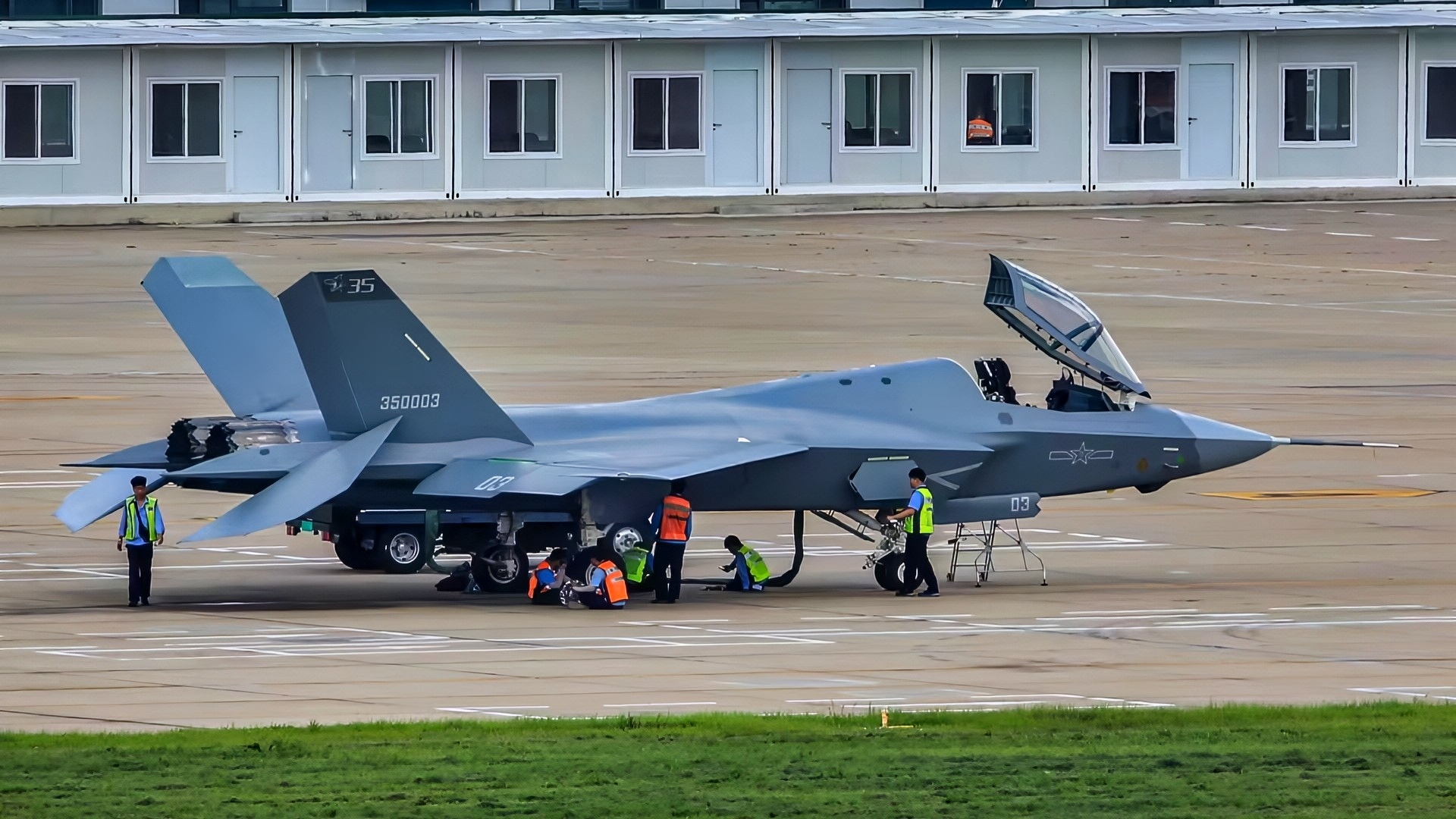
Key Points and Summary – A direct comparison of the U.S. F-22 Raptor and China’s J-35 is described as an “exercise in futility” because they are fundamentally different aircraft.
-The F-22 is a pure air dominance fighter, designed with unparalleled, all-aspect stealth to control contested airspace.
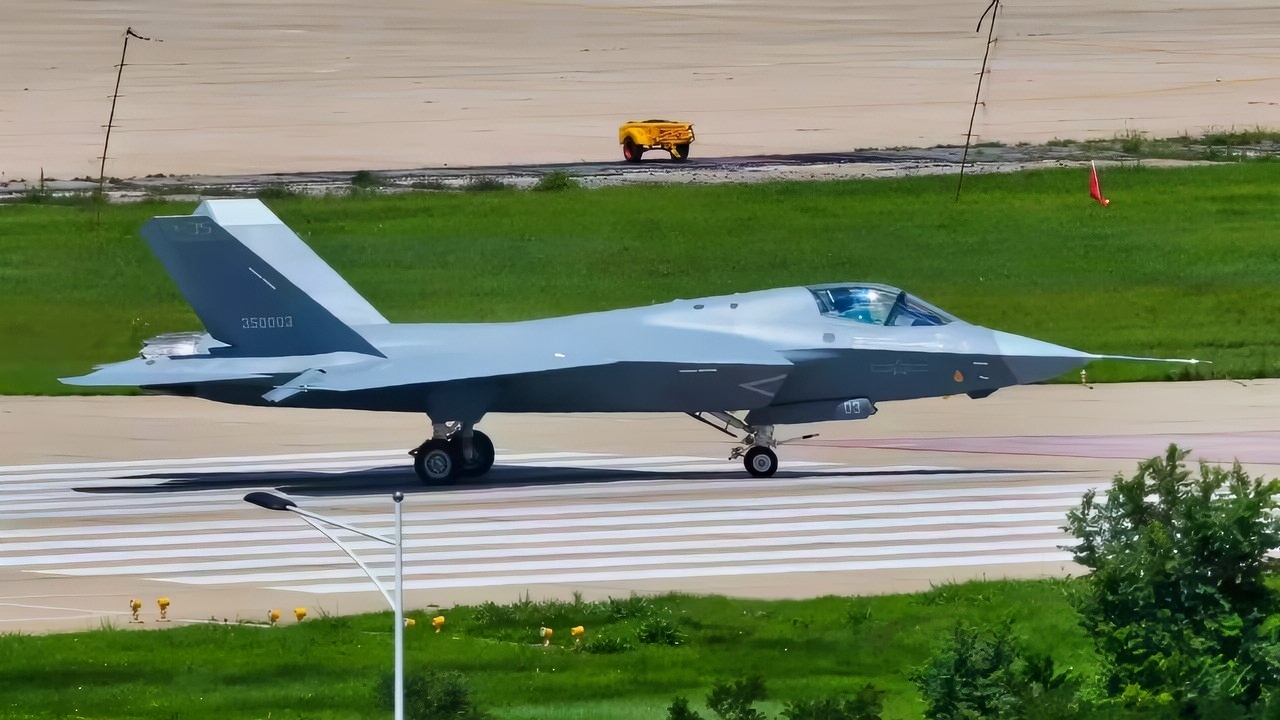
J-35 Fighter X Screenshot. Image Credit: X Screen Capture.

J-35 Stealth Fighter from China. Image Credit: Creative Commons.
-In contrast, the J-35 is a multi-role, carrier-based fighter analogous to the F-35, designed to extend China’s naval reach and replace older jets in large numbers.
-While the F-22 would likely win a hypothetical duel due to superior stealth, their distinct operational roles make them apples and oranges.
F-22 vs. J-35: What’s the Difference?
The F-22 Raptor was conceived from the outset as an air dominance platform.
This radar-defeating fighter jet could enter contested adversarial airspace, exert control over it, and maintain control.
Every part of that jet’s engineering is designed to achieve this: its radar-absorbent stealth coatings, its carefully contoured fuselage and V-tail assembly, and its extreme maneuverability and speed.
All of these factors converge to give the Raptor an unparalleled first-kill advantage.
The Raptor’s radar cross-section, a measure of the jet’s detectability by enemy radar, is minimized from every angle—even the jet’s Pratt & Whitney F119 engines, capable of thrust vectoring for greater agility in the air, are angled to deflect and defeat radar.
The Raptor’s weapon loadout is also a reflection of what that jet was designed to do: high-altitude combat at beyond visual ranges deep inside enemy airspace.
China’s J-35, on the other hand, stands in stark contrast to the Raptor in terms of flight characteristics, operational role, and weapon loadout. The J-35 is not an air superiority fighter, but is more akin to the visually similar F-35 Lightning II, a multirole fighter.
And like two F-35 variants — the B and C models — the J-35 is also capable of takeoff and landing from an aircraft carrier.
China’s J-20 family of aircraft fills the long-range interceptor role that the F-22 Raptor plays.
Within that context, the J-35 emphasizes lower cost and a broader range of applications beyond air superiority and interception.
The jet’s fuselage shaping suggests minimizing radar visibility from the frontal aspect, with significantly less consideration given to reducing visibility to adversary radar from the rear aspect.
Still, this consideration is adequate for most strike missions and defensive counter-air missions, but doesn’t compare to the Raptor’s all-around stealth.
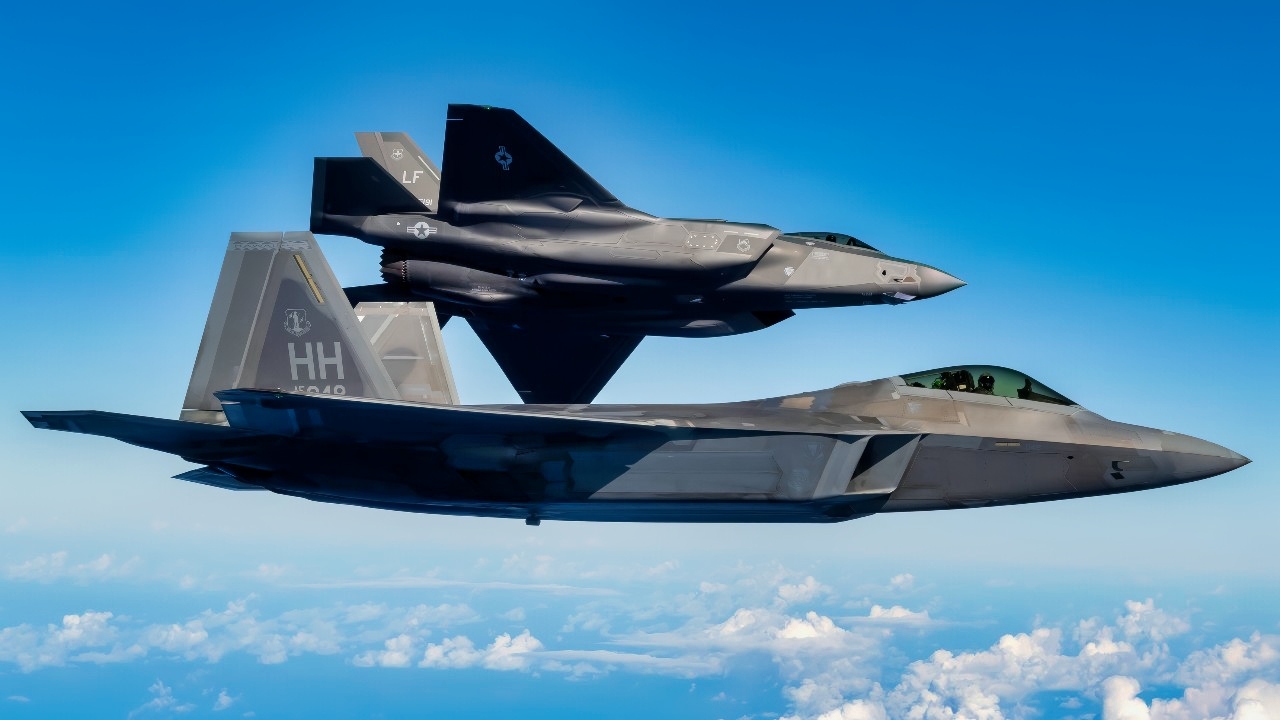
An F-35A Lightning II banks away from an F-22 Raptor Feb. 6, 2020, near the Hawaiian Islands. F-35 Airmen from Luke Air Force Base, Ariz., temporarily relocated to Joint Base Pearl Harbor-Hickam, Hawaii, to join other flying squadrons in exercise Pacific Raptor. Every training mission of the exercise was carried out by total-force teams from the Air Force’s Active, Reserve and Air National Guard components. (courtesy photo)

A U.S. Air Force F-22 Raptor assigned to Joint Base Langley-Eustis, Virginia, takes off during Checkered Flag 23-1 at Tyndall Air Force Base, Florida, Nov. 4, 2022. Checkered Flag is a large-force aerial exercise which fosters readiness and interoperability through the incorporation of 4th and 5th-generation aircraft during air-to-air combat training. The 23-1 iteration of the exercise was held Oct. 31 – Nov. 10, 2022. (U.S. Air Force photo by Tech. Sgt. Betty R. Chevalier)
The two jets reflect the radially distinct environments in which they were conceived.
The F-22’s origin story begins during the Cold War, at a time when Soviet air defenses caused some consternation within the Pentagon. Concerned that Soviet SAM sites would defeat American planes, the U.S. Air Force ran the Advanced Tactical Fighter program, which pitted two highly stealthy stealth fighter prototypes against each other. Ultimately, the Raptor won the ATF program.
In stark operational contrast to the Raptor’s genesis is the J-35’s operational environment. Instead of exerting control over contested airspace, the J-35 is the first indigenous Chinese fighter designed from the outset to take off and land from People’s Liberation Army Navy aircraft carriers.
Though the People’s Liberation Army Navy Air Force (PLANAF) operates two carrier-capable aircraft, the J-11 and J-15, those aircraft are variants of Russian aircraft and lack the dedicated stealth characteristics of the J-35.
The J-35’s role is to extend Chinese regional reach and expand deterrence.
As a stealthy platform, the J-35 brings valuable capabilities to Chinese naval aviation. As a multirole aircraft, it can perform fleet defense and carrier strike group defense, as well as threaten targets within the first and second island chains, depending on where its home carrier is.
“With the J-35/A [the carrier-capable J-35 and its land-based sibling, the J-35], China will have two entirely separate fifth-generation fighter families in active production,” one analyst wrote.
“In the PLAAF, the J-35A will be complemented by the larger fifth-generation J-20/A, and both will be augmented by substantial numbers of 4.5th generation fighters (J-16s, J-10Cs, and J-11BGs). The J-35A may enable faster retirement of early fourth-generation aircraft (Su-27/J-11A/Su-30, J-10A) and the few remaining third-generation aircraft.”
Far from an exquisite stealth fighter, the J-35 and J-35A may facilitate the retirement of older, less survivable aircraft that lack dedicated stealth characteristics rather than representing an attempt to field a very high-performance fifth-generation stealth fighter.
Postscript
The J-35 and F-22 are fundamentally different aircraft, built in wildly different eras to fill very disparate operational roles, making a one-to-one comparison between the two an exercise in futility.
Are there scenarios in which the two fighters could conceivably go toe-to-toe in aerial combat?
Potentially. But a much more likely scenario would see F-35s and J-35s dogfight at sea somewhere over the Pacific Ocean.
If the F-22 were conceivably to face off against the J-35, the Raptor’s high degree of stealth would be a distinct advantage, as would its long-range radar and beyond-visual-range air-to-air missiles.
The F-22 Raptor can hide from adversary radar at any location and from virtually any angle or altitude.
The J-35 can’t match that—and given its naval aviation role, it probably won’t have to.
About the Author: Caleb Larson
Caleb Larson is an American multiformat journalist based in Berlin, Germany. His work covers the intersection of conflict and society, focusing on American foreign policy and European security. He has reported from Germany, Russia, and the United States. Most recently, he covered the war in Ukraine, reporting extensively on the war’s shifting battle lines from Donbas and writing on the war’s civilian and humanitarian toll. Previously, he worked as a Defense Reporter for POLITICO Europe. You can follow his latest work on X.
More Military
Hwasong-20: North Korea’s New Solid-Fueled ICBM Has Arrived
Midway-Class Aircraft Carrier USS Coral Sea (CV-43) Has a Message for the U.S. Navy
Ukraine Just Unveiled Its New ‘Long Neptune’ Missile
The M1 Abrams Tank Can Go Much Faster Than the Army Admits
The U.S. Navy Has Its Own Aircraft Carrier-Killer Missile: Meet the Maritime Strike Tomahawk


bis-biss
October 12, 2025 at 12:16 am
Writer isn’t too forthcoming in this article, but assuming he’s saying or writing something on a contest in the western pac.
In the western Pacific, a contest involving the elderly or biden-like f-22 would be highly disastrous.
Why did Robert gates canceled the f-22. Becuz rumor has it that one f-22 was actually shot down in aug-sept 2007.
Just hours ago, a mighty rocket lifted a jilin-1 satellite to space. What’s jilin-1. A sat that provides wide-area E/O view over the western Pacific.
Other SATs like the ludi sats provide synthetic aperture radar view over the entire western Pacific, night and day, sunny or cloudy weather.
This, the f-22 with its fabled stealth quality amounts to nothing, Nothing that’s spelled with a capital N, over the western Pacific.
Over Europe, f-22 could amount to somethin’, but in the western Pacific, it’s just a flying dodo.
Recently, an aviator flying the j-16, told of how he forced a pair of f-22s to flee when he barrel-rolled over one of them and thrn locking onto both with his radar.
F-22 is like Joe Biden, now receiving radiation treatment. A desperate last gasp method to avoid getting collected by the grim reaper.