

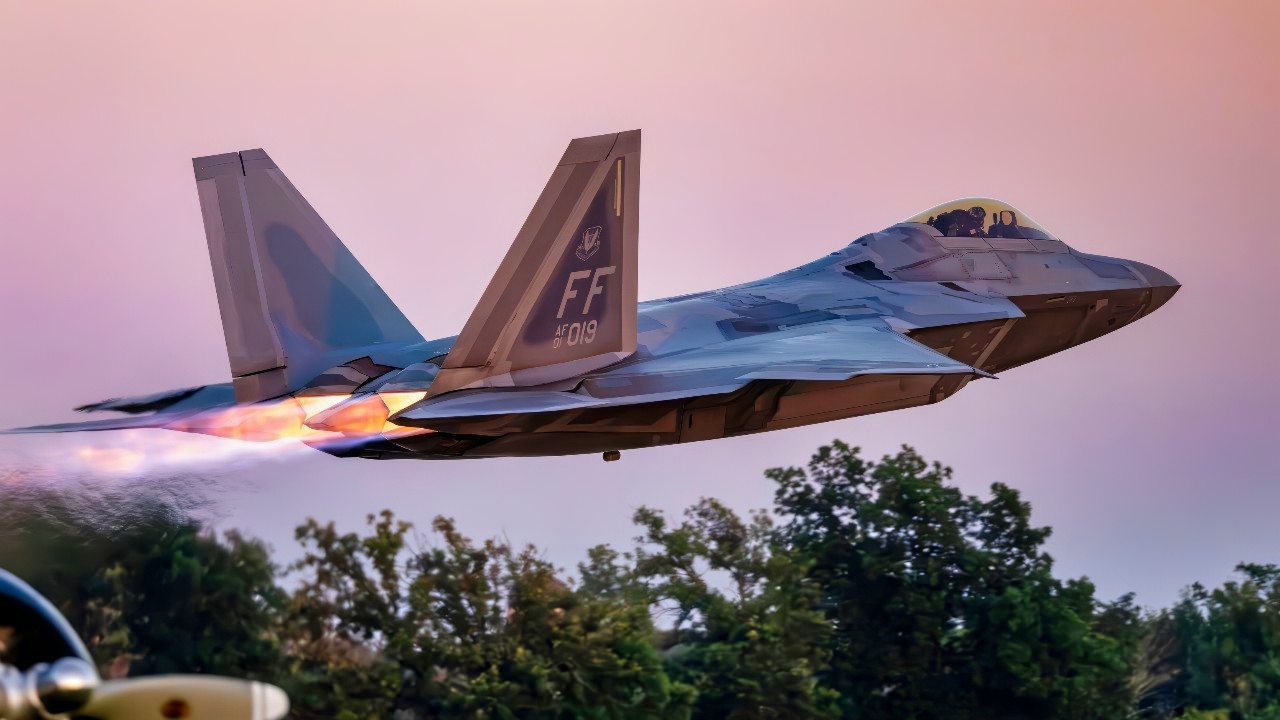
The F-22 Raptor has struggled with readiness rates throughout its service life, with numbers in recent years particularly troubling. Readiness has been a perennial issue not just within the F-22 Raptor fleet, but across the U.S. Air Force more generally. The average mission-capable rate for the U.S. Air Force in 2024, according to one source, was 67.15 percent. In 2023, that number was slightly higher, at 69.92 percent. In 2022, that figure was, again, slightly higher, at 71.24.
Earlier in the decade, the F-22 fleet generally hovered at the low fifty percent range — numbers that were considered deeply disappointing — if not outright concerning — for the world’s most advanced frontline air superiority fighter.

U.S. Air Force maintainers assigned to the 3rd Air Expeditionary Wing prepare F-22 Raptors for take-off on the flightline during exercise Resolute Force Pacific 2025 in Tinian, Northern Mariana Islands, July 19, 2025. The REFORPAC exercise is part of a first-in-a-generation Department-Level Exercise series, employing more than 400 Joint and coalition aircraft and more than 12,000 members at more than 50 locations across 3,000 miles. (U.S. Air Force photo by Airman 1st Class Tala Hunt)

U.S. AIR FORCE ACADEMY, Colo. – An F-22 Raptor performs a flyover and air demonstration during noon meal formation at the U.S. Air Force Academy in Colorado Springs, Colo., April 14, 2023. Events such as these aim to cultivate warrior ethos, a future-focused mindset, and supplement existing character, leadership, and officer development efforts with the cadets. (U.S Air Force Photo by Trevor Cokley)
In 2018, then-Defense Secretary Jim Mattis set a particularly pointed goal for the Air Force’s F-16s, F-35s, and F-22s — at eighty percent. It did not meet that target.
Part of the Raptor fleet’s problem is its size and age. The Air Force only purchased 187 operational F-22s before the production line closed in 2011. The fleet’s small size means that every F-22 Raptor aircraft absorbs an intense operational burden that cannot be spread as widely as with other fleets, which number in the thousands. Unlike the significantly larger fleets of F-15s, F-16s, and F-35s, the Air Force cannot easily rotate Raptors through maintenance cycles without adversely affecting availability.
It is for these reasons, among others, that the F-22 fleet’s operational readiness numbers — mission-capable numbers — have been chronically low. But even that mission-capable metric only tells a part of a larger story.
Behind the Scenes on F-22 Raptor
There are a number of reasons why an aircraft wouldn’t be counted as mission-capable. These include depot maintenance, inspections, downtime waiting for spare parts, software or hardware updates, various structural repairs, engine maintenance or overhaul, repairs for damage incurred during battle, or grounding due to a variety of technical issues.

U.S. Air Force Maj. Paul “Loco” Lopez, Air Combat Command F-22 Raptor Demonstation Team commander, flies the F-22 Raptor, demonstrating its combat capabilities at FIDAE (Feria Internacional del Aire y del Espacio) in Santiago, Chile, April 7, 2018. The Raptor is a multirole fighter capable of supporting both air-to-air and air-to-ground missions worldwide.
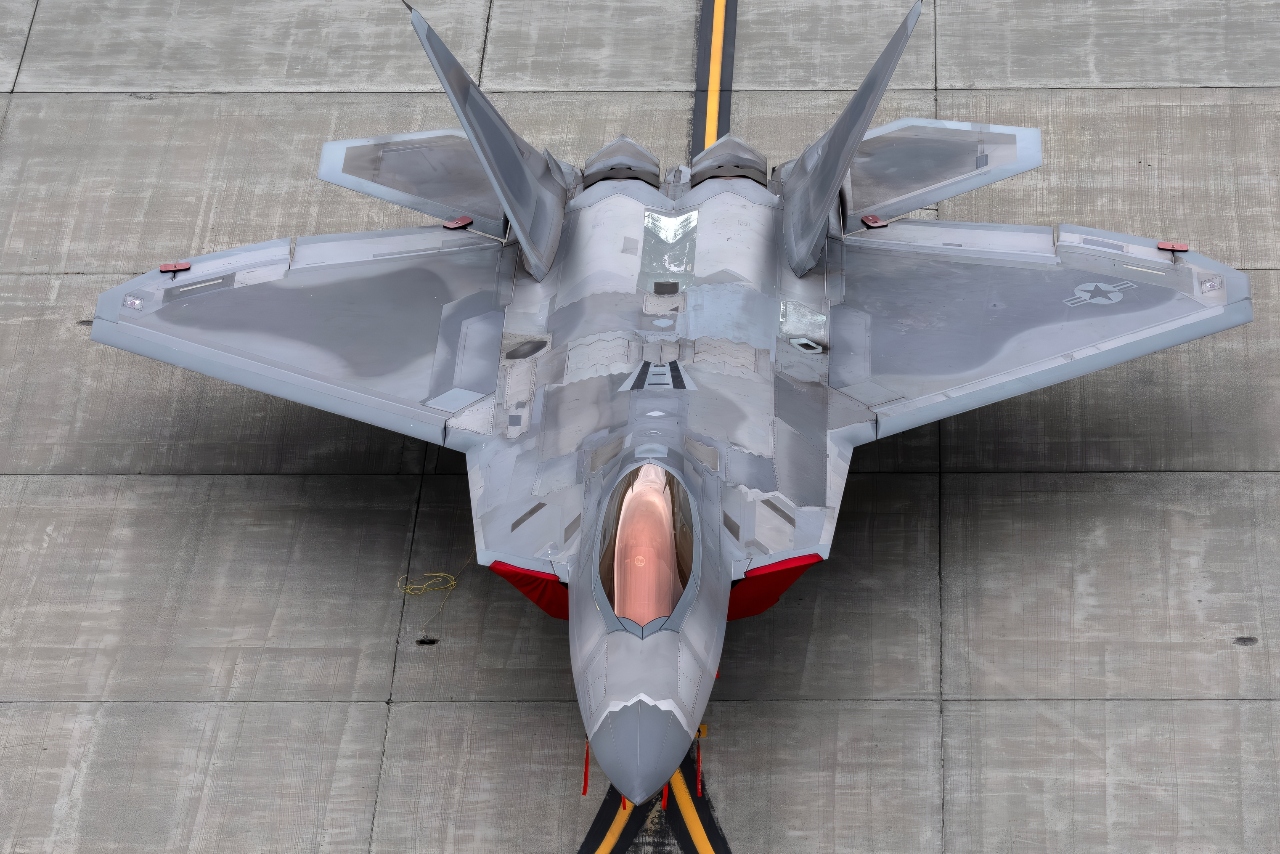
A U.S. Air Force F-22 Raptor is displayed on the flight line during a summit between U.S. President Donald J. Trump and Russian President Vladimir Putin at Joint Base Elmendorf-Richardson, Aug. 15, 2025. (Alaska National Guard photo by Seth LaCount)
During a time of acute need, say, during a major conflict, the Air Force could temporarily boost readiness significantly by cannibalizing parts from grounded aircraft, delaying non-critical maintenance, surging resources to combat units, and reducing the number of aircraft available for training. These are temporary measures, however, and could have a detrimental effect on long-term readiness.
For these reasons, readiness statistics during peacetime can be somewhat deceptive. Though a fleet might show, say, fifty percent readiness on paper, that same fleet could still be able to generate a much larger combat force during a crisis scenario, albeit for a limited time period.
For stealth aircraft like the F-22 Raptor, the B-2 Spirit bomber, and the F-35, readiness is particularly sensitive to the maintenance demands associated with their stealth coatings and supply chains. Conversely, older aircraft like the F-15 and F-16 can generally achieve higher readiness in part because they lack those specialized stealth components, and their maintainers have decades of experience. Spare part networks are also more mature and, in many cases, global.
But within the mission-capable designation, there are several subcategories, such as Fully Mission Capable aircraft and Partially Mission Capable aircraft. FMC aircraft can perform all assigned missions. For example, an F-22 Raptor with all its sensors, stealth systems, weapons interfaces, communications systems, and serviced engines functioning within normal parameters would fall into the FMC category.
A PMC aircraft, on the other hand, can perform at least one of its mission sets, but has some degraded capabilities. For example, a fighter could be cleared for air-to-air combat training, even if a sensor or datalink function is down.
However, when the Air Force says the F-22 fleet has a 40% mission-capable rate, that does not mean only 40% of the F-22 fleet can fly and fight. Rather, it means that around forty percent are available to perform at least one assigned mission at any given time.
The Times Are Changing?
Speaking last year at the Air and Space Force Association’s AFA Warfare Symposium, then-Air Force Chief of Staff General David Allvin gave a keynote address.
“Our Air Force continues to be the most dominant on the planet,” Allvin said. “I don’t want to be here next year, or have the next chief, say we’re no longer [dominant]. So we’ve got to work on this.” In that regard, there does seem to be work that has to be done.

Afterburners are lit as an F-22 Raptor performs an aerial demonstration at the New York Air Show at Montgomery, New York, Aug. 23, 2025. The rapid change in angle of attack causes visible vapor to form around the aircraft, giving spectators a clear view of the jet’s aerodynamic performance. This demonstration highlights the unique thrust-vectoring capabilities of the F-22, allowing it to achieve extreme agility unmatched by other fighter aircraft. (U.S. Air Force photo by Staff Sgt. Lauren Cobin)
About the Author: Caleb Larson
Caleb Larson is an American multiformat journalist based in Berlin, Germany. His work covers the intersection of conflict and society, focusing on American foreign policy and European security. He has reported from Germany, Russia, and the United States. Most recently, he covered the war in Ukraine, reporting extensively on the shifting battle lines in Donbas and writing about the war’s civilian and humanitarian toll. Previously, he worked as a Defense Reporter for POLITICO Europe. You can follow his latest work on X.


