


Key Points and Summary – The F/A-18E/F Super Hornet was never meant to be a star, but it became the backbone of U.S. naval airpower after the A-12 collapsed and the F-14 aged out.
-Enlarged, more powerful, and far longer-legged than the legacy Hornet, it grew into a true multirole strike fighter, carrying a deep and varied weapons load while proving incredibly reliable at sea.

An F/A-18 Super Hornet from Naval Air Station Oceana, Virginia, performs an aerial demonstration over Rickenbacker International Airport, Ohio, June 16, 2024, as part of the Columbus Air Show. This year’s event featured more than 20 military and civilian planes, including a KC-135 Stratotanker from the 121st Air Refueling Wing, which served as the base of operations for military aircraft participating in the show. (U.S. Air National Guard photo by Senior Airman Ivy Thomas)
-With AESA radar, Block III upgrades, and manned–unmanned teaming with the MQ-25, it’s now the Navy’s indispensable bridge to the future F/A-XX.
-Not glamorous, but decisive, the Super Hornet is the fleet’s quiet, all-purpose bruiser.
The F/A-18 Super Hornet Was Never Supposed to Be a Legend
In the unforgiving world of carrier aviation, some aircraft are legends, born to be icons. The F-14 Tomcat, with its imposing size and cinematic fame, was the thoroughbred fleet defender.
The F-35C Lightning II, a stealthy, flying supercomputer, is the ghost of the future.
And then there is the Boeing F/A-18E/F Super Hornet—the machine that was never supposed to be a legend, but became the single most important tactical aircraft in the U.S. Navy for a generation.
It is the ultimate workhorse, a blue-collar brawler that has held the line, adapted to every threat, and formed the backbone of American naval airpower for more than two decades.
The Super Hornet was born not from a visionary quest for a revolutionary new fighter, but from a crisis. It was a pragmatic solution to a gaping wound in the Navy’s capabilities, a testament to clever, evolutionary design over high-risk, clean-sheet gambles.
To understand the Super Hornet is to understand the art of the possible. It is a story of how a good design was made great, becoming a multi-role master that could absorb any mission, endure the brutal tempo of combat deployments, and keep the Navy in the fight when its more exotic platforms faltered.
A Phoenix from the Ashes of Canceled Ambitions
The story of the Super Hornet begins with the death of two other programs in the early 1990s. The first was the Navy’s ambitious A-12 Avenger II, a stealthy flying-wing bomber intended to be the future of carrier-based deep strike.
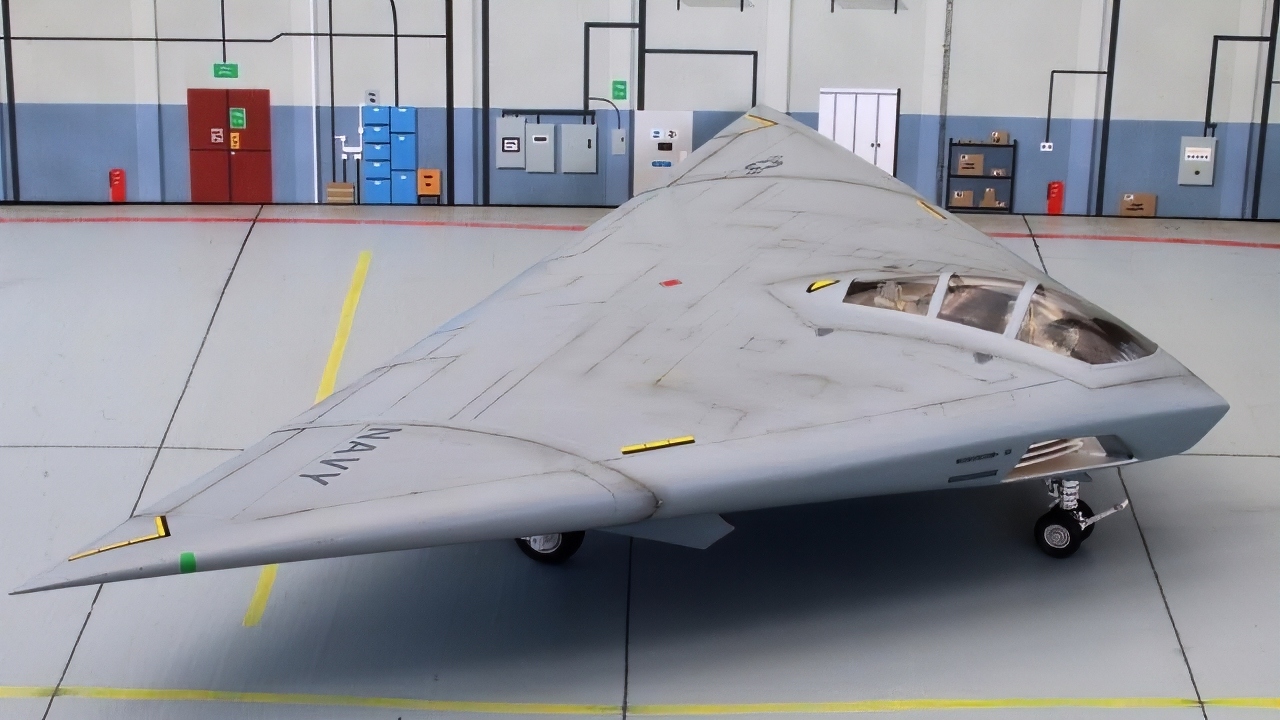
A-12 Avenger II Flying Dorito. Image Credit: Creative Commons.
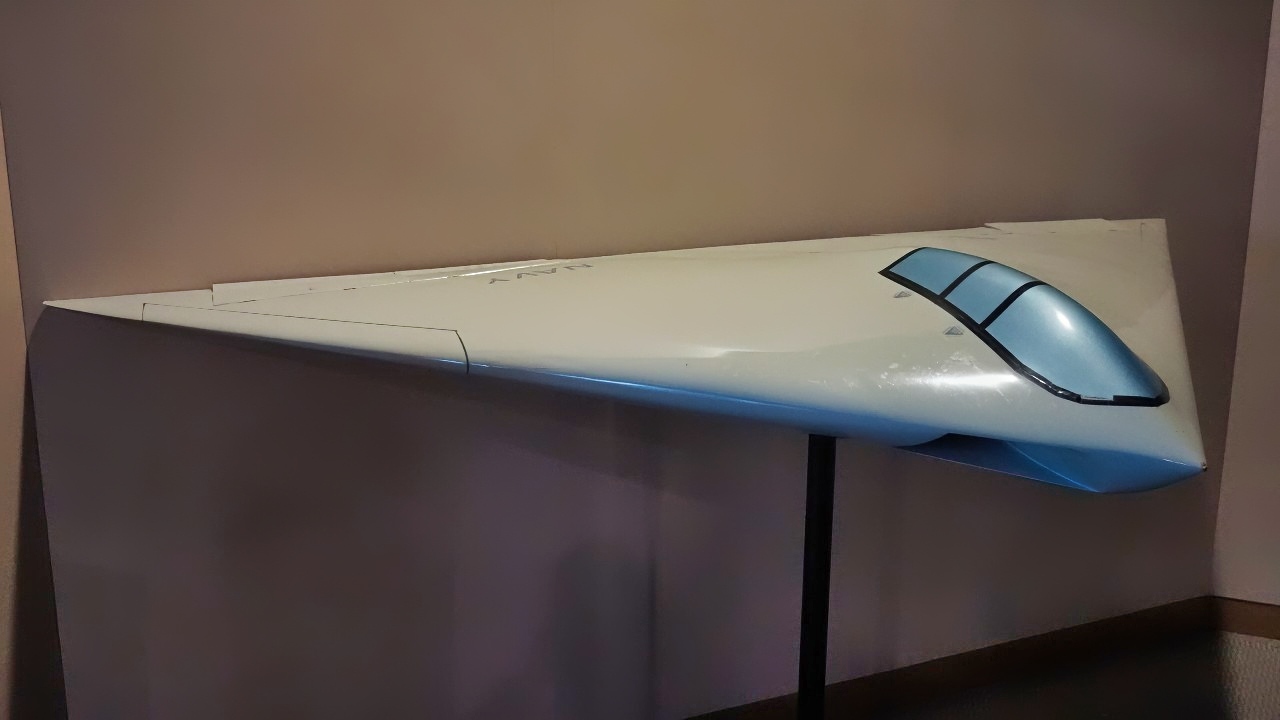
A-12 Avenger II Model. Image Credit: Creative Commons.
When the A-12 program collapsed under its own weight and staggering cost overruns in 1991, the Navy was left with a massive problem: its aging fleet of A-6 Intruders needed a replacement, and fast. At the same time, the decision was made to accelerate the retirement of the legendary F-14 Tomcat.
While an unmatched interceptor, the F-14 was incredibly expensive to maintain and operate, and its 1970s-era systems were becoming obsolete.
This created a terrifying capability gap. The Navy was about to lose its primary long-range strike platform and its premier fleet air defense fighter, with nothing on the horizon to replace them. The existing F/A-18 “Legacy” Hornet (the A/B/C/D models) was a fantastic multi-role fighter, but it had one crippling flaw: a notoriously short combat radius. It simply did not have the legs for the demanding missions of the modern era.
The solution, championed by McDonnell Douglas (later Boeing), was not to start from scratch, but to radically evolve a proven design. The proposal was for a “Super Hornet,” an aircraft that looked like its predecessor but was, in reality, almost entirely new.
It would be roughly 25% larger, carry 33% more internal fuel, and be powered by new, more powerful engines. It was the perfect compromise: a low-risk, affordable program that promised to solve the Navy’s range and payload problems while retaining the reliability of the original Hornet. In an era of shrinking defense budgets, it was an offer the Pentagon couldn’t refuse.
A Brawler’s Toolkit: More Power, More Fuel, More Weapons
The Super Hornet is visually similar to the legacy Hornet, but the differences are profound and purpose-driven. The F/A-18E (single-seat) and F/A-18F (two-seat) variants are built around solving the key limitations of their predecessors.
The most critical improvement was range. The enlarged airframe allows the Super Hornet to carry over 14,000 pounds of internal fuel, dramatically increasing its combat radius and loiter time over a target area. This single change transformed the aircraft from a short-range dogfighter into a true, long-range strike fighter.

U.S. Navy Aviation Boatswain’s Mate Aircraft Handling 2nd Class Kyle Darmanin, from Mooresville, North Carolina, assigned to air department’s flight deck crash and salvage division, signals an F/A-18E Super Hornet, attached to Strike Fighter Squadron (VFA) 27, on the flight deck of Nimitz-class aircraft carrier USS George Washington (CVN 73) while underway in the Timor Sea in support of Talisman Sabre 2025, July 14, 2025. Talisman Sabre is the largest bilateral military exercise between Australia and the United States advancing a free and open Indo-Pacific by strengthening relationships and interoperability among key allies and partners, while enhancing our collective capabilities to respond to a wide array of potential security concerns. (U.S. Navy photo by Mass Communication Specialist 2nd Class Tyler Crowley)

A Sailor directs an F/A-18E Super Hornet from the “Kestrels” of Strike Fighter Squadron (VFA) 137 on the flight deck of the aircraft carrier USS Nimitz (CVN 68) in the South China Sea, May 12, 2025. Nimitz is underway in the U.S. 7th Fleet area of operations on a scheduled deployment, demonstrating the U.S. Navy’s unwavering commitment to a free and open Indo-Pacific. (U.S. Navy Photo by Mass Communication Specialist Seaman Apprentice Franklyn M. Guage)
This was enabled by two new General Electric F414 engines, which produce 35% more thrust than the engines on the legacy Hornet.
This gave the Super Hornet the power it needed to carry heavier loads off the carrier deck without sacrificing performance.The airframe was also strengthened and given two additional wing pylons, increasing its total number of weapons stations to 11. This allows it to carry a staggering and diverse mix of ordnance. For air superiority, it can carry the latest AIM-9X Sidewinder and AIM-120 AMRAAM missiles.
For strike missions, its arsenal includes everything from laser-guided bombs and GPS-guided JDAMs to anti-radiation HARM missiles and HARPOON anti-ship missiles.
But the most significant technological leap in the Super Hornet, especially in later production blocks, was the integration of the Raytheon AN/APG-79 Active Electronically Scanned Array (AESA) radar.
This was a generational jump in capability. Unlike older mechanically-scanned radars, the AESA can scan vast areas of sky and ground simultaneously, track dozens of targets, and guide multiple missiles at once, all while being highly resistant to enemy jamming. It turned the Super Hornet into a formidable electronic warfare platform and a supreme hunter.
F/A-18 E/F Super Hornet: The Combat-Proven Workhorse
While more advanced fighters were often beset by maintenance issues and low availability rates, the Super Hornet quickly earned a reputation for being the most reliable and ready aircraft on the carrier deck. It entered service just in time to become the backbone of naval aviation during the Global War on Terror.
The Super Hornet first drew blood during Operation Southern Watch, enforcing the no-fly zone over Iraq in 2002. However, it was during Operation Iraqi Freedom in 2003 that it truly came into its own. Flying thousands of combat sorties, the Super Hornet fleet proved its worth as a multi-mission powerhouse.
In a single mission, a Super Hornet could provide close air support for troops on the ground, strike a pre-planned target with precision munitions, and still defend itself against enemy aircraft. Its two-seat F model was particularly valuable, with the Weapon Systems Officer in the back seat managing the complex tasks of targeting and communication, freeing the pilot to fly the aircraft.
Throughout the long wars in Iraq and Afghanistan, and later in the fight against ISIS under Operation Inherent Resolve, the Super Hornet was the Navy’s go-to platform.
It demonstrated an incredible ability to sustain a high operational tempo, consistently posting the highest mission-capable rates in the carrier air wing. While other, more specialized aircraft came and went, the Super Hornet was always there, ready to launch.
It even scored the first U.S. air-to-air kill of a manned enemy aircraft in nearly two decades when it shot down a Syrian Su-22 in 2017.
The Bridge to the Future: Block III and the Robotic Wingman
Even as the F-35C enters the fleet, the story of the Super Hornet is far from over. The Navy is investing heavily in the new Block III configuration, an upgrade so significant that it essentially creates a new generation of the aircraft.
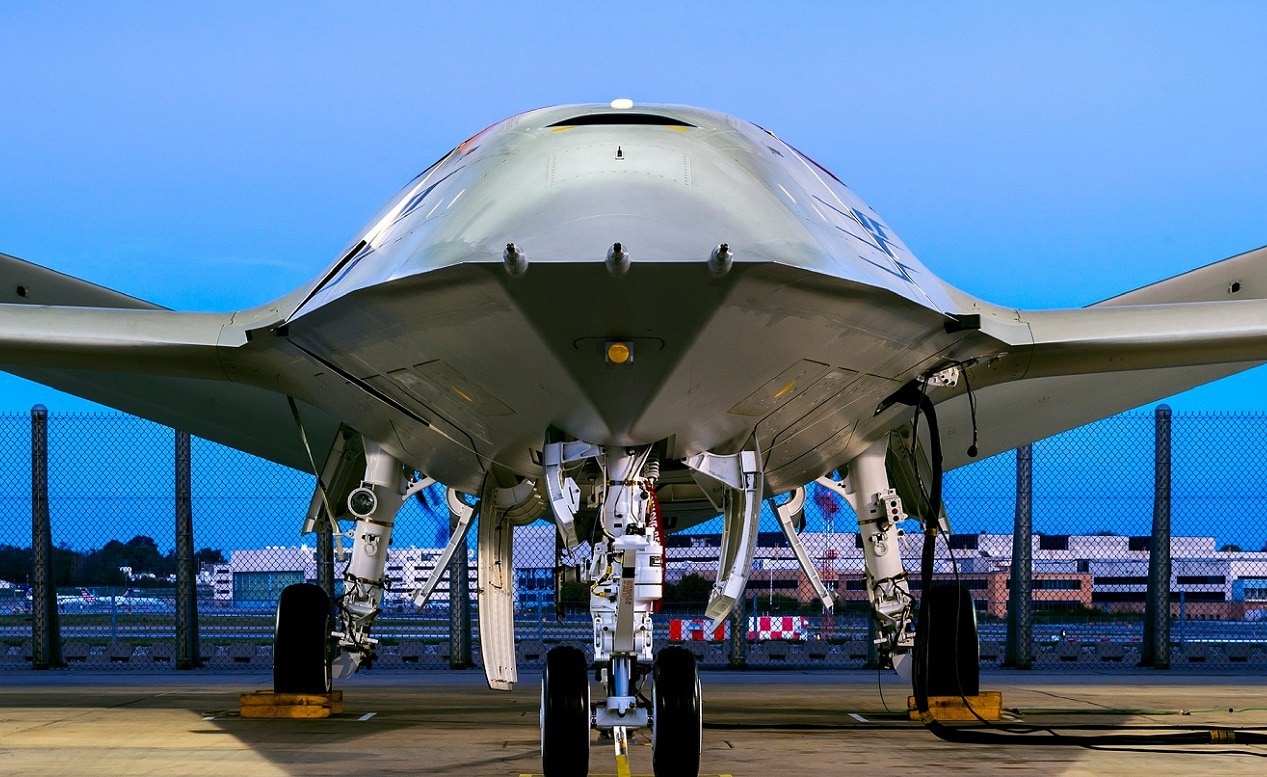
MQ-25. Image Credit: Creative Commons.
The Block III Super Hornet is designed to fight and win in a modern, contested environment. It features conformal fuel tanks that add even more range without sacrificing aerodynamics, an advanced cockpit system with a large area display, and a new computer processor to handle the immense amount of data on the modern battlefield.
Its airframe life is extended from 6,000 to 10,000 flight hours, ensuring it will remain in service for decades to come.
Crucially, the Block III is designed with a new level of network connectivity, allowing it to share vast amounts of data with other aircraft and ships.
This is where its future lies: not just as a fighter, but as a command-and-control node for the robotic age.
The Super Hornet is the designated platform to control the Navy’s new MQ-25 Stingray unmanned aerial tanker.
An F/A-18F crew will be able to direct the drone, extending the reach of the entire carrier air wing and freeing up other Super Hornets from the “buddy tanking” role.
This manned-unmanned teaming is the key to the future of naval aviation, and the Super Hornet is at the very center of that evolution.
This evolution will eventually lead to its replacement. The U.S. Navy’s Next Generation Air Dominance program, or F/A-XX, is already underway, with companies like Boeing developing concepts for a sixth-generation, penetrating fighter to succeed the Super Hornet in the 2030s and beyond.
This future aircraft will incorporate lessons learned from decades of Super Hornet operations.
Until that day comes, the Block III Super Hornet will serve as the indispensable bridge, providing the Navy with the combat-proven capability it needs today while paving the way for tomorrow’s technology.
Conclusion: The Unsung Hero of the Fleet
The F/A-18E/F Super Hornet may never have had the Hollywood mystique of the F-14 or the revolutionary headlines of the F-35, but its legacy is just as profound.
It was the aircraft that saved naval aviation from a looming crisis, a reliable and adaptable warrior that shouldered the burden of combat for a generation.
It is a testament to the power of smart, evolutionary design, proving that you don’t always need a revolution to achieve dominance.
The Super Hornet is the unsung hero of the modern U.S. Navy—a brawler, a tanker, a precision bomber, and an air superiority fighter all rolled into one tough and dependable package.
It is the workhorse that never quits, and it will continue to be the backbone of the fleet for years to come, a silent professional standing guard on the flight decks of America’s carriers.
About the Author: Harry J. Kazianis
Harry J. Kazianis (@Grecianformula) is Editor-In-Chief and President of National Security Journal. He was the former Senior Director of National Security Affairs at the Center for the National Interest (CFTNI), a foreign policy think tank founded by Richard Nixon based in Washington, DC. Harry has over a decade of experience in think tanks and national security publishing. His ideas have been published in the NY Times, The Washington Post, The Wall Street Journal, CNN, and many other outlets worldwide. He has held positions at CSIS, the Heritage Foundation, the University of Nottingham, and several other institutions related to national security research and studies. He is the former Executive Editor of the National Interest and the Diplomat. He holds a Master’s degree focusing on international affairs from Harvard University.


Krystal cane
September 3, 2025 at 11:35 am
Is the message we have a complete idiot and charge of the United States?
Big Jake
September 7, 2025 at 8:22 pm
Block III Rhino (Super Hornet) isn’t getting conformal fuel tanks.