


Key Points and Summary – In a future conflict with China, technological superiority alone will not be enough; “mass matters.”
-The vast distances of the Indo-Pacific and the limitations of sea-launched airpower create a critical need for a large, land-based fleet of long-range, 6th-generation F-47 fighters.

F-47 Fighter from U.S. Air Force. Image Credit USAF.
-A substantial number of F-47s would be essential to overwhelm enemy defenses, deliver the necessary volume of ordnance, and create a resilient, networked force capable of shortening the sensor-to-shooter timeline.
-Without a large F-47 fleet, the U.S. risks being unable to effectively project power and prevail in a great-power conflict.
The F-47 Numbers Debate
The United States military now operates hundreds of F-35 fighter aircraft, and the Air Force plans to deploy a fleet of more than 1,700 F-35As, circumstances that suggest the Pentagon indeed believes that “mass” still matters.
The phrase “mass matters,” originating from the ancient writings of Sun Tzu, remains highly relevant today, despite the numerous advances in technology.
The emergence of AI, stealth, and long-range weapons and sensors has not entirely displaced or removed the importance of deploying a large force.
Enter Boeing’s F-47 Fighter
There are many reasons for deploying a large force, and there are many questions that bear heavily upon the question of just how many new 6th-gen F-47s the Air Force should acquire.
Given the current threat situation, the service would be well served by planning to build an extensive fleet of F-47s.
A substantial fleet would not only make sense due to the many advances in technology likely woven into the F-47 but also relate to any Air Force need to address the growing threat from the People’s Liberation Army Air Force.
Any potential conflict in the Pacific is likely to cover an extensive geographical area spanning from the Korean Peninsula to the South China Sea and even waters North of Australia. This is an area spanning thousands of miles of ocean, which would undoubtedly require a large fleet of 5th- and 6th-generation aircraft.
While sensing and weapons attack ranges are exponentially greater than they have been in decades, enabling fighter jets to target and attack at much greater ranges, there are many reasons why a large fleet would prove critical to any effort to win a conflict in the Pacific.
One key reason many airframes would be important relates to simple networking technology. The F-47 is likely to feature F-35-like data-link connectivity, enabling 6th-generation aircraft to communicate with one another.
The F-35, of course, is known to operate with MADL, or Multi-Function Advanced Data Link. This technology enables F-35s to quickly and seamlessly share data across a formation of aircraft, coordinating targeting and attacks, sharing intelligence, and sustaining connectivity across a wide theater of combat engagement.
It seems inevitable that the F-47 will use similar or even more advanced technology, designed to enable multi-domain, long-range networking.
Networking and AI in Modern War
This kind of connectivity and multi-domain networking is understood to be of critical importance to modern warfare, strategic and tactical thinking, given the growing significance of quickly sharing information in combat to improve command and control. Networking data and intelligence information in the age of AI continues to prove that connecting nodes and platforms in real-time or near real-time can massively truncate or shorten sensor-to-shooter time. This places an attacking force ahead of or within an enemy’s decision cycle, making it much more possible for a group of fighter jets to prevail in a combat engagement.
Yet another need for a large fleet of F-47s pertains to ordnance and the scale at which an attack might be necessary.
A single F-47 will be capable of flying with a certain amount of ordnance, and a large-scale engagement is likely to require a massive amount of ordnance delivered by stealth aircraft.
An advanced adversary, such as Russia or China, would make it extremely difficult for large bombers, like the non-stealthy B-52, to operate over enemy airspace. Therefore, operating a large number of F-47s would significantly improve attack capacity.
A great power or large-scale war with China or Russia would cover a vast geographical area, so an attacking US force would need a wide air combat envelope and a significant operational formation to be effective.
Land-Launched Stealth Attack
Finally, there is the matter of sea-launched stealth attack volume.
A US Navy amphibious assault ship is capable of operating with roughly 20 F-35Bs, and an aircraft carrier can likely launch roughly 90 F-35Cs at maximum capacity, depending upon the mix of aircraft in a Carrier Air Wing.
This means that a 5th- or 6th-generation sea-launched attack from US Navy carriers and amphibs would operate with some scale or volume limits. In the event that an attacking US force needed to operate with hundreds of 5th- and 6th-generation aircraft, something which is likely the case in any war with China, using only sea-launched stealth fighters might place the US at a disadvantage. This might still be the case even if the US Navy were to operate dual-carrier operations, something it has already shown it can successfully perform.
Therefore, land-launched F-47s emerging from Japan, South Korea, or even the Philippines and the South China Sea would prove critical to any successful air campaign against the People’s Republic of China.
Range Challenges
The question of range is highly significant to this equation, given the distances from which land-launched stealth aircraft would have to travel from the Philippines and Japan. Areas of the Philippines are anywhere from 750 to 2,000 miles from China, and parts of Southern Japan are roughly 500 to 800 miles from Taiwan.
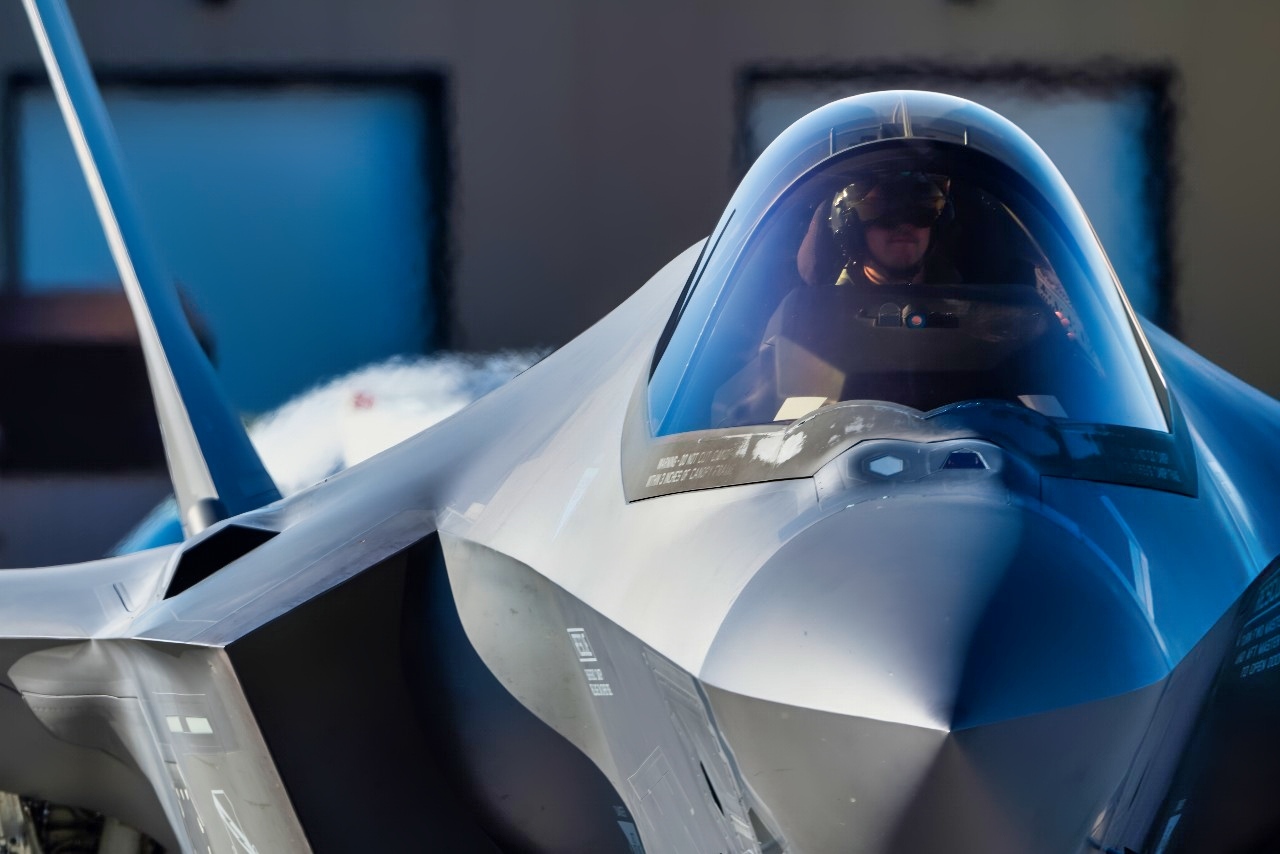
An F-35A Lightning II fighter jet, a single seat, single engine, all-weather stealth multirole fighter aircraft, assigned to the 466 fighter squadron prepares to taxi across the flightline at Hill Air Force Base, Utah, Oct. 5, 2024.
This means land-launched F-35s would, of course, reach ocean areas and some land targets of importance in the Pacific, but might require non-stealthy refuelers to sustain any extensive air-attack campaign. Of course, the US Navy will operate its carrier-launched MQ-25 Stingray aerial drone refueler and will likely have stealthy drone refuelers in the future. Yet, land-launched F-35s may still encounter some reach and range challenges.
Longer Range F-47
Very little is known about the F-47 due to clear security reasons, yet numerous public reports indicate that Pentagon and Air Force experts have confirmed the F-47 will operate at unprecedented ranges. Therefore, the ability to launch or operate a large number of land-launched 6th-generation aircraft with much longer ranges would introduce a paradigm-changing ability to reach and attack targets in the Pacific on a large scale, should US forces operate with a large fleet of F-47s.
About the Author: Kris Osborn
Kris Osborn is the President of Warrior Maven – Center for Military Modernization. Osborn previously served at the Pentagon as a highly qualified expert in the Office of the Assistant Secretary of the Army—Acquisition, Logistics & Technology. Osborn has also worked as an anchor and on-air military specialist at national TV networks. He has appeared as a guest military expert on Fox News, MSNBC, The Military Channel, and The History Channel. He also has a Masters Degree in Comparative Literature from Columbia University.
Military Affairs
China’s Stealth Air Force Has 1 Mission


Off-CNN
August 25, 2025 at 4:40 pm
F-47 non-stsrter. Yep.
Reason is its very coming existence is now even already very much in doubt. Masses of f-47s, forget it.
In a ‘high-end fight’ in the pacific, f-47s and burkes and fords ain’t gonna make it.
Reason is that ‘high-end fight’ gonna be a nuclear one.
There are lots of satellites watching the pacific, including geo SAR (syn aperture radar) and E/O and LEO optical ones.
So, What genghis gonna do.
Genghis has already given many hints. He has already spoken of the Big One, the cataclysmic confrontation, the hellscape, the demolition site carpark.
He gonna use hypersonic and long-range missiles to tear down the first line of defense. And long-range bombers. Outside the view of those sats.
Long-range bombers like b-1, b-2,etc, etc, lugging HACMs, LRSO, ARRWs, and other missiles, loads of them will tear apart the defense site.
Once that has been achieved, the front door now regarded as being kicked down, genghis will move in with his tactical nukes and wallop a few or several sites.
The ultimatum will then be quickly issued; surrender Now, or yor mega cities gonna get the treatment.
Effectively, GAME OVER.
Where does f-47s come in. Only in a post-lunch hour midday dream.
doyle
August 25, 2025 at 6:58 pm
There’s another scenario, which could well happen today, now, in 2025, that the author hasn’t considered. Won’t require f-47s at all.
What happens if trump and co force russia onto the ropes in eastern ukraine today, this year.
Russia would be forced to use nukes to save its very self from the evil nazis.
But that would likely trigger a ww3-type reaction from the west. (trump, rubio, hegseth, macron, etc.)
To wriggle out of that dicey situation, russia would have no choice but to nuke Taipei, a move that would compel those guys to straightaway pivot east directly to the pacific.
That would likely save russia, as those guys will have to confront someone else, someone more powerful than the russian army. Would f-47s be needed..
None at all. Not a single one.
Steve Rosenberger
August 26, 2025 at 8:26 am
Nice idea. I tell my Congress Rep. all the time that I cannot afford all his good government. Same here. No money son, spent it all at the massage parlor.
Stephan Larose
August 27, 2025 at 1:02 am
Perhaps the US just shouldn’t provoke a war with China. We all know the US wants to be seen as the big boy in town, and its imperial ego is incredibly fragile—but a conflict with China would lead to nuclear war—which everyone loses. I know the US doesn’t know how to do diplomacy and win-win negotiation, but that’s the only realistic option.