


Key Points and Summary – The U.S. must avoid repeating the “huge mistake” it made with the F-22 and should strategically sell its new F-47 sixth-generation fighter to key allies.
-The F-22’s export ban and short production run weakened America’s overall position.

U.S. Air Force Maj. Josh Gunderson, F-22 Demo Team commander, enters into the Raptor Slide during the Millville Airshow, Sept. 3, 2021, at Millville Army Airfield, Millville, New Jersey. During the Raptor Slide the aircraft actually slides down and backwards under control before Gunderson adjusts the aircrafts position and powers out of the maneuver. (U.S. Air Force photo by Staff Sgt. Don Hudson)
-Selling the F-47 to staunch allies like Japan and the UK would create a powerful, interoperable network to deter China, strengthen collective defense, and share the security burden.
-While sales should be highly selective, creating a coalition of F-47 operators would send an “unmistakable message” to Beijing.
Question: Should The US Sell The F-47 To Our Allies?
When U.S. President Donald Trump announced that Boeing had won the contract to produce the Next Generation Air Dominance (NGAD) stealth fighter, dubbed the F-47, he added that sales of the future sixth-generation aircraft to staunch U.S. allies would be considered.
Since that announcement, all has been quiet on the F-47 foreign-sales front, at least publicly. However, Japanese media leaked that during a phone call with Japanese Prime Minister Shigeru Ishiba, Trump indeed offered to sell the F-47 to Japan.

NGAD. Image Credit. Lockheed Martin.
The question of whether the U.S. should sell the F-47 is complex, with compelling arguments on both sides. But it is essential to find an answer soon, and to define potential sales parameters, because the aircraft is critically important.
Remember The Lesson Learned From The F-22
After the United States introduced the F-22 Raptor, it built only 185 of the stealth fighters. The Soviet Union collapsed, military budgets tightened, no more Raptors were purchased, and the F-22 production lines shut down and were dismantled. In retrospect, this was a huge mistake.
Under Trump, the U.S. is shifting from a longstanding role of global policeman to seeking to act as a key member of coalitions working together to provide collective defense. This is a wise strategic redirection, and selling platforms such as the F-47 to allies would seem to fit the framework.
Initially, Trump’s decisions regarding defense in Europe elicited fears that the U.S. would abandon its allies, or vice versa. Now, NATO countries are finally beefing up their defense budgets and taking more active control of their collective defense. Adding the sixth-generation F-47 to their defenses wouldn’t hurt U.S., but would expand and strengthen its defense strategy.
Further, the Chinese threat in the Indo-Pacific might seem less potent if U.S. allies such as Japan, Australia, and others had fleets of F-22 Raptors. Had production of the F-22 continued, U.S. fighter fleets would be even more formidable than they are today, but in a crisis, U.S. squadrons would not have to operate alone in Pacific hotspots if their partners flew Raptors.
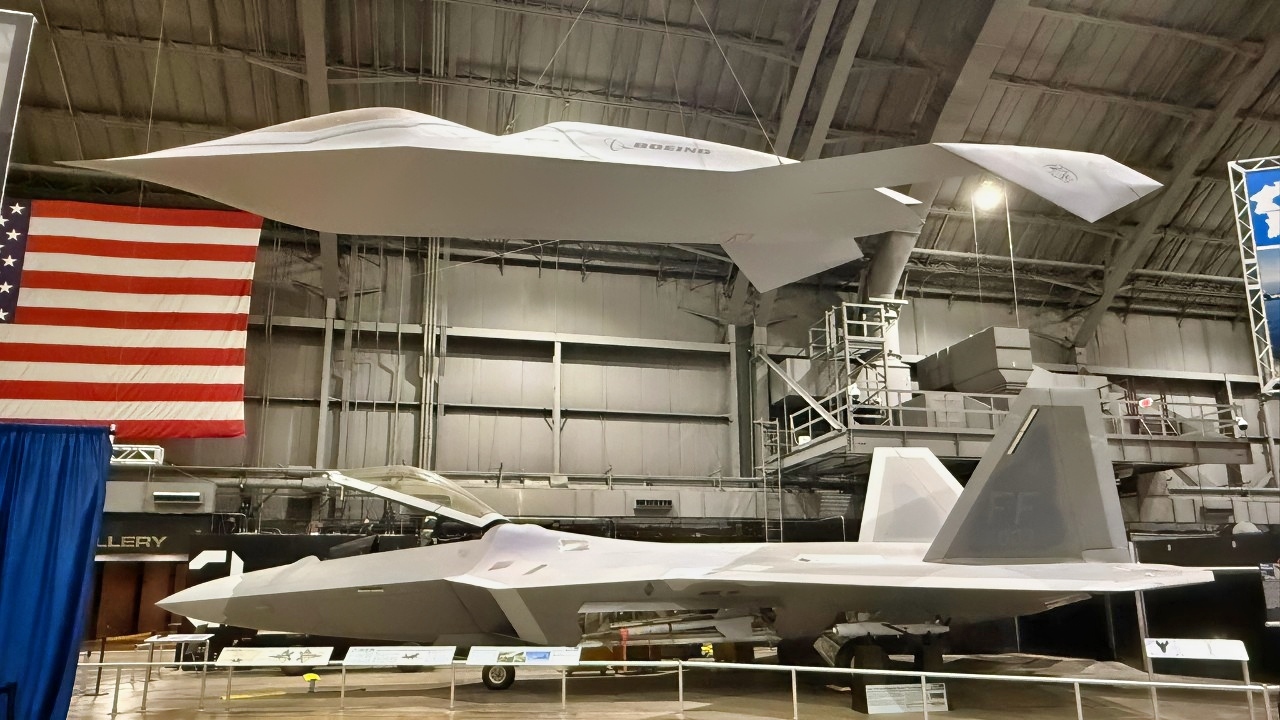
YF-118G above and F-22 Raptor Below. Image from National Security Journal.
Collective Defense Among Coalition Partners
U.S. pilots can operate more effectively alongside Pacific allies, making the collective defense much stronger, if all involved parties fly the same latest-generation platform. This already happens: The multinational F-35’s universal Multifunctional Advanced Data Link technology enables all F-35s to securely and seamlessly share time-critical combat information across a formation. This adds a command-and-control advantage to attacking stealth aircraft, as they are positioned to quickly share intelligence and targeting information.
However, sales of the F-47 should be extremely selective and limited to the very closest U.S. allies. In Europe, partners could certainly include the United Kingdom and Poland, but the U.S. should not replicate the “yard sale” approach taken with the F-35, where nearly everyone got into the act. This caused as many problems as it fixed, with political headaches and constant shortfalls in production.
Strategic Deterrence Is Built In For Defense
China has made a strategic bet that either U.S. partners will fold and accept Chinese hegemony in the region, or that the U.S. will not come to their defense when it matters.
Having a regional network of F-47s across the Pacific in U.S. partners’ hands would send an unmistakable message to China that the opposite is true. It would build a much more flexible, lethal defense with the means to act quickly and decisively in the event of an attack on one or more partners.
This idea would show China and others that the U.S. will not be forced to act alone, but rather according to the Special Forces model of “by, with, and through” partners. Dr. Andrew Latham wrote that this would create “doubt in the minds of Chinese military planners. And in deterrence, doubt is everything.”
The F-47 Will Be A Force Multiplier, A Quarterback In the Sky
The F-47 sixth-generation stealth fighter is not a single entity.
The NGAD program included other ambitious elements, such as developing Collaborative Combat Aircraft (CCA) drones with significant autonomy, as well as new jet engines, weapons, electronic warfare suites, sensors, networking systems, and battle management capabilities.
The F-47 might act as a drone mothership that could oversee CCAs as they fly out ahead and collect reconnaissance data, conduct electronic warfare, and protect the F-47 with their early-warning ability.
The U.S. must first build up its strength and start manufacturing at a scale that suits American needs, so that selling to partners will not be an issue down the road.
Selling the F-47 would add to the collective defense for decades to come. If wielded selectively and strategically, it will strengthen the U.S. as well as its allies and partners.
About the Author: Steve Balestrieri
Steve Balestrieri is a National Security Columnist. He served as a US Army Special Forces NCO and Warrant Officer. In addition to writing on defense, he covers the NFL for PatsFans.com and is a member of the Pro Football Writers of America (PFWA). His work was regularly featured in many military publications.
The Best Tanks on Earth
AbramsX: The Tank the US Army Wants


