

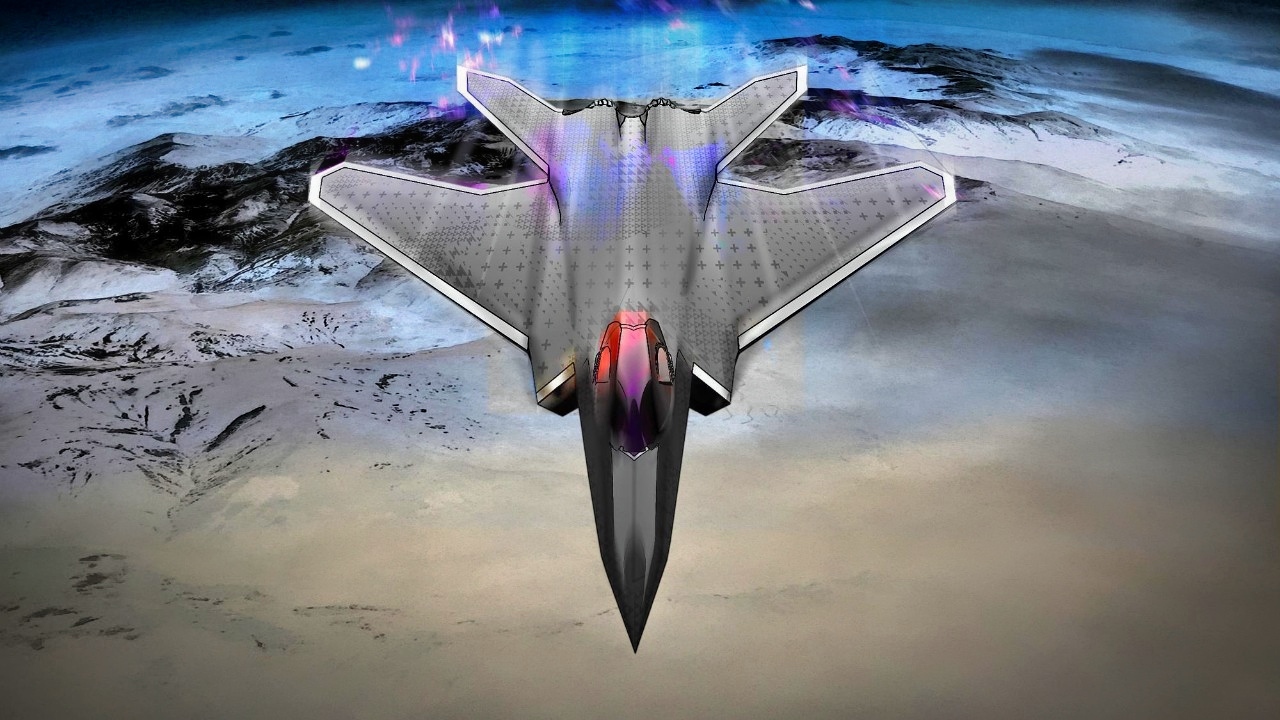
Key Points and Summary – Europe’s flagship sixth-generation project, FCAS, is stumbling just as Russia grows more aggressive and the air domain becomes harsher and more transparent.
-The continent increasingly relies on the American F-35—an aircraft it neither controls nor can replace—because its own industrial base and test infrastructure cannot deliver a rival on time.

FCAS Fighter Mock Up. Image Credit: Creative Commons.
-Meanwhile, the US is already moving ahead with NGAD and F/A-XX as software-defined hubs of manned-unmanned air warfare.
-Europe now faces a choice: accept deep, long-term integration with US systems or cling to the illusion that delayed national programs will restore airpower sovereignty in time.
Europe’s FCAS Fighter Problem
Europe’s next-generation airpower flagship is wobbling. When the head of Dassault Aviation publicly concedes he no longer knows whether the Future Combat Air System (FCAS) will ever fly, the admission lands with strategic force. It reveals more than contractual friction or the normal turbulence of multinational procurement. It exposes a deeper structural problem: Europe is struggling to deliver a sixth-generation fighter within a security ecosystem that is evolving far faster than its procurement machinery can keep pace.
A continent facing increasingly aggressive Russian behavior cannot afford strategic uncertainty about the very platform meant to anchor its future air deterrent. Air dominance is no longer a prestige industrial ambition; it is the foundation of credible defence. Yet Europe increasingly relies on an American fifth-generation aircraft—the F-35—that it did not design, cannot modernize independently, and has not yet produced any means to replace. The gap between Europe’s strategic vocabulary and its operational reality is widening.
Beyond Workshare: The Deeper Failure
FCAS’s troubles are often explained away as the predictable friction of collective procurement: work-share disputes, sovereignty anxieties, intellectual property quarrels, budget fights. All real, yet none decisive.
The deeper issue is structural. Europe struggles to sustain the industrial depth, integrated technological base, and defence-scientific pipeline required to build, test, and field a sixth-generation system on a realistic timeline.
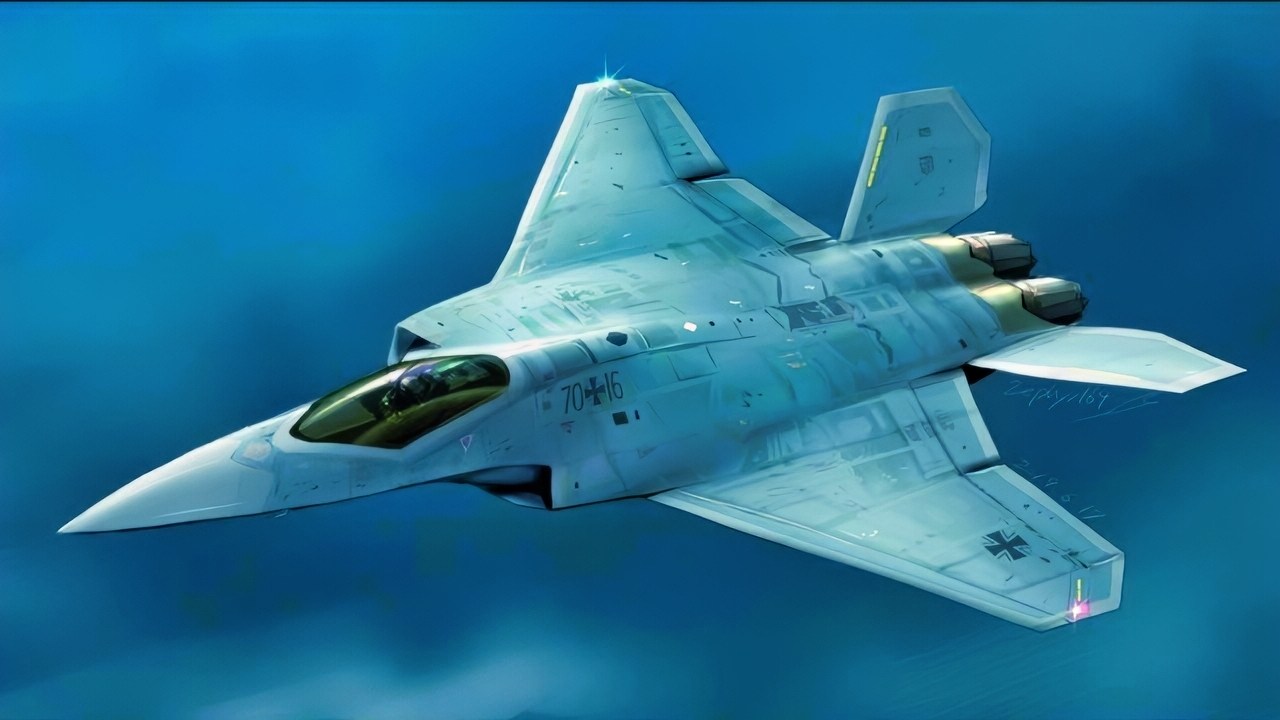
FCAS Photo Artist Image. Image Credit: Creative Commons.
This shortfall is not about talent. Europe’s engineers remain exceptional. The constraints lie upstream. Sixth-generation airpower demands mastery of stealth shaping, advanced materials, sensor fusion built on artificial intelligence, human-machine teaming, distributed autonomy, and the capacity to run rapid, iterative flight-test cycles at scale.
It requires a defence-industrial ecosystem able to update software continuously, integrate new sensors and effectors across a kill web, and absorb operational feedback into development almost in real time.
Europe’s post-Cold War consolidation of its aerospace industry economized on cost but thinned the competitive ecosystem that once produced disruptive leaps in aviation. That thinning is now biting at precisely the moment Europe needs breadth, redundancy, and velocity.
The F-35 and Europe’s Uncomfortable Reality
These constraints are visible on many NATO flight lines. The F-35—still the world’s premier fifth-generation fighter—has become Europe’s airpower backbone not through political pressure but because no European platform delivers comparable capability, integration, or survivability today.
European air forces now train and fight within an American-built combat cloud because nothing Europe currently produces can replicate the F-35’s sensing architecture, data fusion, or weapons integration in the battlespace.
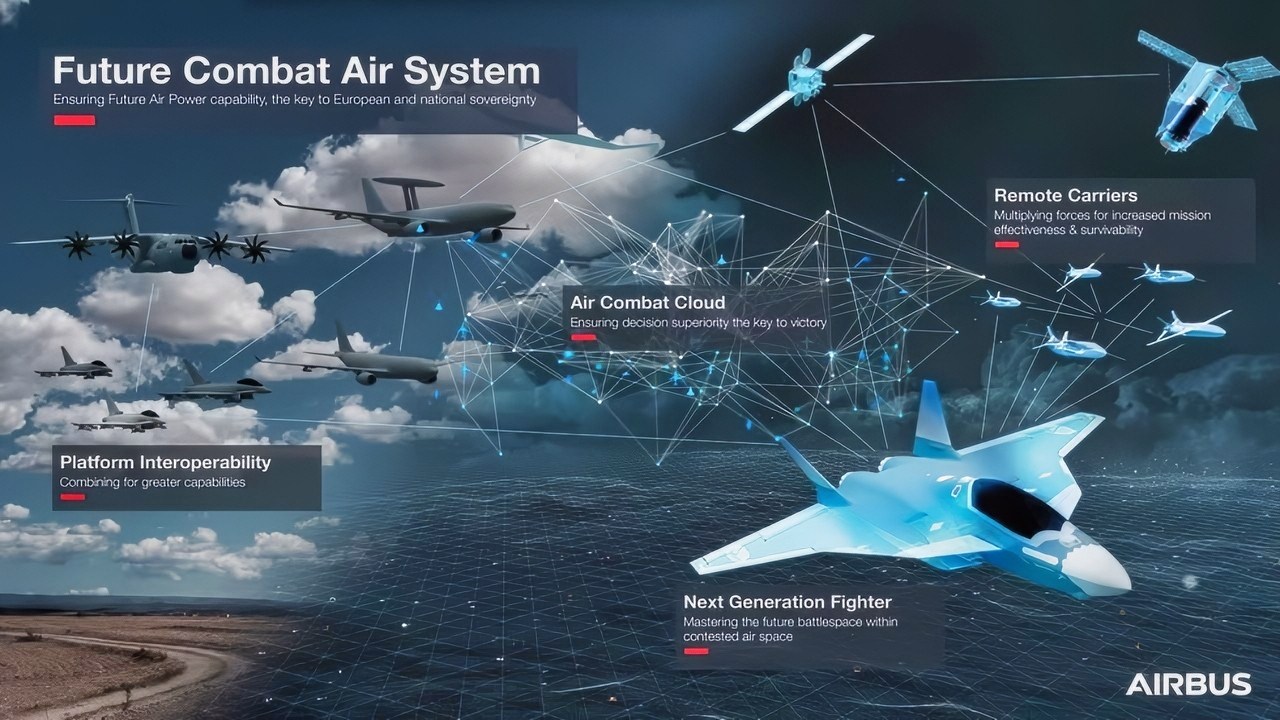
FCAS Graphic. AIRBUS Handout.
This dependence reveals an awkward truth for advocates of sovereign European defence. The continent’s air deterrent is now tied to a platform governed by U.S. export controls, sustained by a U.S.-dominated supply chain, and modernized in line with U.S. operational priorities. None of this reflects malign intent. It is the predictable consequence of asymmetrical investment. The United States poured immense resources into fifth-generation airpower through the 2000s and 2010s. Europe did not. The result was always going to be structural reliance.
Russia’s Proximity Raises the Cost of Delay
Ukraine has given Europe a brutally honest preview of the future. The battlespace is growing sharper, more transparent, and more dynamic with each passing year. Russian air defenses remain adaptive, its drones and missiles operate at a scale that stresses even robust NATO networks, and its electronic-warfare systems probe Alliance airspace with increasing sophistication.
And Moscow, too, is developing its own sixth-generation fighter, the MIG-41. Any conflict on Europe’s frontier would require rapid attainment of air superiority against an environment explicitly engineered to deny it.

MiG-41 Artist Rendering. Image Credit: Creative Commons.
That reality gives Europe’s developmental lag a hard strategic edge. Without its own next-generation platform, Europe must assume that the United States will shoulder the burden of high-end air dominance for at least the next two decades.
Yet American attention is stretched across the Indo-Pacific, the Middle East, and homeland defense modernization. The assumption of automatic American capacity—and automatic American willingness—to carry Europe’s air burden can no longer be taken for granted. Deterrence rests on air superiority. Without the latter, the former becomes fragile.
The Sixth-Generation Leap Europe Hasn’t Made
The air combat world emerging in the 2030s and 2040s will be shaped by manned-unmanned teaming, autonomous strike networks, distributed lethality, and machine-speed decision cycles. It will reward software-defined aircraft capable of continuous updates, dynamic retasking, and deep integration with sensors and shooters spanning the entire battlespace.

A U.S. Air Force F-35A Lightning II assigned to the 56th Fighter Wing, Luke Air Force Base, Arizona, performs a strafing run during Haboob Havoc, April 24, 2024, over Barry M. Goldwater Range, Arizona. Haboob Havoc is a total force exercise that provides a way for pilots from various bases to demonstrate their skills across a diverse range of aircraft, including F-35 Lightning IIs, F-16 Fighting Falcons, and A-10 Thunderbolt IIs, while also testing their abilities in different mission sets such as dogfighting and gun runs. (U.S. Air Force photo by Airman 1st Class Mason Hargrove)

Capt. Andrew “Dojo” Olson, F-35 Demonstration Team pilot and commander performs aerial maneuvers during the Wings Over Houston Airshow Oct. 18, 2019, in Houston, Texas. The show featured performances from the U.S. Air Force Thunderbirds, Tora, Tora, Tora, and Oracle. (U.S. Air Force photo by Senior Airman Alexander Cook)

NAS PATUXENT RIVER, Md. — An F-35 Lightning II test pilot conducts flight test Sept. 10 to certify the carrier variant of the fighter aircraft for carrying the AGM-158C Long-Range Anti-Ship Missile (LRASM). As part of ongoing integration efforts, the Pax River F-35 Integrated Test Force (Pax ITF) team flew two days of test flights to evaluate flutter, loads, and flying qualities with two AGM-158 loaded on external stations. LRASM is a defined near-term solution for the Offensive Anti-Surface Warfare (OASuW) air-launch capability gap that will provide flexible, long-range, advanced, anti-surface capability against high-threat maritime targets. The Pax River ITF’s mission is to effectively plan, coordinate, and conduct safe, secure, and efficient flight test for F-35B and C variants, and provide necessary and timely data to support program verification / certification and fleet operational requirements.
This is where the United States is already heading. The Air Force’s NGAD program—whose production aircraft will almost certainly be the F-47—is designed not as a traditional fighter but as the central node of a kill web. In parallel, the Navy’s F/A-XX initiative is advancing toward a long-range, unmanned-compatible platform optimized for contested environments and integrated strike packages.
In short, the United States is already building the sixth-generation ecosystem, while Europe is still negotiating its governance. FCAS is not delayed because France and Germany disagree over a fuselage line. It is delayed because Europe lacks the scale, integration, and test infrastructure needed to match the American innovation cycle.
Europe at a Strategic Fork
Europe now stands at a strategic fork. One path preserves the political aesthetics of sovereignty—continue FCAS and GCAP, absorb the delays, and accept that their entry into service will trail U.S. sixth-generation systems by a decade or more.
The other path demands strategic realism—recognize that credible airpower today and for the foreseeable future requires deep integration with American systems, even when that grates against continental instincts for autonomy.
What Europe cannot do is cling to the fiction that FCAS or GCAP will restore airpower independence on any timeline relevant to current deterrence demands.
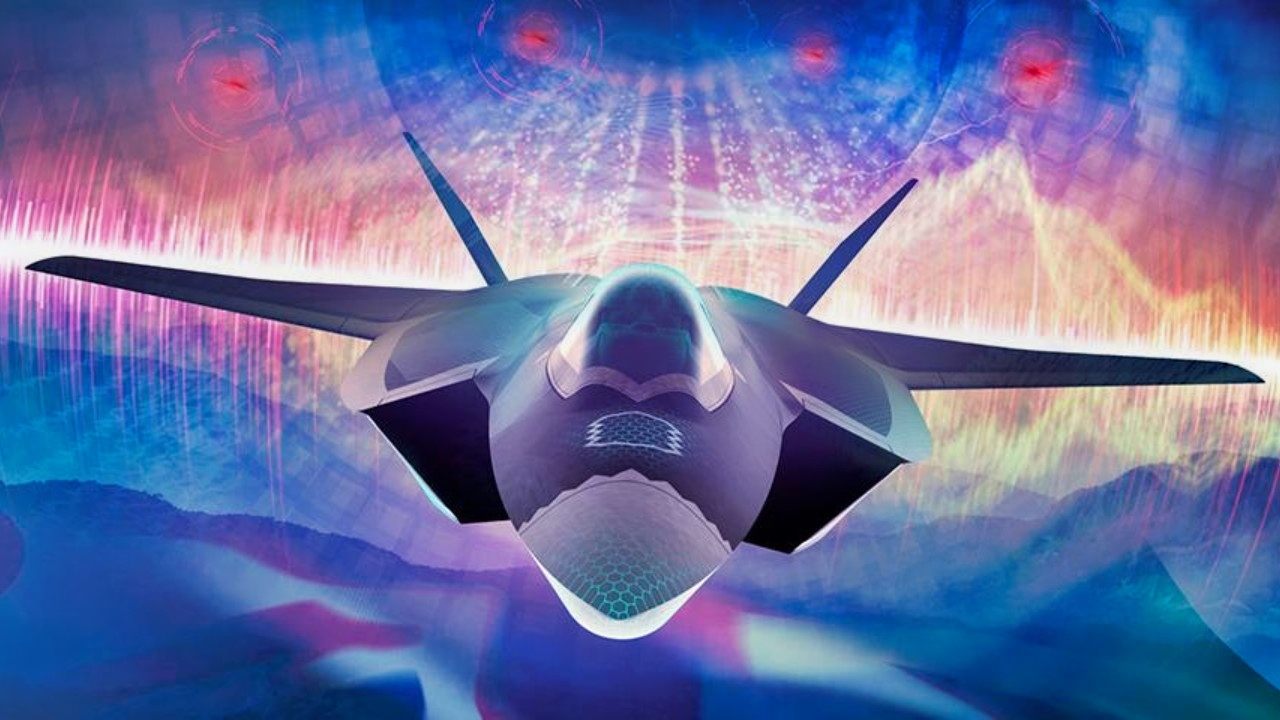
GCAP Fighter. Image Credit: Creative Commons.
The battlespace is too unforgiving, technological change too rapid, and operational need too immediate.
Europe’s future in the air will be determined not by declarations of sovereignty but by mastery of the domain itself—where integration is strength, delay is danger, and self-delusions carry a strategic price the continent can no longer afford to pay.
About the Author: Dr. Andrew Latham
Andrew Latham is a non-resident fellow at Defense Priorities and a professor of international relations and political theory at Macalester College in Saint Paul, MN. You can follow him on X: @aakatham.


Matthew Hatton
December 16, 2025 at 5:38 pm
Well Andrew….there are more holes in your article than there are in a Swiss cheese!
US is going to be getting some very direct competition from the Brit led GCAP, which will win a lot of international export orders.
You won’t want to hear that thought the fact remains.
Sorry about that.
Davy Jones
December 17, 2025 at 1:47 am
You point out all the difficulties fcas is facing, then suddenly, out of nowhere, link gcap into the narrative. Also completely ignoring that gcap’s timeline is ahead of ngad. Whether either keeps to that timeframe is debatable, but gcap is underway and, trilateral agreements in place and joint ventures formed.
David Poot
December 17, 2025 at 3:24 am
So…. You keep on mentioning the failings of Europe with this platform, but make no mention of the other European 6th gen programme lead by the UK (with full participation by Japan and Italy). It’s workshare is solid and equal,it is tri-national, but it’s design is clearly led by the UK. A very blinkered and pro team-USA article that reads like a college student’s first year submission.
Ted Striker
December 17, 2025 at 7:13 am
I can’t believe this article was written by someone with a PhD and is a professor teaching students. The total lack of any comprehensive thought process is laid thread bare. He writes about how Europe needs a 6th generation FCAS very badly to deter an increasingly aggressive Russia, while totally neglecting the reality that the Russians are struggling against Ukraine. The Russians don’t have 5th Gen fighters, let alone developing a 6th Gen fighter. He fails to recognize that he’s writing about how Europe is being threatened by Russia, but fails to make a point that Russia is but 1 country and Europe is a collection of nations with larger population and more technological superiority.
What plagues Europe isn’t lack of 6th Gen fighters. The crisis in Europe is unlimited immigration of people with incompatible cultures and who don’t want to assimilate. Europe’s fall is going to be from within due to a failure to maintain a society that made Western Civilization a great force.
Douglas White
December 17, 2025 at 7:33 am
This article forgets the more likely option that Germany and the rest of Europe will by the GCAP from the UK/ Japanese alliance whilst adding their own loyal wingwen & weapons systems.
Douglas White
December 17, 2025 at 7:35 am
A d as an add on. GCAP will ve available in the same time frame as NGAD. Just look at the performance on the F35
Stephen Wood.
December 17, 2025 at 1:02 pm
Totally biased article, very pro USA and doesn’t even mention the UK/Italy/Japan GCAP project, especially when it’s projected delivery timeline is ahead of the US.
Either poor research or a politically motivated article by a Trump Shill trying to do down Europe in general.
Jimbob-billybob
December 17, 2025 at 1:25 pm
What a ridiculous article, glances over the existence of GCAP, mentions it twice towards the end in negative context despite the fact it is ahead of NGAD and is looking very promising. Total US bias here.
peter brigg
December 17, 2025 at 2:02 pm
I imagine with the right sort of AI hype, a simple paper dart would in theory , with a bit of AI enhancement, prove to be superior design concept. and give us reassurance.
If ever anything wrt design was truely superior , we would literally be the last to know until the last nanosecond…
Matthew Hatton
December 17, 2025 at 3:26 pm
Spot on!
Jimmy
December 17, 2025 at 5:17 pm
Ridiculous, we all saw the mighty American defense complex bumble through the F-35 program who still fails to deliver what was promised years, in some cases decades, ago. Do anyone really believe the F-47 will do that much better? Last I heard the future navy fighter is on life support. Funding was cut yet according to this article it’s just dandy. I can’t help but feel there’s different yardsticks applied.
As for the apparently lethal russian Mig, you’re having a laugh? They can’t even build a meaningful number of Su-55s but we’re expected to believe they’ll soon have a functional 6th generation fighter? They can’t even win aerial supremacy in Ukraine who’s most modern planes are a couple handduks of F-16a/b and Mirage 2000. I think the European inventory of Tiffys, Rafales and Gripens could handle RuAF just fine. Add the F-35s which are in the hundreds in European hands…
Even if Gcap takes fifteen more years to come out in numbers my bet is Europe would still have the upper hand over Russia when it comes to fighter aircraft.
Island trader
December 17, 2025 at 7:40 pm
What a bizarre pro us /trump article, totally detached from reality, and this guy is supposed to be educated 😳🙄
Paul Wilson
December 18, 2025 at 8:43 pm
I came here to say That I was very confused by this article. But others got here before me. GCAP – it’s as if the author has no knowledge of it and that perhaps someone pointed this out to him an hour before the article was published and then it was mentioned as an afterthought. GCAP, or Tempest is led by the UK and is a 6th generation fighter who’s first flight will be in 2027. Ahead of everyone else.