

Russia Fires Economist Who Warned War Economy Is In Trouble – Russia has spent years insisting that Western sanctions and the enormous cost of the Ukraine war have failed to seriously damage its economy, with President Vladimir Putin repeatedly assuring citizens that the economy is resilient. But when Moscow fired one of the country’s most prominent economists, it became clear that the Kremlin may be hiding the real economic damage being inflicted on the national economy and its wartime industries.
Andrei Klepach, the chief economist at Russia’s state development corporation VEB.RF, and a former deputy economy minister, was dismissed on Sunday, August 16. The economist recently issued stark warnings about the country’s economic future, and while VEB did not publicly give a reason for his dismissal, it is widely believed to be related to his recent comments.
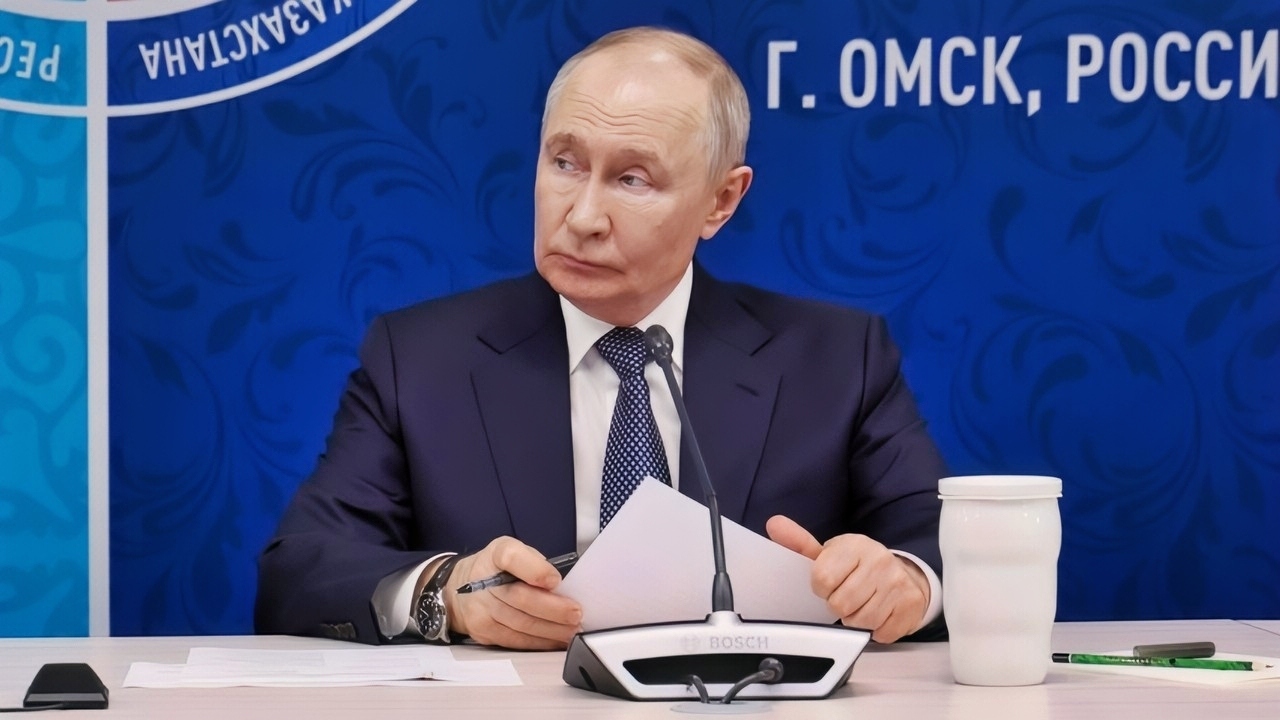
Putin at Conference on July 2026 Creative Commons Photo
The Bell, an independent Russian outlet, reported that the decision was connected to his comments, citing sources familiar with the matter. Notably, Klepach’s remarks represented a particularly candid assessment of current conditions from a longtime member of Russia’s economic establishment.
It comes as Russia’s economy continues to grow, but its budget deficit widens, fuel supplies remain restricted and at serious risk of continued Ukrainian strikes, interest rates stay high at 14%, and both commercial and military logistics networks come under repeated assault.
What Klepach Said
Klepach warned on May 21 that Russia was losing economically and technologically to its global adversaries and peers, and that it could not win a prolonged “war of attrition” against a Western-backed Ukraine. He also predicted that the mounting costs of the war would eventually push the country toward a social crisis – not just an economic one.
“We are falling behind. We are losing both the technological and economic competition in the world. ” And we are losing it not only to China and the United States; in some ways, we are losing it to Ukraine too,” he said in his comments during a presentation titled “Russia’s Economy and Geopolitical Challenges. ”
The speech was made at a meeting of the Nikitsky Club, a Moscow-based discussion forum that brings together academics, economists, government officials, and businesspeople. Klepach was speaking as a representative of VEB.RF, where he had served since 2014 after spending a decade at the Economy Ministry.
In the speech, he acknowledged that the Ukrainian economy had been badly damaged by the war and was surviving largely because of substantial Western financial assistance. But that support, he said, was precisely why Moscow’s expectation that Ukraine would eventually exhaust itself economically was wrong.
“We will not win the competition in this war of attrition. We have the illusion that everything there (in Ukraine) will collapse. It has not collapsed and will not collapse. Our costs are mounting,” he said.
Is Collapse Coming?
Those costs, Klepach said, now include economic damage being caused by sustained Ukrainian attacks inside Russia. He also singled out strikes against Russian ports, oil and gas infrastructure, logistics networks, and chemical plants – Ukraine’s biggest targets since its long-range capabilities have been fully realized. He said that those losses are now becoming a noticeable barrier to economic growth. He also used the speech to highlight falling investment and worsening healthcare, as well as the technological gap Russia is experiencing as it focuses its economic resources almost entirely on military production.
After the economy pivoted toward military spending and production in 2023 and 2024, Klepach said investment has fallen significantly in parts of the civilian industry, with some elements now in recession.
He also criticized Moscow’s decision to combine massive wartime military expenditure with restrictive monetary policy and high borrowing costs.
Economic Pressures Could Produce A Crisis
But Klepach’s most serious warning, perhaps, was that those economic pressures could eventually produce a political and social crisis even if there is no outright economic collapse.
“In my view, the economy will hold up, but a social crisis could arise – and at a time when no one particularly expects it. Yet, let me remind you, no one expected the [1917] February revolution either,” he said, drawing a comparison to the revolution that toppled Tsar Nicholas II. He also invoked the collapse of the Soviet Union in 1991 as an example of how mounting economic and political pressures can produce complex and hard-to-predict consequences.
The remarks attracted little public attention when he first delivered them in May, but on August 14, The Moscow Times reported on the speech. The comments soon circulated widely in Russian media, prompting VEB to dismiss Klepach two days later, on Sunday, August 16.
The Costs Keep Mounting
Klepach’s dismissal is understandable. Moscow, after all, must keep a lid on public criticism if it is to continue to pursue a war that is clearly causing major economic harm. His firing comes as Russia’s federal budget deficit reaches 6.5 trillion rubles, or roughly $79 billion, in the first seven months of 2026 – already around 70% higher than Moscow’s target for the entire year.
About the Author: Jack Buckby
Jack Buckby is a British researcher and analyst specializing in defense and national security, based in New York. His work focuses on military capability, procurement, and strategic competition, producing and editing analysis for policy and defense audiences. He brings extensive editorial experience, with a career output spanning over 1,000 articles at 19FortyFive and National Security Journal, and has previously authored books and papers on extremism and deradicalization.


