

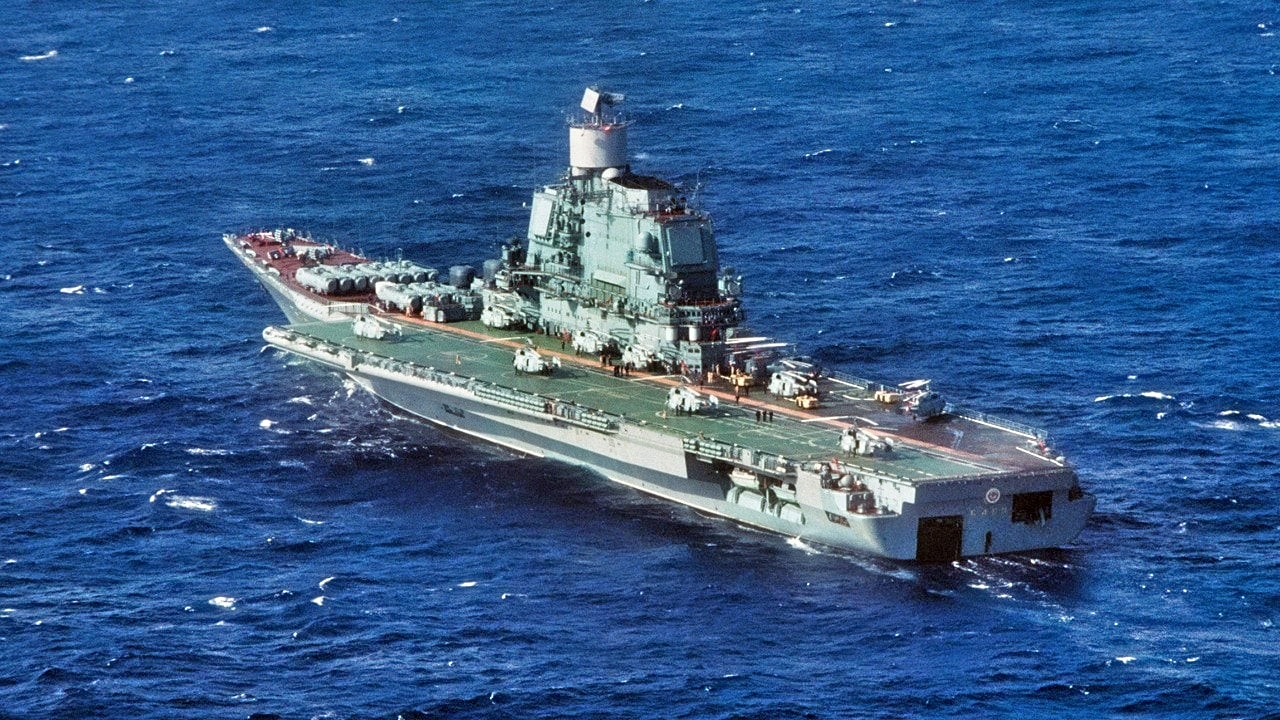
Key Points and Summary – The Soviet Navy’s Kiev-class was a unique and remarkable warship, a hybrid that was part aircraft carrier and part heavily-armed missile cruiser.
-Designed to hunt NATO carrier strike groups, their real value lay not in their small air wing of Yak-38 vertical take-off jets, but in their potent arsenal of P-500 Bazalt supersonic anti-ship missiles.
-By designating them “aviation cruisers,” the Soviets could legally move them through the Turkish Straits.
-Though ultimately a transitional design, the Kiev-class gave the USSR vital experience in carrier operations, paving the way for its later, larger carriers.
Part Aircraft Carrier, Part Cruiser: the Soviet Navy’s Kiev-class
Although the Soviet Navy’s Kiev-class warships marked the first time the Soviet Union flew fixed-wing aircraft from sea, their real value lay in their potent anti-ship weaponry, intended to push back and potentially sink NATO Carrier Strike Groups, thereby protecting Soviet home waters.
The Kiev-class was a rather remarkable class of four aviation cruisers built for the Soviet Navy initially in the 1970s and 1980s. Notable for their unique design, which combined elements of aircraft carriers and cruisers, the Kiev-class was one of the Soviet Union’s early concerted efforts to build a fleet of aircraft carriers capable of carrying fixed-wing aircraft that could project power widely and engage in robust surface combat.
During some of the tensest eras of the Cold War, the Soviet Union sought a way to counter United States Navy Carrier Strike Groups and the naval assets of the NATO alliance. But rather than build American-style supercarriers, a costly and technologically complex venture, and one that the Soviet Navy would be unlikely to undertake successfully, the Soviets instead decided on a compromise design: the so-called heavy aviation cruiser.
The designation was part of the Cold War’s subterfuge. With the label of cruiser instead of aircraft carrier, the Soviet Navy could legally transit the warships through the Turkish-controlled Bosporus and Dardanelles Straits, which placed tonnage restrictions on aircraft carriers and other warships.
Compared to traditional aircraft carriers, the Kiev-class were very heavily armed. 12 P-500 Bazalt supersonic anti-ship cruise missiles were the class’s primary armament, complemented by torpedo tubes for anti-submarine warfare and rocket launchers. The ships also had extensive defensive measures: AK-630 close-in weapon systems and an array of other defensive missiles.
Thanks to the Kiev-class’s relatively small flight deck, they could carry up to 12 Yak-38 vertical take-off and landing aircraft, marking the first time the Soviet Navy operated fixed-wing aircraft from sea. However, given the limitations of that aircraft, notable for its shorter range, smaller payload, and lower readiness and reliability compared to Western counterparts, Kiev’s real value lay in its ship-killing missiles and onboard helicopters for anti-submarine warfare.
Blue-water Navy
The United States Navy, during the Cold War and still today, is a true blue-water navy, one that can respond to humanitarian disasters around the world, protect important maritime trade routes from piracy, and ensure a robust reserve presence to react to or preempt geopolitical crises at short notice. It stands in stark contrast to the navies of other countries.
The Soviet and now Russian navies stand in stark contrast to their American counterpart. Rather than attempting to project overwhelming force around the globe at multiple points and for extended periods of time, those navies instead sought to offset the gap in their technological sophistication through a powerful range of carrier-killer weaponry, including long-range anti-ship weaponry, and thanks to the Kiev-class, naval aviation assets.
As a green-water navy, the Soviet Navy was tasked with pushing adversaries out from their own home and near-abroad waters, a legacy that today’s Russian Navy largely emulates.
Meet the Kiev-Class ‘Aircraft Carriers’
There were only four Kiev-class warships built: the lead of the class, the Kiev, commissioned in 1975, and the class’s flagship, which was retired in the 1990s and was sold to China, where it was a kind of theme park and floating attraction.
The Minsk, commissioned just a few years later, was also sold to China for a similar purpose. The Novorossiysk, commissioned in 1982, was scrapped in the late 1990s after suffering damage from a machinery fire earlier that decade.
Lastly, the Admiral Gorshkov, originally the Baku, which was commissioned in 1987, underwent improvements to its weapon suite and sensors before being sold to India, where it serves as the INS Vikramaditya as a conventional aircraft carrier following extensive refurbishment and modifications.
A Sad Ending?
Although the Kiev-class incorporated several novel design features into a single platform, the design was ultimately more transitional than permanent.
Their hybrid nature meant that they could not perform as well as a dedicated aircraft carrier, nor could they operate purely as a cruiser either.
However, the Kiev-class did give the Soviet Navy insight into the intricacies of fixed-wing carrier operations, which paved the way for the Admiral Kuznetsov-class, a much larger class of true aircraft carriers.
Ultimately, the collapse of the Soviet Union and the end of Cold War hostilities meant that the knowledge gleaned nearly 50 years ago from the Kiev-class was, perhaps not squandered, but not put to as full a use as it could have been.
That build of that newer class of ski-jump aircraft carriers was delayed and curtailed.
About the Author: Caleb Larson
Caleb Larson is an American multiformat journalist based in Berlin, Germany. His work covers the intersection of conflict and society, focusing on American foreign policy and European security. He has reported from Germany, Russia, and the United States. Most recently, he covered the war in Ukraine, reporting extensively on the war’s shifting battle lines from Donbas and writing on the war’s civilian and humanitarian toll. Previously, he worked as a Defense Reporter for POLITICO Europe. You can follow his latest work on X.
More Military
The U.S.-Venezuela War of 2025?
The F-15EX Eagle II Doesn’t Need Your Stealth Pity


