


Key Points and Summary – Dassault’s Super Étendard is a compact, carrier-born strike fighter that punched far above its weight.
-Its global coming-out was the 1982 Falklands War, when Argentine jets firing AM39 Exocets crippled HMS Sheffield.
-Powered by the SNECMA Atar 8K-50 and guided by Agave (later Anemone) radar and an early UAT-90 computer, the jet evolved steadily: HOTAS cockpits, ECM, NVG use, laser-guided bombs, and even the ASMP nuclear missile.
-Deployed from Foch, Clemenceau, and Charles de Gaulle, it flew combat in Lebanon, over Serbia during Allied Force, and alongside Rafales in Afghanistan.
-Rugged, upgradeable, and versatile, the Super Étendard became one of France’s most effective indigenous fighters.
The Super Étendard Is One of the Best Fighter Jets the French Ever Produced
This is an underrated fighter jet that you may not be familiar with.
It’s called the Super Étendard, which enjoyed an outstanding combat record over the years, beginning with the Falklands War.
Many have looked back at the Falklands War as a brief conflict that the much longer Cold War overshadowed.
However, the French-made Super Étendard achieved some notable successes while fighting valiantly alongside the Argentines.
Étendard is French for “battle-flag,” and this fighter was prepared well for dogfighting and surface strike in Argentine service.
They were made between 1974 and 1983. In May 1982, the Super Étendard shocked the world when it took a British Royal Navy warship out of service.
The Story of the Sinking
The Argentines desperately needed an answer to the British navy’s huge advantages in numbers and capabilities.
They had only four operational Super Étendards, but the fighter pilots were undeterred.
The aviators flew the French-made fighters low and fast, skimming above the waves 60 miles off Port Stanley, en route to the carrier Hermes.
The Super Étendards fired two Exocet anti-ship missiles.
One veered off and missed the Hermes, but the other hit paydirt against the HMS Sheffield, a Type 42 destroyer that was escorting the Hermes.
The Sheffield had no time to make evasive maneuvers as its radar only detected the missile ten seconds before it hit. Soon, the destroyer was enveloped in flames.
Twenty sailors were killed, and the survivors had to be rescued as the Sheffield was towed away with no more ability to fight.
The Super Étendard Was Tailor-made For Aircraft Carriers
After that, the French thought they had a hit on their hands.
The Super Étendards were assigned carrier duty to protect the homeland. Sixteen were deployed on each of the French aircraft carriers Foch and Clemenceau, and later on the Charles de Gaulle.
The History of France’s Under-rated Fighter Jet
The Super Étendard was one of the French military’s most advanced fighters in the 1970s.
The French Navy ordered 100 Super-Étendards in 1973. The engineers, designers, and technicians at Dassault Aviation and Breguet got to work. It took its maiden flight in 1974.
The Snecma Atar 8 K 50 engine onboard the prior Étendard IV was one of the finest engines that were produced for French airplanes.
The fighter was equipped with the modernized inertial navigation/attack system. This allowed the airplane to detect, identify, and track multiple targets.
The Super Étendard’s development dates back to the 1950s, when France needed a new aircraft to protect its sovereignty from potential Soviet Union attacks.
It was going to be better than the failed Jaguar M that was supposed to be for aircraft carriers.
Soon, the French realized that the Étendard program would get a green light for development.
Deeper Look at the Super Étendard
The Super Étendard featured the powerful SNECMA Atar 8K-50 turbojet, producing 11,000 pounds of thrust, along with a new wing and enhanced avionics.
It was popular with the government because it was made entirely by French defense contractors. Plus, the price was considered reasonable. However, only 71 were acquired.
The airplane wasn’t very large and had only a single engine. It had a swept-wing and tail. The fighter had the esteemed Thomson-CSF Agave radar that was able to spot the British ship that was taken out by the Exocet missile.
The Super Étendard had one of the first onboard computers called the UAT-90. The French then replaced the Agave radar with an improved Anemone model, which had a 100 percent greater range.
Then Dassault decided to upgrade the cockpits of the airplanes, granting 15 per year with new HOTAS controls. There were modernized electronic countermeasures for better survivability.
The pilots were eventually able to use night-vision goggles. In the 1990s, the fighter could fire the strategic Air-Sol Moyenne Portée, a ramjet-powered air-launched nuclear missile. Laser-guided bombs were also added to the munitions arsenal.
Sterling Combat Record
The French used the Super Étendard during the civil war in Lebanon, which began in 1983. The airplanes acquitted themselves well during ground strike duties.
The Syrians were firing at French peacekeepers, and the aircraft eliminated many Syrian gun emplacements.
The fighter jets also destroyed terrorist training camps.
The Super Étendard served in Operation Allied Force during the NATO intervention against Serbia. It was instrumental again in destroying multiple on-the-ground objectives. Four hundred combat missions were flown, with 73 percent of the targets destroyed.
The airplane was not done. After 9/11, the French supported the United States during the war in Afghanistan. The Super Étendard flew with Dassault Rafales for several years during the war.
This was one versatile and strategic airplane. The French depended on it for decades, and its deployments on aircraft carriers were superb. This was an underrated airplane with an excellent combat record. It was a bridge airplane to the Rafale.
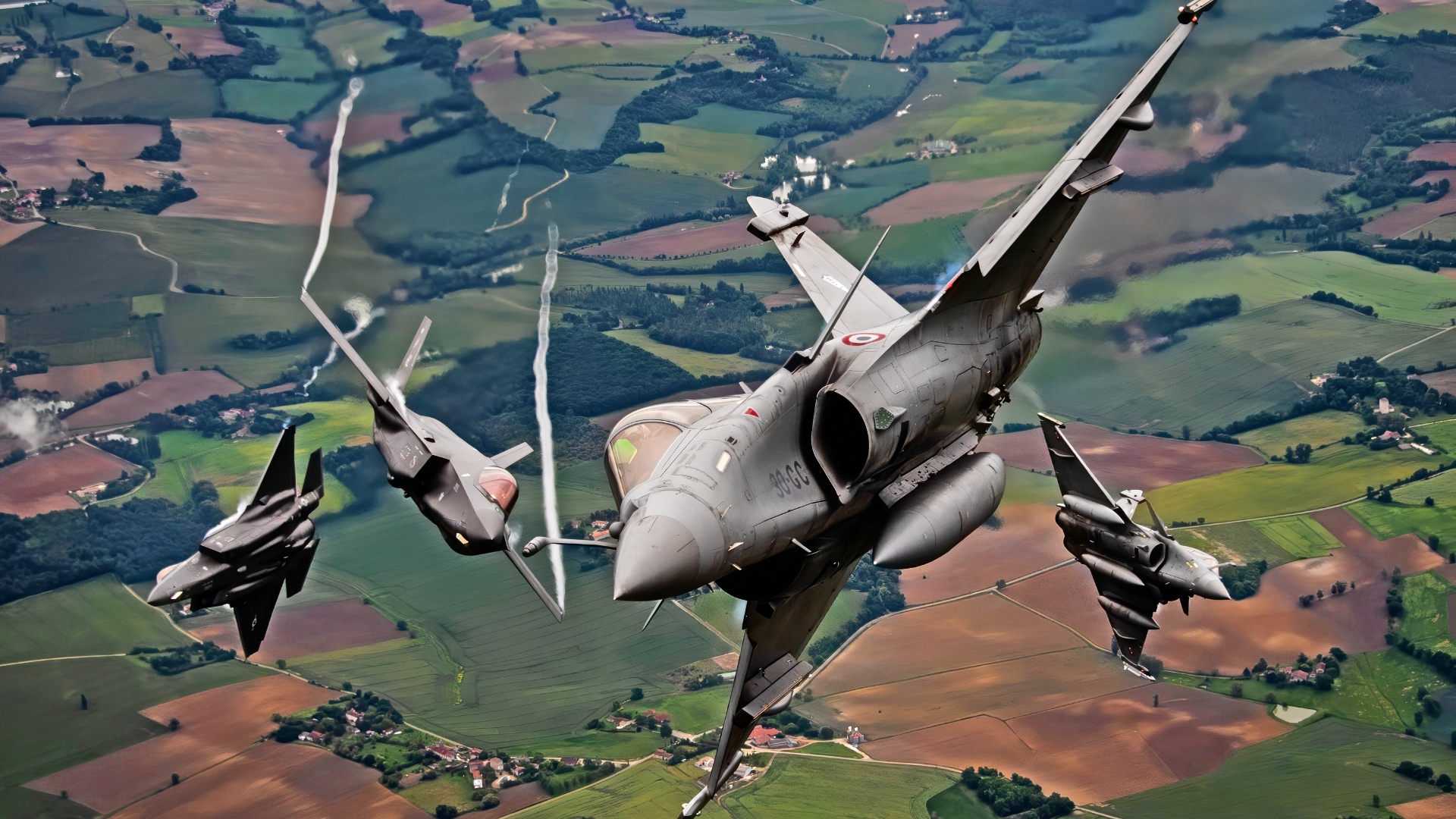
Two U.S. Air Force F-35A Lightning IIs assigned to the 4th Fighter Squadron, Hill Air Force Base, Utah, and two Dassault Rafales assigned to the 1/4 Gascogne Fighter Squadron, 113 Saint-Dizier-Robinson air base, France, break formation during flight May 18, 2021 over France. The flight was apart of the Atlantic Trident 21 exercise which is a joint, multinational exercise involving service members from the U.S., France and the U.K., and is aimed at enhancing fourth and fifth generation integration, combat readiness and fighting capabilities, through conducting complex air operations in a contested multinational joint force environment. (U.S. Air Force photo by Staff Sgt. Alexander Cook)
The French took lessons learned from the Falklands War and put them to brilliant use. Since this was a totally homegrown airplane, it demonstrated that the French could produce a warbird that had staying power over the decades, with service in many conflicts.
French pilots are likely to have many stories about their exploits with the Super Étendard. It was a capable airplane that underwent significant upgrades over the decades. This was a testament to the French designers and engineers who continually improved it over time.
The Super Étendard will go down as one of the best French fighters ever indigenously produced.
About the Author: Brent M. Eastwood
Brent M. Eastwood, PhD is the author of Don’t Turn Your Back On the World: a Conservative Foreign Policy and Humans, Machines, and Data: Future Trends in Warfare plus two other books. Brent was the founder and CEO of a tech firm that predicted world events using artificial intelligence. He served as a legislative fellow for US Senator Tim Scott and advised the senator on defense and foreign policy issues. He has taught at American University, George Washington University, and George Mason University. Brent is a former US Army Infantry officer. He can be followed on X @BMEastwood.
More Military
Russia Now Has a Death Star Battlecruiser
France’s Charles de Gaulle Aircraft Carrier Has a Message for Any Navy on Earth
Russia’s Last Aircraft Carrier Might Soon Be Headed to the Grave


