


Key Points and Summary – France’s Dassault Rafale and America’s F/A-18E/F Super Hornet are first-rate multirole fighters, but they win in different ways.
-Rafale’s lighter airframe, higher thrust-to-weight, supercruise, SPECTRA EW, RBE2 AESA, IRST, and Meteor give it a decisive BVR edge and superb situational awareness.

Aviation Boatswain’s Mate (Equipment) 3rd Class Mark Ruiz, assigned to Air Department aboard the world’s largest aircraft carrier, USS Gerald R. Ford (CVN 78), prepares a Carrier Air Wing 8 F/A-18E Super Hornet attached to Strike Fighter Squadron 37 for launch on the flight deck, Aug. 1, 2025. Gerald R. Ford, a first-in-class aircraft carrier and deployed flagship of Carrier Strike Group Twelve, is on a scheduled deployment in the U.S. 6th Fleet area of operations to support the warfighting effectiveness, lethality and readiness of U.S. Naval Forces Europe-Africa, and defend U.S., Allied and partner interests in the region. (U.S. Navy photo by Mass Communication Specialist 2nd Class Mariano Lopez)
-The Super Hornet brings maturity, APG-79 AESA, JHMCS, AIM-9X, high-alpha handling, rugged carrier design, and a vast sustainment network.
-In WVR, outcomes hinge on pilot skill: Hornet excels in slow-speed nose authority; Rafale sustains energy and turns. In real operations, enablers—AWACS, datalinks, tankers, and tactics—decide fights. In a neutral duel, Rafale likely prevails; in fleets, the Hornet endures and reliability.
Dassault Rafale vs Super Hornet: Which Fighter Wins a Real Dogfight?
The Dassault Rafale is currently France’s aircraft of choice. Designed with versatility and reliability in mind, the Rafale is an excellent multi-role fighter and is well-equipped to face the challenges of 21st-century aerial combat.
Likewise, the F/A-18E/F Super Hornet is a deeply modernized version of the legacy F/A-18 platform that is currently in use by the U.S. Navy. It boasts improved avionics compared to its predecessors, a reinforced airframe, and several systems designed to enhance its survivability in contested environments.
Currently, there is no chance of the U.S. and France ever fighting each other. However, in a hypothetical situation, which fighter would be victorious?
The Rafale vs the Super Hornet
Dassault Aviation developed the Rafale as a response to France’s need for a versatile aircraft that could replace several aging platforms, including the Mirage F1, Jaguar, and Super Étendard. France wanted a single aircraft capable of performing air-to-air combat, ground attack, reconnaissance, and nuclear deterrence missions.
The result was a highly agile, twin-engine fighter with a delta wing and canard configuration, optimized for both land-based and carrier operations. The Rafale entered service in 2001 and has since become the backbone of the French Air Force and Navy.
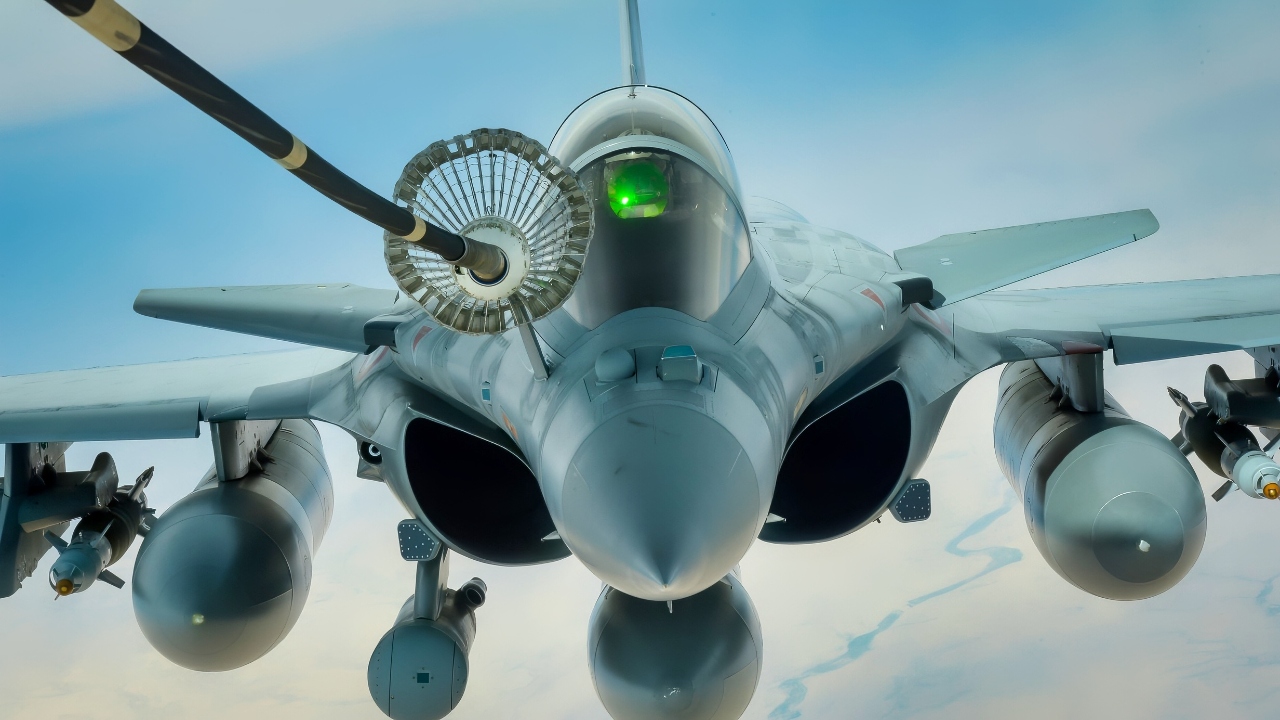
A French air force Dassault Rafale refuels from a U.S. Air Force KC-10 Extender from the 908th Expeditionary Air Refueling Squadron before conducting an aerial refuel during a Combined Joint Task Force – Operation Inherent Resolve mission March 20, 2017. The KC-10 provides aerial refueling capabilities for U.S. and coalition aircraft as they support Iraqi Security Forces and partnered forces as they work to liberate territory under the control of Islamic State of Iraq and Syria. (U.S. Air Force photo by Senior Airman Joshua A. Hoskins)
In contrast, the Super Hornet was developed as an evolution of the original F/A-18 Hornet. The U.S. Navy needed a replacement for the aging F-14 Tomcat and a complement to the F-15 and F-16 in its tactical air fleet. Boeing (originally McDonnell Douglas) designed the Super Hornet to be larger, more capable, and more versatile than its predecessor.
It entered service in 1999 and has since become the primary carrier-based fighter of the U.S. Navy, known for its reliability, ease of maintenance, and multirole flexibility.
Engine Performance
When comparing performance, both have similar high speeds, with a top speed of around Mach 1.8. Snecma M88 engines power the Rafale and have a higher thrust-to-weight ratio, approximately 1.13 compared to the Super Hornet’s 0.93, which translates into superior acceleration and climb rate.
The Rafale’s rate of climb is around 60,000 feet per minute, significantly faster than the Super Hornet’s 45,000 feet per minute. Additionally, the Rafale is capable of supercruise whereas the Super Hornet cannot.
In terms of agility, the Rafale benefits from its aerodynamic design. The delta wing and canards provide excellent maneuverability, especially in close-range dogfights. The aircraft is highly responsive and can maintain energy in tight turns, giving it an advantage in visual-range engagements.
The Super Hornet is also an incredibly agile aircraft (there’s a reason why the Blue Angles currently use it for airshows). The aircraft’s frame is designed to make it aerodynamic and acrobatic, making it suitable for close-range dogfights as well.
Avionics
Avionics and sensor fusion are another area where the Rafale excels. It is equipped with the RBE2-AA active electronically scanned array (AESA) radar, which offers excellent tracking and targeting capabilities. The Dassault Rafale also features the SPECTRA electronic warfare suite, which provides advanced threat detection, jamming, and countermeasures. One of the Rafale’s standout features is its high level of sensor fusion, integrating data from radar, infrared search and track (IRST), and electronic warfare systems into a single tactical picture. This allows the pilot to make faster and more informed decisions.
The Super Hornet is equipped with the AN/APG-79 AESA radar, which is highly capable and offers long-range tracking and synthetic aperture radar modes. Its electronic warfare suite includes the ALQ-214 Integrated Defensive Electronic Countermeasures (IDECM) and the ALR-67(V)3 radar warning receiver. While the Super Hornet’s avionics are advanced, it does not possess the same level of sensor fusion capabilities that the Rafale has and relies more heavily on external systems like Link 16 for situational awareness.
Weaponry and Stealth Systems
When it comes to weapons, both aircraft are highly versatile. The Rafale can carry a wide range of air-to-air and air-to-ground munitions, including the MICA IR and RF missiles, the long-range Meteor missile, SCALP EG cruise missiles, AASM precision-guided bombs, and the ASMP-A nuclear missile. It can also be equipped with Exocet anti-ship missiles and reconnaissance pods. The Meteor missile, in particular, gives the Rafale a significant advantage in beyond-visual-range (BVR) combat due to its long range and high no-escape zone.
The Super Hornet carries AIM-120 AMRAAMs for BVR engagements and AIM-9X Sidewinders for close-range combat. For ground attack, it can deploy JDAMs, JSOWs, SLAM-ERs, and AGM-88 HARM anti-radiation missiles. It also carries Harpoon anti-ship missiles and various reconnaissance and targeting pods. While the Super Hornet’s weapons suite is extensive and proven, the Meteor missile gives the Rafale a distinct edge in long-range air combat.
Who Wins in 4 Words: Maybe It’s a Draw?
So, who would win in a one-on-one fight?
Assuming a neutral environment with no external support such as AWACS, tankers, or ground-based radar, and both aircraft are armed with their best available weapons, the Dassault Rafale would likely come out on top. In a BVR engagement, the Rafale’s Meteor missile and superior sensor fusion give it an advantage. In a close-range dogfight, the answer is less clear. Both possess exceptional maneuverability and weaponry for the occasion.
The Rafale, however, benefits from better situational awareness and survivability due to its advanced electronic warfare suite.
However, in a real-world scenario, the outcome would depend heavily on external factors such as pilot skill, mission context, and support assets. The Super Hornet excels in carrier operations and joint-force environments, where it can leverage the full power of U.S. Navy infrastructure and networked warfare.
It is also easier to maintain and has a larger global support network, making it more sustainable in prolonged operations.
About the Author: Isaac Seitz
Isaac Seitz, a Defense Columnist, graduated from Patrick Henry College’s Strategic Intelligence and National Security program. He has also studied Russian at Middlebury Language Schools and has worked as an intelligence Analyst in the private sector.
More Military
The Massive B-36J Bomber Has a Message for the U.S. Air Force
Russia’s Su-47 Fighter: Moscow Only Made 1 For Good Reason
B-52J vs. B-21 Raider: The Air Force Might Have a Bomber Problem


