


Key Points and Summary – Grumman’s F9F-8 Cougar was the U.S. Navy’s swept-wing evolution of the Panther—a timely answer to Soviet and MiG-driven realities of the early Cold War.
-With more fuel, refined aerodynamics, and a sturdier carrier fit, the F9F-8 brought better dash, climb, and deck handling to a fleet transitioning to jets.

Grumman F9F-8 Cougar National Security Journal Photo
-It served widely in frontline squadrons through the mid-to-late 1950s, then shifted to reconnaissance, training, and Blue Angels duty while faster supersonic types arrived.
-Though it saw little shooting war, the Cougar trained thousands, patrolled during tense crises, and proved concepts—from AIM-9 integration to two-seat jet training—that shaped the Navy’s path to the Crusader, Tiger, and beyond.
Grumman F9F-8 Cougar: The Swept-Wing Bridge The Fleet Needed
The U.S. Navy’s first generation of post-WWII jets—straight-wing types like the F9F Panther—gave carriers their initial taste of jet performance, but the Korean War and encounters with swept-wing MiG-15s made the next requirement unavoidable: more speed, climb, and sustained turn in the carrier environment. The Navy needed a fighter that could launch from smaller decks, trap reliably, and still keep pace with rapidly improving threats and tactics.
At the same time, brand-new “clean-sheet” supersonic designs were not ready for fleet mass. The service needed an intermediate step—a jet available now—to raise performance and buy time while the next generation matured. Grumman’s answer was to sweep what already worked.

Grumman F9F-8 Cougar Original National Security Journal Photo. Taken on September 18. 2025.
What It Built On: From Panther To Cougar
Grumman started with a known quantity: the rugged, deck-friendly F9F Panther airframe and systems. The concept was straightforward but effective—retain Grumman’s trademark carrier toughness and maintenance access, graft in a swept wing and tail, and refine the inlets and structure for higher subsonic performance.
The first swept variant, the F9F-6 Cougar, entered service as a transitional fighter. Experience with that model—handling quirks near the stall, carrier approach cues, and fuel fraction in real deployments—fed directly into the later and more numerous F9F-8.
Development: How The F9F-8 Evolved
The F9F-8 was not just a block upgrade; it was a thorough refinement:
Airframe Stretch & Fuel: A modest fuselage stretch and internal rearrangement increased fuel capacity, extending range and giving pilots more margin for deck cycles and patrols.
Wing Re-work: Revised planform with greater area and re-profiled leading edges improved low-speed lift and approach behavior while preserving the swept-wing dash that the fleet needed against MiG-class opponents.
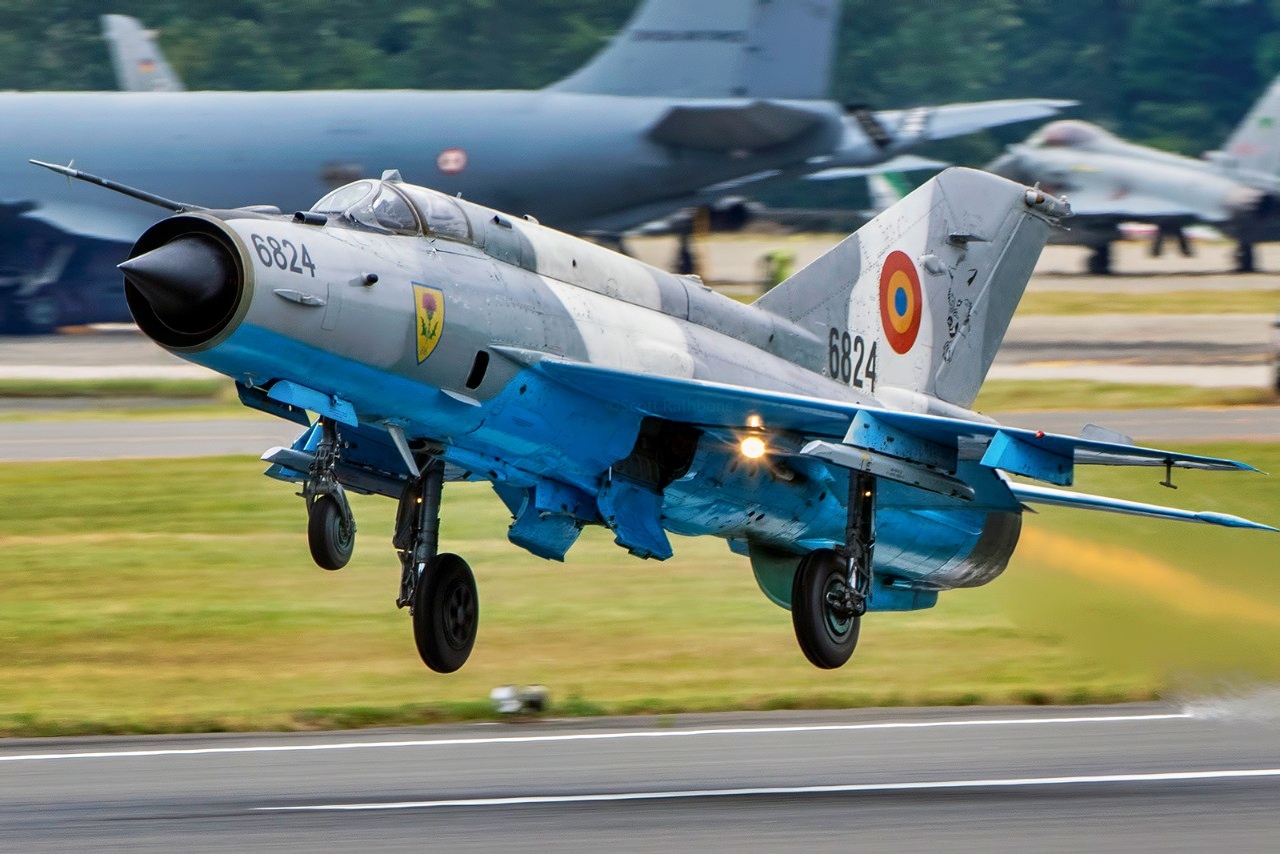
MiG-21 Fighter from Russia. Image Credit: Creative Commons.
Carrier Systems: Strengthened landing gear, arresting hook arrangements, and brakes reflected lessons learned from ramp strikes and heavy bring-backs on earlier jets.
Engine Family: Powered by the J48 series (a license-built Rolls-Royce Tay), the F9F-8 delivered reliable thrust and easy maintenance—key virtues for a type expected to fly hard on older Essex-class decks.
Growth Paths: Production and retrofit brought in-flight refueling probes to many aircraft, modernized radios and navigation gear, and—on specific sub-variants—provisions for new weapons and pods.
Grumman and the Navy treated the F9F-8 as a fleet tool, not a laboratory piece: changes were aimed at sortie generation and carrier safety, even as they nudged performance upward.
Weapons Loadout And Capabilities
The Cougar was built as a day fighter that could also carry useful ordnance:
Guns: Four 20 mm cannon in the nose—simple, reliable, and lethal within visual range.
Air-To-Air: Later F9F-8 batches, often designated F9F-8B after conversion, integrated the AIM-9 Sidewinder, giving line squadrons a credible short-range missile for the first time.
Air-To-Ground: Underwing pylons supported rockets and bombs for strike training and contingency attack loads.
Photo Reconnaissance: The F9F-8P replaced guns with cameras in a reshaped nose, providing the fleet with a compact, carrier-ready reconnaissance platform.
Two-Seat Training: The F9F-8T (later TF-9J) added a second cockpit and duplicated controls, turning the Cougar into a jet trainer that could take a student all the way to the groove.
No one mistook the Cougar for a supersonic air-superiority thoroughbred. Its value was availability plus flexibility: it gave squadrons a dependable gun/missile day fighter and gave the air wing a jack-of-many-trades until newer types took over.
Operational Rollout: Filling The Decks
Once the F9F-8 reached the fleet in the mid-1950s, it quickly spread across Atlantic and Pacific carrier air groups. Pilots appreciated the better climb and dash compared to Panthers, the friendlier approaches brought by the wing refinements, and the way the jet absorbed the daily grind of at-sea operations.
The Cougar also became an important shore-based trainer and patrol jet, rotating through WestPac and Mediterranean cruises while carriers practiced the high-tempo cycles that would define Cold War sea power.
Where It Served And What It Did
Although the F9F-8 arrived too late for Korea and too early to feature in large-scale Vietnam air combat, it was everywhere during a volatile decade:
Crisis Deterrence: Cougars stood patrols in the Taiwan Strait tensions of the late 1950s and showed the flag during Mediterranean and North Atlantic flashpoints.
Reconnaissance At Sea: The -8P photo variant provided rapid shipborne imagery, a priceless commodity for commanders tracking deployments and coastline changes.
Training Pipeline: The two-seat TF-9J became a staple of jet transition and carrier qualification, shaping habits that later paid off in the F-8 Crusader, F-11F Tiger, and ultimately F-4 communities.

F-4 Phantom Fighter National Security Journal. Image Taken on August 23, 2025.
Blue Angels: The Navy’s flight demonstration team flew Cougars in the mid-1950s, showcasing swept-wing carrier performance to the public and cementing the type’s place in service culture.
In short: even with minimal combat headlines, the F9F-8 carried the fleet through a period when tactics, procedures, and deck choreography for jets were being written in real time.
Accidents And Known Issues
Like many early jets, the Cougar paid a price in mishaps as squadrons pushed envelopes and training pipelines scaled up:
Approach/Carrier Landings: Swept wings demand respect at low speed. While the F9F-8’s wing changes helped, some early-career stall/settling incidents and bolters drove refinements in approach techniques, lens use, and maintenance checks on slats and flaps.
Engine Reliability: The J48 was generally dependable, but hot-day operations from short decks highlighted thrust margins and occasionally exposed weak links in fuel and bleed-air systems—issues that maintenance teams learned to pre-empt with rigorous inspections.
Aging Airframes: Hard traps and cat shots accumulate stress. By the early 1960s, fatigue management—particularly in high-time training birds—became part of the daily routine.
None of these problems were unique to the Cougar; they were the growing pains of making jets routine at sea. The lessons shaped NATOPS procedures and deck operations for the supersonic era.
The Beginning Of The End: Supersonic Replacements
Technology sprinted. By the late 1950s, F-8 Crusaders and F-11F Tigers promised true supersonic fleet defense, followed quickly by the two-seat F-4 Phantom II that would dominate the 1960s. As those types filled decks, Cougars migrated:
Frontline to Second-Line: F9F-8 fighters shifted from first-line fighter squadrons to training, reserve, and recon roles.

F-4 Phantom Images Original National Security Journal.
Photo To The Last: The F9F-8P continued making itself useful from carriers and shore until newer recon solutions arrived.
Trainers Endure: The TF-9J lasted the longest, serving deep into the 1960s (and in some units beyond) as a student-friendly jet with carrier bones.
In 1962, the Pentagon’s tri-service designation system relabeled the line: F9F-8 became F-9J, and the F9F-8T kept the designation TF-9J. The new letters did not change the trajectory; the fleet’s future lay with faster, heavier-hitting jets.
Retirement: A Quiet Fade, Not A Fall
By the mid-1960s, most fighter-role Cougars were out of frontline service. Recon and training examples soldiered on for a few more years until new trainers and photo platforms made them redundant. The final Navy aircraft left service as logistics tails thinned and airframes reached the logical end of their economical life.
A number of Cougars found second lives as gate guardians, museum pieces, and static trainers, tangible reminders of a period when the Navy learned how to make jets live on carriers day after day.
Why This “Obscure” Jet Matters
Obscurity is not the same as insignificance. The F9F-8 Cougar proved several ideas that became standard:
Evolution As Strategy. While bold new fighters were maturing, the Navy used a smart derivative to improve performance now—without pausing fleet readiness.
Missile Integration On The Boat. Early AIM-9 fits on Cougars helped normalize missile employment in the carrier environment before it became the default for newer fighters.
Two-Seat Training With Carrier DNA. The TF-9J made thousands of carrier aviators safer, faster—an investment whose payoff is felt in every later community.
Reconnaissance Flexibility. The F9F-8P showed how a mid-size fighter could do useful shipborne photo work without a bespoke airframe.
Cougars also carried culture: the Blue Angels’ swept-wing routines taught the Navy’s own pilots—and the public—what the jet era meant at sea.
Final Verdict: The Bridge That Held
Seen from the age of Phantoms and Hornets, the F9F-8 can look like a footnote. Look closer and you see a load-bearing bridge between the straight-wing 1950–53 war and the supersonic 1960s. It gave the fleet time—time to train, to refine deck procedures, to write NATOPS, to integrate missiles, and to prepare crews for a faster future—without surrendering day-to-day deterrence.

An F/A-18 Super Hornet from Naval Air Station Oceana, Virginia, performs an aerial demonstration over Rickenbacker International Airport, Ohio, June 16, 2024, as part of the Columbus Air Show. This year’s event featured more than 20 military and civilian planes, including a KC-135 Stratotanker from the 121st Air Refueling Wing, which served as the base of operations for military aircraft participating in the show. (U.S. Air National Guard photo by Senior Airman Ivy Thomas)
That’s not an obscure contribution; it’s a decisive one. In naval aviation, the jets that keep the line moving are often the most important. The F9F-8 Cougar was exactly that kind of airplane.
About the Author: Harry J. Kazianis
Harry J. Kazianis (@Grecianformula) is Editor-In-Chief and President of National Security Journal. He was the former Senior Director of National Security Affairs at the Center for the National Interest (CFTNI), a foreign policy think tank founded by Richard Nixon based in Washington, DC. Harry has over a decade of experience in think tanks and national security publishing. His ideas have been published in the NY Times, The Washington Post, The Wall Street Journal, CNN, and many other outlets worldwide. He has held positions at CSIS, the Heritage Foundation, the University of Nottingham, and several other institutions related to national security research and studies. He is the former Executive Editor of the National Interest and the Diplomat. He holds a Master’s degree focusing on international affairs from Harvard University.
More Military
The Lockheed A-12 Oxcart Could Hit Mach 3
The A-6 Intruder Has a Message for the U.S. Navy
USS Intrepid (CV-11) Has a Message for the U.S. Navy


