

Key Points and Summary – As some European buyers cool on the F-35, upgraded “Super” rivals emerge.
-Dassault’s Rafale F5 touts enhanced stealth, drone teaming, hypersonic weapons, and an EW “self-defense bubble,” plus next-gen cruise/anti-ship missiles.
-The Eurofighter refresh adds a 200× processing boost, improved datalinks, Striker II helmet, and Praetorian DASS.
-On paper, Rafale and Typhoon outpace the F-35 in speed/range (Typhoon ~Mach 2.35; Rafale Mach 1.8), but questions linger: higher unit costs (Rafale exports €250–269M), limited Typhoon production (~14/yr), and whether either can match the F-35’s low observability and interoperability “flying computer” edge.
-Verdict: promising upgrades, uncertain parity.
F-35 vs. the ‘Super’ Jets Coming From Europe
United States President Donald John Trump’s relations with Western Europe have been a mixed bag. On the one hand, Mr. Trump has scored new trade deals with the European Union and the United Kingdom (not to mention a warm reception at Windsor Castle by Great Britain’s Royal Family), and, most significantly from a military standpoint, securing an agreement all the NATO nations—with the exception of recalcitrant Spain—to accommodate the American President’s longstanding demand to boost members share of defense spending 5 percent of GDP.
On the other hand, the combination of Mr. Trump’s policies and personality has borne some rotten fruit (metaphorically speaking, of course) for the foreign military sales (FMS) prospects for America’s flagship fighter jet program, the Lockheed Martin Skunk Works F-35 Lightning II 5th-generation stealth fighter.
In fairness to President Trump, the European would-be customers also have technical and logistical concerns about the F-35 that transcend individual political personalities, such as reliability (including the undying “kill switch” rumors), exorbitant cost (a lifetime cost of $2 trillion USD, equivalent to 1.6795 trillion Euros at the current exchange rate).
Accordingly, the F-35 has been rejected by Spain (that name again), Portugal, and Switzerland (granted, the Swiss are not in NATO, being true to their longstanding neutrality policy).
Two European-made alternatives to the F-35 that are being proffered are “super” versions of the Dassault Rafale and the Eurofighter Typhoon.
But can these upgraded Rafales and Typhoons really match or beat the F-35?
Contender #1: The “Super” Dassault Rafale
The “Super Rafale” is the colloquial label for what’s more officially known as the Rafale F5, which is Dassault Aviation’s intended successor to the current variants, the Rafale F3R and F4 (not to be confused with America’s 4th-generation, Cold War veteran McDonnell Douglas F-4 Phantom II).
And it could conceivably transform the Rafale series from the 4.5-generation all the way into the 6th-generation. Specific enhancements to the F5/Super Rafale include:
–Enhanced stealth capabilities
–Integration with unmanned combat drones
-Ability to deploy hypersonic missiles
-Next-generation electronic warfare (EW) capabilities to jam and then obliterate hostile radar defense systems
-A reportedly “impenetrable ‘self-defense bubble’” that provides a cutting-edge active protection system shielding both the Super Rafale itself and allied assets alike from enemy threats
-Replacing the aging SCALP/Storm Shadow and AM39 Exocet with newer and more advanced missile systems such as the STRATUS, AKA the Future Cruise / Anti-Ship Weapon (FC/ASW), AKA the Futur Missile Anti-Navire/Futur Missile de Croisière (FMAN/FMC), which is manufactured by MBDA.
Contender #2: The “Super” Eurofighter Typhoon
Whilst the Dassault Rafale is a wholly French product, the Eurofighter Typhoon is, as the name suggests, the product of a consortium of multiple European nations, namely the UK, Germany, France, Italy, and Spain.
The Typhoon is being put up for midlife upgrades that may not be quite as “Gucci” (so to speak) as those of the Super Rafale, but are quite impressive and highly desirable all the same. These upgrades were extolled in detail by Paul ‘Mufti’ Smith, head of Typhoon strategy delivery for BAE Systems’ Air sector, during a briefing at the DSEI 2025 defence exhibition in London on 11 September.

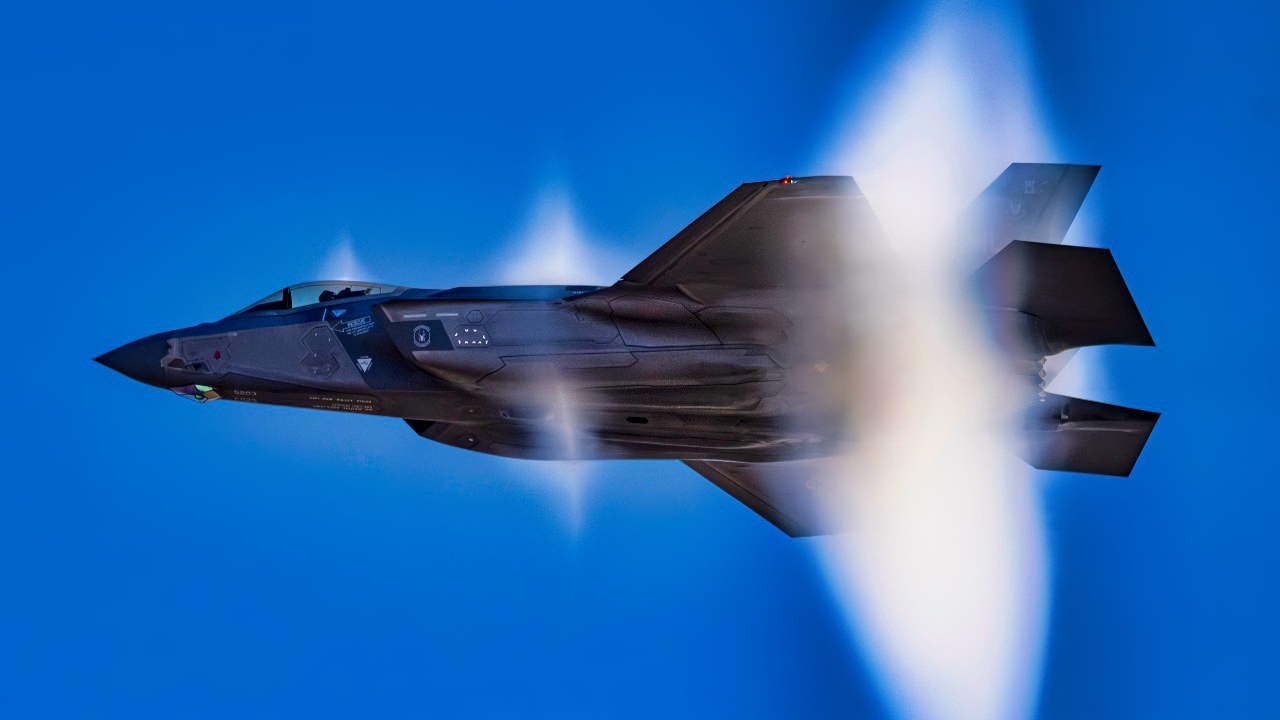
A U.S. Air Force F-35A Lightning II, assigned to the 421st Expeditionary Fighter Squadron, Hill Air Force Base, Utah, prepares for take off at Kadena Air Base, Japan, July 1, 2025. The continuous rotation of aircraft to Kadena ensures the 18th Wing remains flexible and postured to deliver lethal and credible airpower to deter acts of aggression. (U.S. Air Force photo by Airman Nathaniel Jackson)
-improvements to the aircraft’s Joint Tactical Radio System (JTRS) datalink
-200× increase in the aircraft’s processing capacity
-Introduction of the Striker II helmet-mounted display, which Smith said would deliver “much better situational awareness in a night environment”.
–EuroDASS Praetorian Defensive Aids Sub System (DASS), which “brings unmatched survivability when matched and closely co-ordinated with the robust integration that we lead as the integrator of that EuroDASS capability.”
But How Do They Stack Up Against the F-35?
Well, at the very least, neither the F5 nor the Super Eurofighter will be plagued by rumors of a kill switch. Going beyond that…
France’s Rafale, despite a lack of true stealth capabilities, already has some advantages over its Compétition américaine in terms of max airspeed and range:
-Top speed of Mach 1.8 for the Rafale vs. Mach 1.6 for the Lightning II
-Combat range of 1,850 km (1,150 mi; 1,000 nmi) for the Dassault product vs. 1,410 km (870 mi; 760 nmi) for the Lockheed Martin offering
Presumably, the “Super” Rafale F5 will build upon these extant advantages.
But what about the expense factor? For the sake of fairness & balance vis-à-vis the F-35 price tag, it should be noted that the Rafale certainly isn’t a “cheap” fighter either. As pointed out by Gabriel Michel in a July 3, 2025, article for Express Caraibes: “The ‘France’ cost, in 2024 for an order of 42 Rafale F4, has exceeded 5 billion euros, or 120 million euros per unit…For export, each contract is unique. In 2025, India pays 269 million euros per aircraft, while Serbia spends 250 million for each of its 12 new Rafale.”
And then there’s the Safran M88 engine, which costs 4 million euros apiece, and requires a budget of “600,000 euros per year to pamper the beast.” Those additional upgrades for the Super Rafale edition will undoubtedly tack on further significant costs. Likely, the F-35 will still have a lower lifetime cost, but we can’t be certain at this point. (Death and taxes being the only certainties in life, n’est-ce pas?)
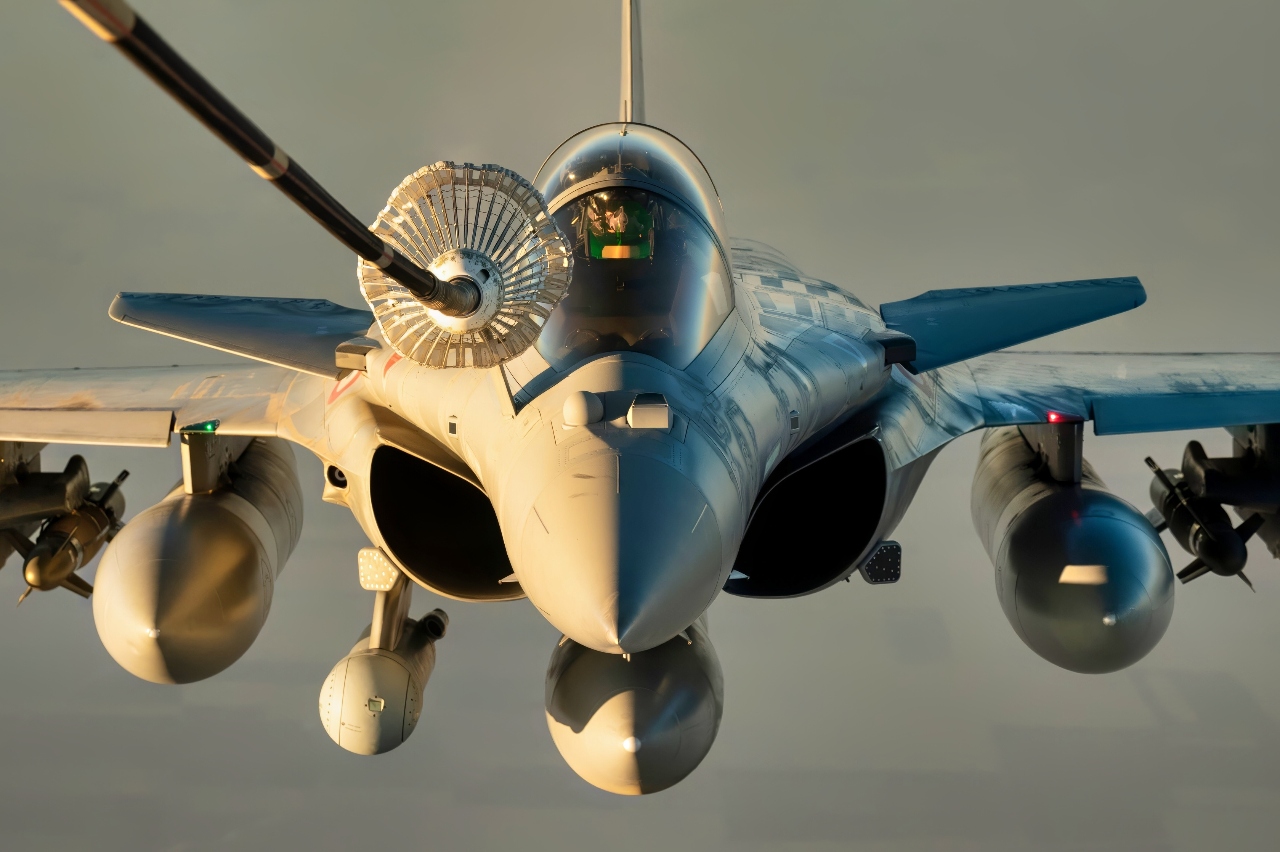
A French Rafale fighter aircraft prepares to receive fuel from a U.S. Air Force KC-10 Extender assigned to the 908th Expeditionary Air Refueling Squadron, during a partner nation aerial refueling mission in the U.S. Central Command area of responsibility, Feb. 20, 2023. The KC-10 provides U.S. and partner nation aircraft the ability to remain in the air for longer durations, maximizing their patrol time and ensuring regional stability. (U.S. Air Force photo by Tech. Sgt. Daniel Asselta)
As for the Typhoon, it has an even bigger speed advantage over the Lightning II than the Rafale does, to the tune of Mach 2.35.
However, the Eurofighter is beset by production capacity shortcomings. Currently, only 14 airframes are being built per year. Even with the upcoming boost to NATO nations’ defense budgets, it is worth questioning whether they can indeed increase their production capacities to match Lockheed Martin’s.
And it remains to be seen if either the F5 or the “Super Typhoon” will truly be able to meet or exceed the stealth and interoperability capabilities of the F-35 (which is known as a “flying computer”).
About the Author: Christian D. Orr, Defense Expert
Christian D. Orr is a Senior Defense Editor. He is a former Air Force Security Forces officer, Federal law enforcement officer, and private military contractor (with assignments worked in Iraq, the United Arab Emirates, Kosovo, Japan, Germany, and the Pentagon). Chris holds a B.A. in International Relations from the University of Southern California (USC) and an M.A. in Intelligence Studies (concentration in Terrorism Studies) from American Military University (AMU). He is also the author of the newly published book “Five Decades of a Fabulous Firearm: Celebrating the 50th Anniversary of the Beretta 92 Pistol Series.”
More Military
SR-72 Mach 6 Mistake the Air Force Needs to End
The U.S. Navy’s Ohio-Class Missile Submarine Nightmare
America Has Mini-Aircraft Carriers
Russia’s Su-57 Felon Stealth Fighter: Made in India?
F-22 Raptor vs. J-20 Stealth Fighter: Hope This Never Happens


