

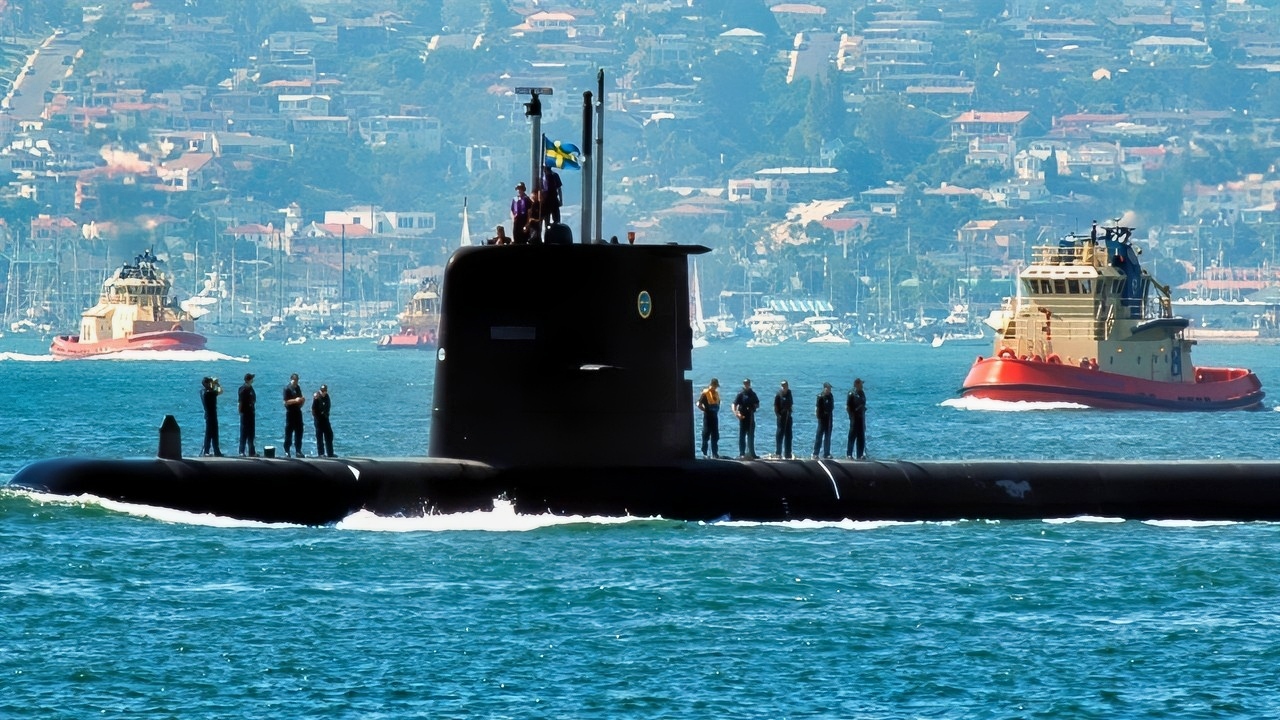
Key Points and Summary – Swedish defense firm Saab builds some of the world’s most effective non-nuclear submarines, a reputation cemented in 2005 when a Gotland-class submarine managed to “sink” the USS Ronald Reagan during an exercise.
-The key to their success is Air-Independent Propulsion (AIP), which allows for exceptionally silent and extended submerged operations.
-The U.S. Navy was so impressed that it leased a Gotland sub for two years to study its capabilities. Now, Sweden is building the next-generation Blekinge-class (A26), an even quieter and more capable submarine designed to deter Russia in the Baltic Sea.
The Gotland-Class: It Can Sink U.S. Navy Aircraft Carriers
Saab, the Swedish defense firm, has a reputation for building small, lightweight, yet extremely effective platforms, both in the air and at sea. Their submarines are among the best non-nuclear submarines in the world today.
Some have even managed to simulate strikes on American aircraft carriers during joint naval exercises.
In 2005, a Swedish Gotland-class submarine managed to take several photographs of the USS Ronald Regan, a United States Navy aircraft carrier, confirming that, had it fired torpedoes, the Swedish submarine would have, in all likelihood, sunk the American carrier.
The Gotland-class uses an air-independent propulsion system for exceptionally silent operation. This propulsion allowed the submarine to successfully penetrate the multilayered defenses of the USS Ronald Regan’s Carrier Strike Group, which includes surface ships, anti-submarine assets in the air, as well as other submarines.
So impressed was the United States Navy that it took the remarkable step of requesting to lease the submarine from the Royal Swedish Navy — complete with the Swedish crew — to evaluate the submarine’s attributes and abilities to hone American antisubmarine warfare capabilities.
Though small and very inexpensive, the Gotland-class is very advanced and is steadily improving.
“The Gotland-class submarines HMS Gotland and HMS Uppland have finished their mid-life upgrades (MLU) — making sure tomorrows challenges are met. The changes result in increased performance, improved stealth capabilities as well as increased navigation, combat, comms and ship control capabilities,” Saab explains.
Those submarines, despite the upgrade, will soon be joined by even more capable submarines in the future: the Blekinge-class.
The company adds that “many systems used in the vessels’ MLU are paving the way for Blekinge-class (A26) submarine cutting-edge capabilities. This makes the Gotland-class a step in the evolutinonary chain of submarines.”
Out with the Old, in with the New
The Blekinge-class submarines are Sweden’s next-generation submarines, which will complement, rather than replace, the Gotland-class submarines.
And while the older Gotlands are considered very capable, the newer Blekinge-class submarines are even another step up.
H I Sutton, a naval expert, explains that the A26 submarines are to be incredibly advanced. “The A-26 is one of the most advanced and forward-looking non-nuclear submarine designs in the world. The baseline version is optimized for littoral combat where larger nuclear-powered attack submarines are at their weakest, and larger derivatives are steadily enhancing its blue-water credentials also.”
Sutton further explains that “Swedish submarines have a tradition of being relatively small to suit their Baltic primary operating environment, and feature very high levels of automation resulting in very small crews. They also pioneered the modern wave of Air Independent Power (AIP, also known as Air Independent Propulsion). More subtle design features include the carriage of 400mm lightweight torpedoes. Unlike other lightweight torpedoes these are wire guided and can be mass-fired.”
The Blekinge-class retains the air-independent propulsion of the Gotland-class, albeit with refinements, which will enable the submarine to remain submerged for longer periods than its predecessor. They are also expected to be quieter than the Gotlands thanks to rubberized hull coatings and other noise and sonar-dampening technologies.
They’ll also be somewhat larger than the Gotland-class, measuring approximately 66 meters, or around 216 feet, in length and weighing around 2,000 tons, although compared to nuclear-powered submarines, they are still quite small. However, one of the Blekinge-class’s primary missions will be intelligence gathering, surveillance, the insertion of special forces, as well as the traditional anti-ship and anti-submarine warfare mission profile. State-of-the-art sonar and electronic warfare suites complement the submarine’s other attributes.
The role of the submarines within the Royal Swedish Navy is to deter other navies, most specifically the Russian Navy, within the Baltic Sea. Unlike the United States Navy, which is a true blue-water navy, capable of projecting power across the globe, deterring adversaries, conducting patrols, and keeping key maritime lanes open, the Royal Swedish Navy is primarily a green-water navy, intended to patrol littoral areas closer to the Swedish coast and around the Baltic.
Both the Gotland-class and Blekinge-class submarines leverage hushed operation to “disappear” within coastal waters, presenting a real challenge to surface ships and other submarines as well — a capability that has attracted international interest.
In addition to the United States Navy, Saab has adapted a derivative of the Blekinge-class design for the Netherlands and Poland, although those deals have yet to be finalized.
About the Author: Caleb Larson
Caleb Larson is an American multiformat journalist based in Berlin, Germany. His work covers the intersection of conflict and society, focusing on American foreign policy and European security. He has reported from Germany, Russia, and the United States. Most recently, he covered the war in Ukraine, reporting extensively on the war’s shifting battle lines from Donbas and writing on the war’s civilian and humanitarian toll. Previously, he worked as a Defense Reporter for POLITICO Europe. You can follow his latest work on X.
Military Affairs
China’s Stealth Air Force Has 1 Mission


